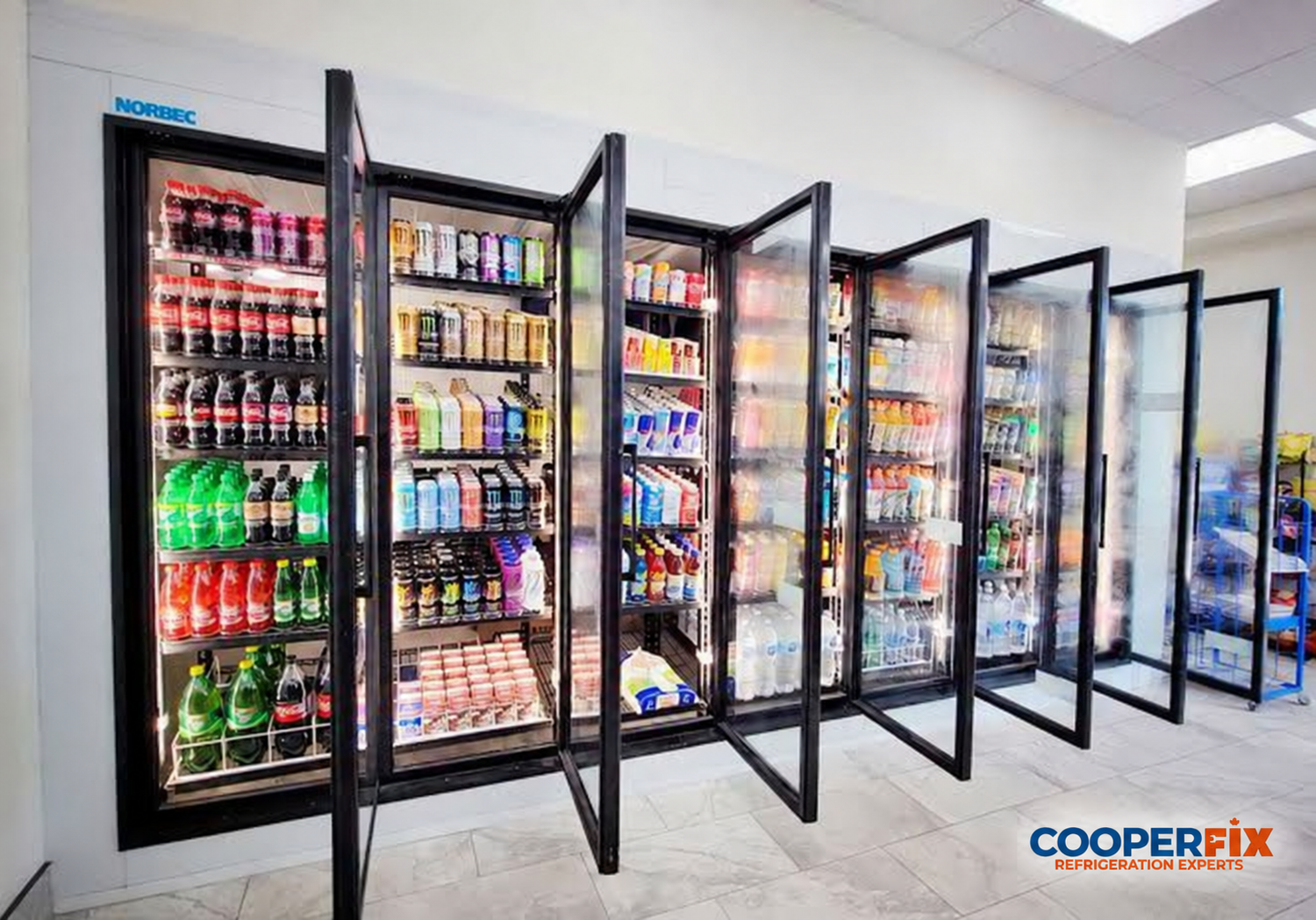
In the store: heat, light and dust
A merchandiser at the front of the store runs under lighting, next to heat-producing equipment and in sunlight through the window. Merchandisers placed next to heat-producing equipment or in direct sunlight lose capacity while an identical unit elsewhere runs normally — the mechanic separates that from a fault by measurement. Head pressure is compared against the air at the condenser, the evaporator and condenser fans are tested, the charge is checked and the failed part is repaired. A cooler that is simply in the wrong place is reported as placement.
Behind the bar: boxed in and opened all night
The back-bar cooler lives in the hottest, tightest space in a bar, and it is opened hundreds of times a shift. Its condenser breathes air that has already been heated by its own discharge and by the equipment around it, so head pressure climbs, the compressor runs longer and longer, and one night it trips. The air entering the condenser is measured against the room, and that shows whether it is clearance or a component. A clearance problem is reported as clearance; a component is repaired.
In the stock room: the cooler that “was fine out front”
Coolers moved to a back room stop holding because the room has no airflow and the condenser recirculates its own heat. The mechanic measures head pressure against the air the condenser actually gets and tells you whether the cooler has a fault or a location problem. Both are named; only one is a repair.
What fails on any beverage cooler
Evaporator and condenser fan motors, start relays and capacitors, temperature probes and controllers, capillary tubes that plug, and refrigerant lost through a leak at a joint. The refrigerant is confirmed from the nameplate before any circuit work; on hydrocarbon models the repair follows the manufacturer’s procedure and the safety controls for that refrigerant. A component installed during beverage cooler repair retains the applicable manufacturer’s parts warranty. CooperFix’s work on that defined repair carries the 90-Day Parts & Labour Warranty under its stated terms.
The beverage cooler faults we repair most often
- Drinks are not cold but the cooler runs all day. A condenser full of dust, a slow condenser fan, a low charge or a plugged capillary tube. Head pressure and superheat separate them.
- The front row is warm, the back is cold. The evaporator fan has slowed or the coil is icing; on open coolers the air curtain has collapsed. Fan amperage and air temperature at the shelf front and back are measured.
- Fog and condensation on the glass. The anti-sweat circuit has failed or the unit is in air too humid for it. The circuit is tested and repaired.
- The cooler clicks and does not start. A start relay or capacitor, an overload tripping on high head pressure, or a locked compressor. Start components and amperage are tested first.
- Persistent or abnormal ice that does not clear as the cooler’s installed control or defrost sequence requires. Low refrigerant feed, a slow fan, blocked airflow, a probe or controller fault, or a defrost fault where fitted can produce the same symptom; the mechanic tests the actual sequence before naming the cause, and repairs the cause, not the ice.
- Water under the cooler. A blocked drain or a failed pan heater. The drain path is traced and repaired.
- The lights work, the compressor is silent. A controller output, a relay, a thermostat, a wiring fault — tested in that order.
- The display reads cold, the drinks are warm. A probe that has drifted or is badly placed. The probe is checked against a reference and repositioned or replaced.
In a multi-section merchandiser, a warm bay does not automatically mean the complete unit has lost refrigeration. The mechanic first establishes whether the sections share a refrigerant circuit, fan path or controller. Air temperatures are taken at the affected shelves and compared with the other sections under the same operating load. A failed section fan, probe or control can then be separated from a fault common to the whole unit. CooperFix explains which section needs work and which findings relate to loading or placement before ordering a part.
How a beverage cooler repair visit runs
The mechanic reads the nameplate first — model, refrigerant, charge. Then the readings: air temperature at the front and back of the shelf, head pressure against the air entering the condenser, compressor and fan amperage, superheat where the circuit allows it. The fault is named from those readings and explained to you before any part is replaced. The repair is done, the cooler is watched through a full cycle, and the readings before and after go in the report.
Why bars, stores and cafés across Toronto call CooperFix
- Ontario 313A licensed mechanics on every beverage cooler repair.
- 20+ Years of Experience on commercial refrigeration in Toronto’s bars, stores and cafés.
- A cooler down before a busy night is taken as an emergency call — see the emergency section further down this page.
- Measurement before parts — a cooler in the wrong place is not sold a compressor.
- All makes of beverage cooler: True, Turbo Air, Beverage-Air, Habco, Arctic Air, QBD, Perlick, Krowne, Migali and others.
- Two warranties: the manufacturer’s parts warranty on the part, CooperFix’s 90-Day Parts & Labour Warranty on the work.
Beverage cooler repair for bars, pubs and restaurants
A back-bar cooler that cannot keep beer cold on a Friday night is a bar problem, not a refrigeration detail. The mechanic works with the cooler in place and measures from the condensing section. Whether stock can stay in the cooler during the repair depends on temperature, access, the repair scope and the bar’s own product procedure; any access requirement is explained before authorized work begins. If the fault is heat rejection in a boxed-in bar, you are told exactly that, with the numbers.
Beverage cooler repair for convenience stores, gas stations and grocery
Merchandisers at the front of a store are the highest-margin square footage in the building. A warm front row or fogged glass loses sales for as long as it stays. The mechanic measures the shelf front and back, the condenser air and the anti-sweat circuit, repairs the failed part and reports what was placement rather than fault. Multi-section merchandisers are repaired one circuit at a time where the unit is built that way.
Some beverage coolers are supplied or owned by a beverage brand while the store operates them. The service request can identify the site contact and the party authorized to approve work, so the mechanic’s findings reach the right decision-maker. CooperFix records the model, serial number, symptoms and measurements for the specific cooler. Where a repair requires access around stocked products or a shutdown, the mechanic explains that scope before work begins. Product handling remains the operator’s decision under its own procedures.
Industries CooperFix serves with beverage cooler repair
- Bars and pubs with back-bar beverage coolers
- Restaurants and cafés with glass-door drink merchandisers
- Convenience retailers operating upright beverage coolers
- Grocery locations with chilled drink displays
- Hotels and event venues with bar refrigeration
- Sports and recreation venues with beverage display units
- Cinemas and entertainment sites with grab-and-go drink coolers
- Office and campus refreshment areas with commercial drink units
- Beverage distributors supporting branded display coolers
- Food halls with counter and merchandiser refrigeration
Where CooperFix repairs beverage coolers
Beverage cooler repair is scheduled for approved restaurants, stores and hospitality locations within CooperFix’s confirmed Toronto and GTA service area. Related pages: commercial cooler troubleshooting, commercial fridge repair, planned refrigeration maintenance and emergency refrigeration repair.