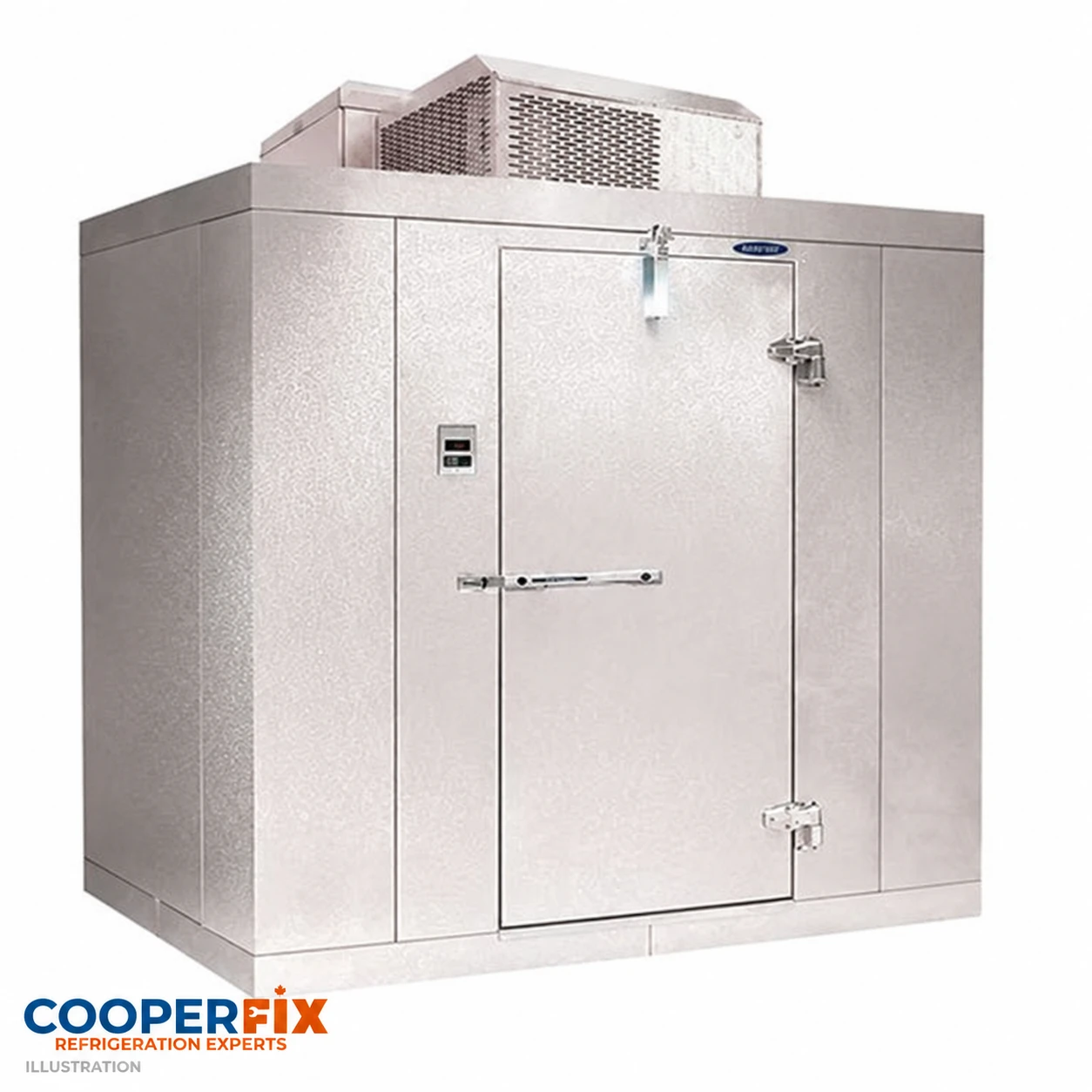
Room air above setpoint, coil cold
The coil is doing its job but the cold is not reaching the room. Evaporator fans have stopped, are turning slowly, or one of several has failed; stock is stacked across the discharge or the return; or the coil is iced over so air cannot pass through it. Fan motors are tested under load, blades and motor mounts are checked, and the airflow path across the coil is measured. A failed motor is replaced; an iced coil is traced to its defrost fault and that fault is repaired.
Coil warm, suction line warm
The refrigeration circuit is not delivering. The charge is low from a leak; the filter drier or the expansion valve is restricting; the liquid-line solenoid is not opening; or the compressor has lost its valves and cannot pull suction pressure down. Gauges on the condensing unit, superheat at the coil and subcooling at the condenser separate these from each other. A leak is found and repaired and the system recharged by weight; a restricted drier or a failed valve is replaced; a compressor is condemned only after a pump-down test proves it.
Coil iced, room warming after every defrost
This is the defrost system. The mechanic confirms that defrost is called, that the defrost heaters draw current, and that the cycle terminates on temperature — not on the safety timer. A defrost that runs too long dumps heat into the room; one that ends too early leaves ice on the coil. The mechanic sets termination so the coil clears and recovery is not delayed. Burned-out elements, a termination thermostat stuck in either position, a timer that has lost its schedule and a controller that never calls defrost each get their own repair.
Water where there should be ice
Defrost water has to leave the coil before it refreezes. The drain pan, the drain line and the drain-line heater are measured — heater current, pan temperature, whether the line is clear to the trap. A failed heater or a blocked line is repaired, and the ice it left behind is removed as part of that repair.
The condensing unit outside
In Toronto the outdoor unit works through +35 °C and −25 °C in the same year. A blocked condenser, a failed condenser fan motor, a start relay or capacitor, a crankcase heater that has stopped, a low-ambient control that no longer holds head pressure in the cold: each is tested at the actual outdoor temperature and repaired. When the season calls for it, winter operation is set up as part of the repair.
What walk-in freezer repair from CooperFix covers
The refrigeration system of the room, from the evaporator inside to the condensing unit outside:
- Evaporator fan motors, blades, motor mounts and fan-delay controls
- Electric defrost: heater elements, termination thermostats, timers and controller defrost programs
- Drain pans, drain lines and drain-line heaters
- Thermal expansion valves, liquid-line solenoids and filter driers
- Refrigerant leak detection, repair, evacuation and recharge by weight
- Compressors, start relays, capacitors, contactors and overloads
- Condenser coils, condenser fan motors and head-pressure controls
- Low-ambient controls and crankcase heaters for winter operation
- Temperature probes, digital controllers and alarm setup
- Pressure controls, pump-down circuits and safety switches
The walk-in freezer faults we repair most often
- The room will not reach −18 °C. Low charge, a restricted drier, a starved coil, a blocked condenser or worn compressor valves. The readings separate these.
- Ice on the evaporator that comes back after every defrost. A burned-out heater element, a stuck termination thermostat, a timer that lost its schedule or a controller that never calls defrost.
- Defrost water freezes again before it leaves the room. A failed drain-line heater or a blocked drain line; the mechanic clamps the heater’s current draw, clears the line and repairs the part that failed.
- Fans that do not restart after defrost. A fan-delay control, a failed motor or a controller output.
- The compressor trips and restarts. Start components, an overload on high head pressure, a pressure control on the edge of its setting.
- The room was fine in summer and struggles in winter. A low-ambient control or a crankcase heater on the outdoor unit.
- An alarm that returns after every reset. A drifted probe, a loose probe connection, a control that is set wrong for the equipment.
- A compressor that will not start at all. Start relay, capacitor, contactor, a locked-out control or a seized compressor — tested in that order.
How a walk-in freezer repair visit runs
The mechanic arrives with gauges, a clamp meter and thermometers. Room temperature and its direction are recorded first. Then the evaporator side: fan operation, air across the coil, ice pattern, defrost heater amperage, drain condition. For the freezer’s outdoor or remote equipment, the mechanic relates suction and discharge conditions to low-temperature load, checks compressor current and verifies the condenser fan and low-ambient controls. Before a freezer component is ordered, CooperFix connects the measured low-temperature fault to the proposed repair and explains why that work is required. After the repair the system is watched through a full cycle, and a full defrost where defrost was the fault. The readings before and after go into the report you receive.
Verify Freezer Capacity Under the Load That Caused the Call
After the confirmed fault is repaired, CooperFix checks whether the walk-in freezer can pull the room back toward its operating range under the conditions present at the site. The mechanic compares room air, saturated suction temperature, suction-line temperature, fan operation and compressor response instead of relying on one controller display. When the original complaint followed a defrost cycle or a busy receiving period, the verification includes the relevant part of that sequence where site conditions allow. On a room with more than one evaporator, each coil is considered so one repaired branch does not hide a second capacity problem. The service record identifies the component repaired, the readings obtained after the work and any remaining operating condition that belongs to a separate decision. This gives the business evidence that the authorized repair restored the affected refrigeration function.
Walk-in freezer repair for restaurants and food service
A restaurant freezer holds the week’s protein, bread and prepared stock. When it warms, the first question is the product, and the mechanic gives you the numbers to decide on it: the current product temperature and which way it is moving. The repair itself is scheduled around service — the evaporator side can usually be worked on without shutting the room, and the condensing unit outside is worked on without entering the cooking area at all. CooperFix repairs freezers behind restaurants, cafés, caterers, delivery-only operators and food halls across Toronto and the GTA.
Walk-in freezer repair for stores, warehouses and food plants
Larger freezers — grocery back rooms, butcher and fish shops, bakeries, ice-cream distributors, food processors and cold-storage warehouses — often run several evaporators on one condensing unit or a rack. One coil failing while the others carry on is a different repair from the whole room warming, and the mechanic measures each circuit to tell them apart. Repairs are planned so that the room stays under refrigeration where the system allows it, and product is only moved when the readings say it must be.