What the mechanic measures before any part is replaced
A commercial fridge repair from CooperFix starts with numbers, not with a parts list. Suction and head pressure against the nameplate refrigerant. Superheat at the evaporator outlet and subcooling at the condenser outlet. Compressor amperage under load against the rated figure. Evaporator and condenser fan amperage. Air temperature into and out of the evaporator. Product temperature at several points in the unit, compared with the display. Those readings separate a low charge from a restriction, a heat-rejection problem from a failed motor, a probe fault from a real temperature loss. The repair follows the numbers.
The five failures CooperFix repairs most on commercial fridges
- Not holding temperature. Low charge from a leak, a restricted filter drier or capillary tube, a condenser that cannot shed heat, or compressor valves that have lost efficiency. The readings separate these; the failed part is repaired.
- Warm on top, cold at the bottom. The evaporator fan has slowed or stopped, or the coil is partly iced, so cold air no longer circulates. Fan motor, blade or the cause of the ice is repaired.
- Prep-table pans warm while the base stays cold. The rail circuit — its fan, its coil, its air curtain — has failed. It is repaired as its own circuit; turning the setpoint down only freezes the base.
- Product freezing near the outlet. A setpoint pushed too low, a probe or controller fault, or a metering device overfeeding the coil. The mechanic corrects the cause and returns the setpoint to where the food should be.
- Short cycling, humming, a compressor that stops. Start relay or capacitor, a pressure control, an overload tripping on high head pressure, or a probe fault. Repaired before the compressor itself gives up.
Undercounter units and the compact condensing section
Undercounter fridges carry a small condensing unit in a tight space. The condenser clogs, air around it is restricted, and a unit boxed into a tight run rejects heat worse than the same unit with open space around the condenser. A unit that recovers when the space is quiet points the assessment towards load and heat rejection rather than a failed component. The mechanic measures head pressure against the air entering the condenser and separates an installation condition from a failed part — correcting one does not fix the other.
Water leaks and new noise in a commercial fridge
Water under or inside the unit. A commercial fridge produces litres of condensate every day. It runs off the evaporator into a drain and down to a condensate pan, where a heater evaporates it. When the drain blocks, the pan heater fails or the defrost cycle does not complete, that water ends up outside the unit or inside it. The CooperFix mechanic traces the whole path — drain, pan, heater amperage, defrost termination — and repairs the component that failed, not the puddle.
A noise that was not there before. Most new noise comes from a fan motor or fan blade, a compressor with worn internal valves, or liquid refrigerant reaching the compressor. Suction and head pressure are read, fan speed and amperage are checked, and whether the compressor still pumps is confirmed before anything is replaced.
Controls, alarms and a display you no longer trust
Digital controllers on modern fridges report their probe, not your shelf. A display that reads 3 °C over product at 8 °C is a fan, coil or probe fault; an alarm that returns after every reset is a real intermittent fault — a start relay failing warm, a probe with a loose connection, a pressure control on the edge of its setting. The mechanic reads the controller’s alarm log, tests under load and repairs the cause rather than clearing the alarm. CooperFix installs and programs Dixell, Carel, Danfoss and Elitech controllers on commercial refrigeration.
Refrigerant leaks on commercial fridges
Self-contained fridges hold a small, exact charge, and a few grams lost through a factory joint, a Schrader core or a rubbed capillary tube is enough to stop them cooling. Topping up is not a repair: the same charge leaves again. CooperFix finds the leak with an electronic detector and nitrogen, repairs it, replaces the filter drier, evacuates the system below 500 microns and recharges to the nameplate by weight. The refrigerant is confirmed from the nameplate first; on hydrocarbon models the repair follows the manufacturer’s procedure for that refrigerant. The full method is on the refrigerant leak repair page.
Why food businesses across Toronto call CooperFix for fridge repair
- Ontario 313A licensed mechanics on every call — the licence that covers the refrigeration circuit, the controls and the refrigerant.
- 20+ Years of Experience on commercial refrigeration in Toronto restaurants, stores and institutions.
- A fridge that has failed during service is taken as an emergency call; how those calls are handled is set out in the emergency section further down this page.
- Diagnosis by measurement. No part is replaced because it is the usual suspect.
- All makes of commercial fridge: True, Turbo Air, Atosa, Beverage-Air, Traulsen, Habco, Arctic Air, Silver King and the rest — the nameplate decides the parts and settings.
- Replacement parts carry the manufacturer’s parts warranty; CooperFix backs its own work with a 90-Day Parts & Labour Warranty.
Commercial fridge repair for restaurants and cafés
On a restaurant line the reach-in, the prep table and the undercounter all live in the hottest air in the building, and they are opened hundreds of times a shift. Work is planned around the site’s operating conditions: an undercounter is measured where it stands and a prep-table rail is treated as its own circuit. Whether product can remain in the unit depends on temperature, access, the repair scope and the business’s own product-safety procedure. CooperFix explains any shutdown or access requirement, with the readings behind it, before authorized work begins.
Commercial fridge repair for stores, cafés and convenience retail
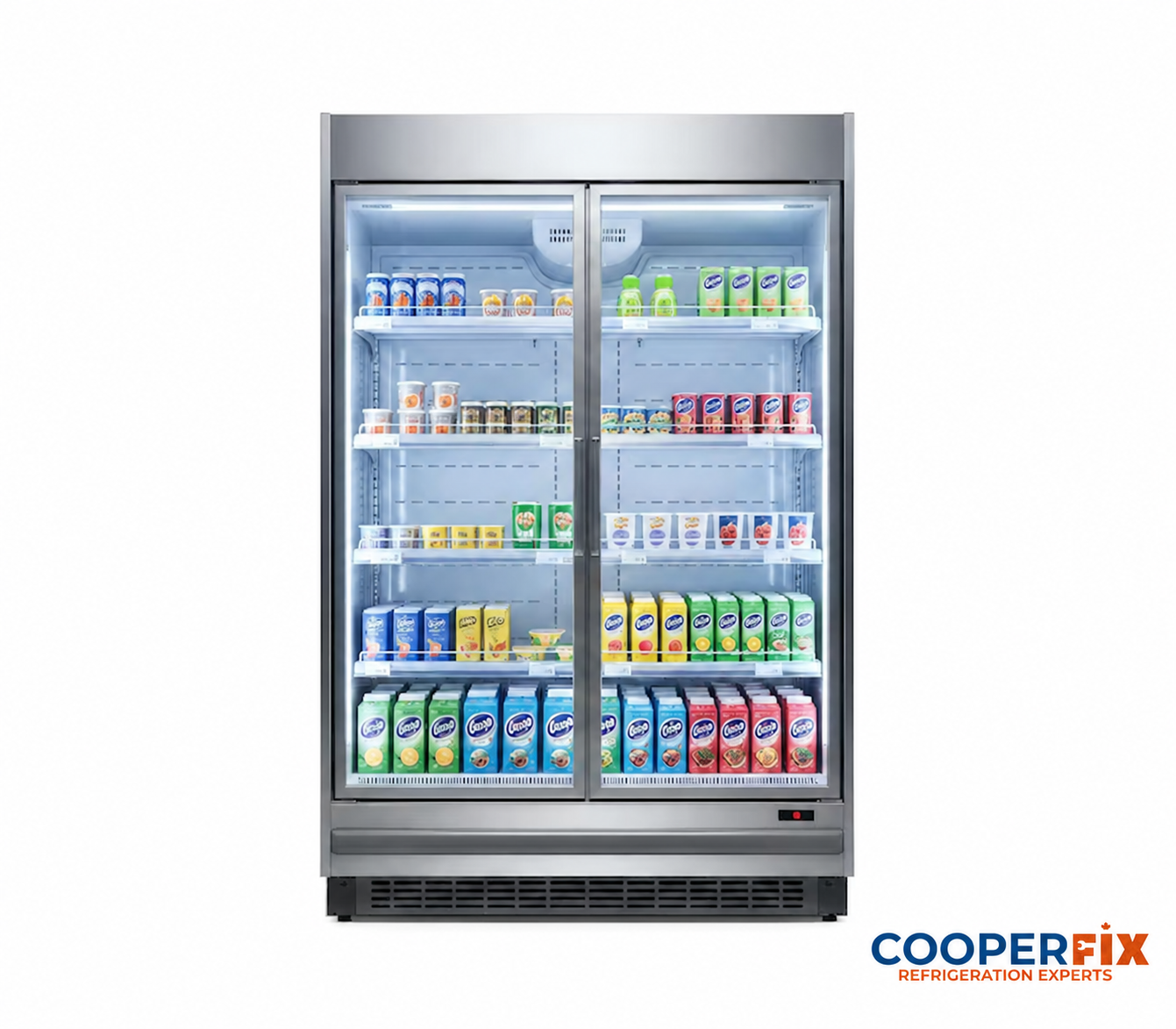
Merchandisers and display fridges sell what they hold. A warm front row, fogged glass, a display that lies about the product — each is a specific fault: a slow evaporator fan, an iced coil, a low-mounted condenser that has pulled in the shop’s dust, an anti-sweat circuit that has failed. The mechanic measures the air at the front and back of the shelf and the head pressure against the air entering the condenser, and repairs the part that has failed. Placement next to heat or in sunlight is reported as placement, not sold as a repair.
Industries CooperFix serves with commercial fridge repair
- Restaurants using reach-in and prep-table refrigerators
- Grocery and deli operators with refrigerated merchandisers
- Convenience retailers with upright commercial fridges
- Bakeries holding ingredients in commercial refrigerators
- Catering commissaries with multi-section fridge storage
- Hotels with back-of-house refrigerator lines
- Institutional food-service sites with commercial fridges
- Butcher and seafood counters using refrigerated storage units
- Pharmacies and laboratories operating commercial refrigerators
- Workplace cafeterias with food-service refrigeration
Parts CooperFix replaces on commercial fridges
Compressors and start components; evaporator and condenser fan motors and blades; thermal expansion valves and capillary tubes; filter driers; defrost heaters, termination thermostats and timers; temperature probes and controllers; condensate-pan heaters; anti-sweat circuits on glass-door units. The common parts are stocked for the models we see most; compressors and coils are sourced for the model on the nameplate. Replacement parts carry the manufacturer’s parts warranty. CooperFix backs its own work with a 90-Day Parts & Labour Warranty.