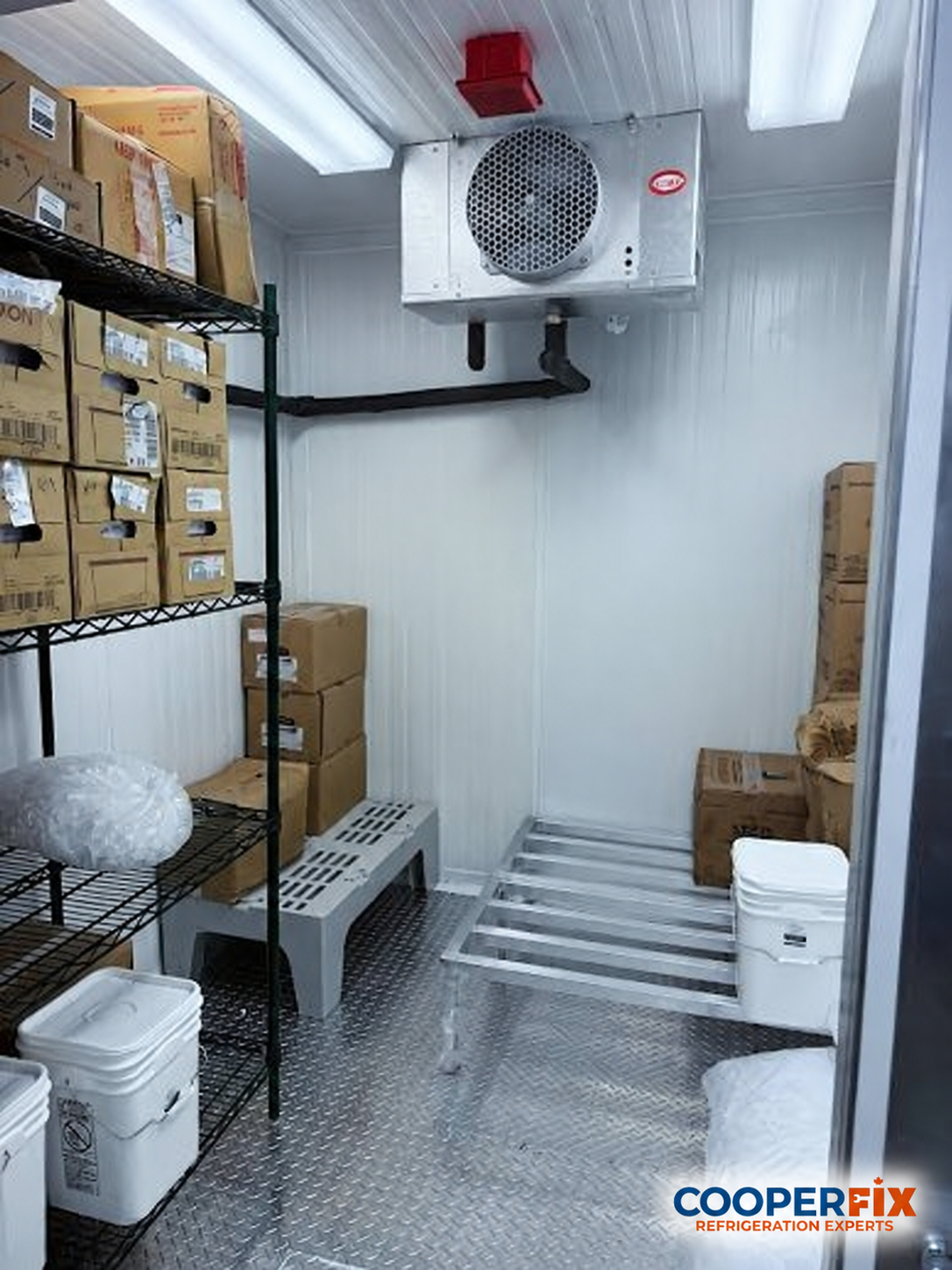
Inside the room
A warm corner, frost that stays on the coil, water under the evaporator, fans that have gone quiet. Air temperature across the coil is taken, each fan motor is tested under load, superheat is read at the coil and the drain is traced. Fan motors, blades, expansion valves and drain components are replaced after the model is identified, the fault is confirmed and the matching part is available. Stock stacked across the airflow is reported as loading, because it is not a repair.
When one corner of a chilled room warms while the controller still reports the setpoint, CooperFix measures supply and return air at the evaporator and compares temperatures across the occupied room. On systems with more than one evaporator, each branch is assessed separately: a fan or refrigerant-feed problem in one branch can be missed if the mechanic looks only at the condensing unit. The record identifies where the temperature difference appears and which component or operating condition explains it. That gives the business a specific repair decision instead of a blanket recommendation for the whole room.
Outside the room
The condensing unit works through a Toronto summer on a roof and a Toronto winter behind the building. Head pressure and condensing temperature are compared against the air at the condenser, the condenser fan and the start components are tested, the crankcase heater and the low-ambient control are checked at the actual outdoor temperature, and the failed part is repaired. When the season calls for it, the winter settings are corrected on the same system.
Where the cold is being lost
- The coil is cold and the room is warm: the cold is not being moved. Fans, airflow, ice.
- The coil is warm and the suction line is warm: the cold is not being made. Charge, restriction, solenoid, compressor.
- The room is cold at night and warm by noon: capacity is at its edge. Condenser, condenser fan, charge, load.
- The room is cold and the display says warm, or the reverse: the controls are wrong. Probe, controller, setpoint.
The mechanic tells the four apart in the first readings, and the repair follows.
How a visit runs
Readings at the coil and at the condensing unit; the fault named from the readings; the repair explained before any part is replaced; the system watched through a full cycle after. The system is measured by an Ontario 313A licensed mechanic, and the repair the readings support is explained before any part is replaced. The completed service record separates the applicable manufacturer’s coverage for the fitted component from CooperFix’s 90-Day Parts & Labour Warranty on the confirmed walk-in fridge repair.
Walk-in fridge faults repaired most often
- Uneven cold: one corner warm, the rest fine. A fan slowing, a coil partly frosted, or cases across the return path.
- Slow recovery after loading. A starved coil, a fan not moving air, or a condensing unit that has lost capacity.
- Frost that stays on the coil. Low charge, a starved coil, fans not moving air, or a defrost setting that does not fit the room.
- Water collects below the walk-in fridge evaporator. CooperFix traces the drain route, checks its fall and verifies any fitted heater so the repair addresses the actual drainage fault.
- The compressor trips or will not start. Start relay, capacitor, contactor, an overload on high head pressure, a locked-out control.
- The room warms on cold nights. Low-ambient control or crankcase heater on the outdoor unit.
- A walk-in fridge alarm returns after reset. The mechanic compares the room condition with the probe reading, wiring and controller setup to identify whether the alarm comes from sensing, connection or programming.
- Product freezes in the discharge path while the rest of the room remains chilled. The mechanic compares controller demand, probe accuracy, airflow and refrigerant feed at that section before correcting the cause.
Walk-in fridge repair service for hotels, institutions and multi-site operators
Hotel and institutional cold rooms run around the clock with several people opening them, and a warm room is a compliance problem before it is a comfort problem. CooperFix repairs them with readings before and after so the record can be shown, and schedules non-urgent work around service periods. Operators with several sites get the same mechanic’s report format on every room, so the records compare.
Walk-in fridge repair service for restaurants, grocers and caterers
Restaurant and grocery walk-ins are loaded warm by the case and opened all day. Their faults are airflow and capacity first. The mechanic measures air into and out of the coil, tests the fans, checks the charge and separates a loading problem — reported as loading — from a failed component. Whether stock can remain in place depends on measured room performance, access, the repair scope and the business’s product-safety procedures; CooperFix explains any interruption or stock-access requirement before authorized work begins.
Industries CooperFix serves with walk-in fridge repair
- Hotels using walk-in fridges for banquet and hospitality stock
- Health-care and campus facilities with chilled walk-in storage
- Restaurants operating walk-in fridges for daily ingredients
- Grocery businesses with medium-temperature walk-in rooms
- Catering commissaries relying on walk-in fridge storage
- Meat, seafood and deli operators with chilled rooms
- Produce and floral businesses using temperature-controlled walk-ins
- Bakeries holding perishable ingredients in walk-in fridges
- Distribution operations with chilled walk-in inventory
- Convenience retailers with walk-in fridge storage
Why CooperFix for walk-in fridge repair service
- Ontario 313A licensed and fully insured on every commercial walk-in fridge call.
- 20+ Years of Experience on walk-in refrigeration across Toronto and the GTA.
- A cold room above temperature with stock in it is treated as an emergency call — how those calls are handled is set out in the emergency section further down this page.
- The system is measured before any part is replaced, and the readings go in your report.
- The mechanic identifies the walk-in fridge’s installed evaporator, condensing equipment and controller from the nameplate and configuration, then matches testing and parts to that system.
- For the walk-in fridge circuit repaired, the service record identifies the fitted component and the work completed. The applicable manufacturer’s parts warranty remains with that component. CooperFix records its authorized work on the identified walk-in fridge circuit under the 90-Day Parts & Labour Warranty, subject to the applicable terms.
Walk-In Fridge Repair Parts and Coverage
Walk-in fridge repair often centres on the room-side components that keep chilled air moving and the controls that tell the system when to feed refrigerant, stop and defrost. CooperFix checks evaporator fan motors and blades, probes, controllers, solenoids, expansion valves, filter driers, pressure controls and the connected condensing equipment as one operating circuit. A replacement is selected from the equipment model, refrigerant and electrical rating shown on the nameplate; the mechanic explains the measured fault and proposed work before a component is ordered. Replacement parts carry the manufacturer’s parts warranty. CooperFix backs its completed repair work with a 90-Day Parts & Labour Warranty under the applicable terms. Service is available for approved business locations across Toronto, Vaughan, Markham, Barrie and the wider GTA. Related routes include walk-in fridge troubleshooting, walk-in cooler repair, commercial fridge repair and walk-in refrigeration repair service.