A warm alert after stock movement needs context
A walk-in freezer can show a changed temperature after a busy stock period, but the timing alone does not identify a failed part. CooperFix assesses the refrigeration equipment, controls and operating response under the conditions available. The mechanic distinguishes a load-related recovery pattern from a system that is no longer functioning correctly. This protects the business from treating every alarm as proof of the same fault while still taking a persistent warming condition seriously.
An evaporator that becomes a solid block of frost
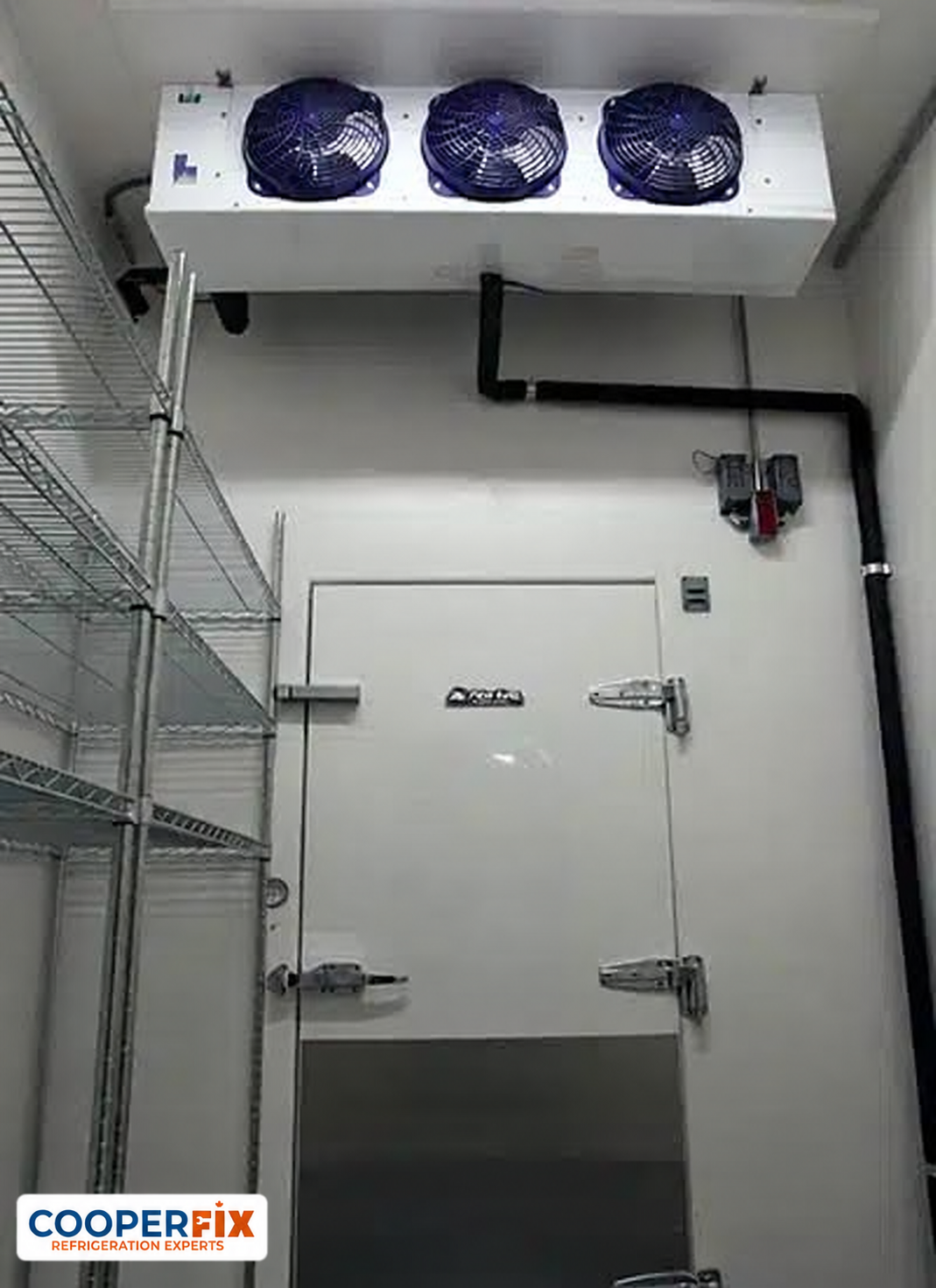
Frost accumulation can prevent air from moving through a coil and reduce its cooling contribution. A temporary thaw may allow the room to pull down again without correcting why the frost returned. CooperFix evaluates defrost initiation and termination, heaters or other fitted components, fans, sensors and refrigerant feed. The mechanic identifies which stage failed and whether the problem is local to one evaporator or common to the system.
Repair work follows that finding. A failed heater circuit, probe, contactor or controller output needs different work from an airflow or refrigerant condition. After repair, CooperFix checks the relevant stage of the sequence and the freezer’s return to cooling under the conditions available. The report distinguishes a demonstrated defrost response from a long-term outcome that has not yet been observed.
Fan delay is part of a complete restart
After a freezer defrost cycle, controls may keep fans off until the refrigeration equipment reaches the required condition. CooperFix checks how that sequence is intended to work on the installed unit and whether the observed response matches it. A fan that is not running at one instant may reflect a control stage or a fault; the mechanic determines which. The diagnosis therefore follows the full restart sequence instead of treating one snapshot as the answer.
Cooling stops or fails to resume after defrost
A freezer can clear its coil yet still warm if the compressor, solenoid or fans do not return at the proper point. CooperFix traces the controller’s outputs and the actual response of connected equipment. A fan-delay setting may be part of normal design, while a fan that never restarts is a fault. The mechanic checks the fitted sequence rather than assuming that every pause after defrost is abnormal.
Electrical checks help distinguish a missing command, a failed contactor or a motor problem. Refrigerant-side assessment shows whether the circuit resumes delivering cooling once the controls call for it. If the problem occurs only intermittently, controller history and observed operation are recorded with their limits. A replacement part is selected from evidence, not from the fact that the freezer was warm after a cycle.
Ice near the evaporator drainage route
Water created during defrost has to leave the evaporator area according to the installed refrigeration design. If it refreezes, CooperFix assesses the fitted drainage and drain-heater components, the defrost sequence and the temperature conditions involved. Ice beneath an evaporator can indicate a failed heater, an incomplete cycle or another system issue. The location of the ice alone cannot establish which part needs repair.
The service concerns the freezer refrigeration equipment and its condensate path. CooperFix reports the component-level finding and defines any repair within that system. Staff are not asked to break ice, dismantle equipment or inspect wiring. If a separate site issue is found beyond the refrigeration scope, the mechanic distinguishes it from the work CooperFix can perform.
The compressor does not start after a warm alarm
A stopped compressor may be responding to an electrical or refrigeration protection. It may also have a starting, control or mechanical fault. CooperFix checks the applicable supply, control call, protective devices and motor behaviour before concluding that the compressor itself failed. A reset without understanding the event can leave the system vulnerable to another shutdown and does not count as a completed diagnosis.
The mechanic interprets compressor measurements with condensing conditions, refrigerant pressures and the evaporator load. If a start component or control has failed, the repair can be more focused than compressor replacement. If major component work is justified, the scope explains the supporting evidence and the circuit work required. The freezer’s response after the repair is checked rather than assumed from the new part.
A freezer that struggles in cold outdoor weather
An outdoor condensing unit can face different refrigerant-flow conditions in cold weather. The installed head-pressure controls and equipment design determine how it should operate. CooperFix evaluates the relevant pressures, fan or valve response and refrigeration performance when the conditions occur. A freezer that worked in summer and weakens in winter may have a seasonal control issue, but the timing alone does not prove it.
Where the visit takes place in another season, the mechanic can assess the installed components and history while stating what winter performance cannot be directly demonstrated. Any proposed repair should relate to an identified fault or design issue, not a generic assumption about Toronto weather. The report explains the observed condition and any follow-up needed under the relevant operating conditions.
One coil affected, several coils affected
Multiple evaporators create useful comparisons. CooperFix assesses each affected branch, its control and refrigerant feed, then compares it with the common condensing equipment. A single iced coil may have a local defrost or fan problem. Several coils warming at once can point to a shared capacity, charge, electrical or control condition. The mechanic avoids assigning a system-wide repair from one local symptom.
This distinction matters to a business whose frozen storage is served by more than one circuit. The repair scope identifies exactly which component or branch requires work. Afterward, CooperFix checks the affected area and how the rest of the installation responds. If another independent problem remains, it is stated separately so the business understands the condition of its freezer equipment.
Refrigerant feed must be judged during sustained operation
The freezer circuit can appear to cool briefly and then fail to keep up with the low-temperature load. CooperFix checks the relevant refrigerant-side behaviour in context with airflow, defrost and compressor operation. The finding identifies whether the installed circuit has a feed or capacity problem supported by measurements. This separates a professional repair recommendation from adding refrigerant or changing a part without first establishing the cause.