Controller installation & programming · Toronto & GTA

Commercial Refrigeration Controller Installation & Programming in Toronto & the GTA

A refrigeration controller does not repair a weak compressor or blocked refrigerant circuit.

It does determine when a working system cools, when its fans operate and how an equipped freezer or cooler moves through defrost. Replacing or adding a controller requires more than choosing a display with the same shape. CooperFix installs and programs commercial refrigeration controls for walk-ins, units and connected systems in Toronto and the GTA. Our mechanics identify the equipment and its operating sequence, assess probes and wiring, select a compatible control approach and verify the equipment after programming. For controller installation or replacement, use the existing request form or call (647) 483-3777.

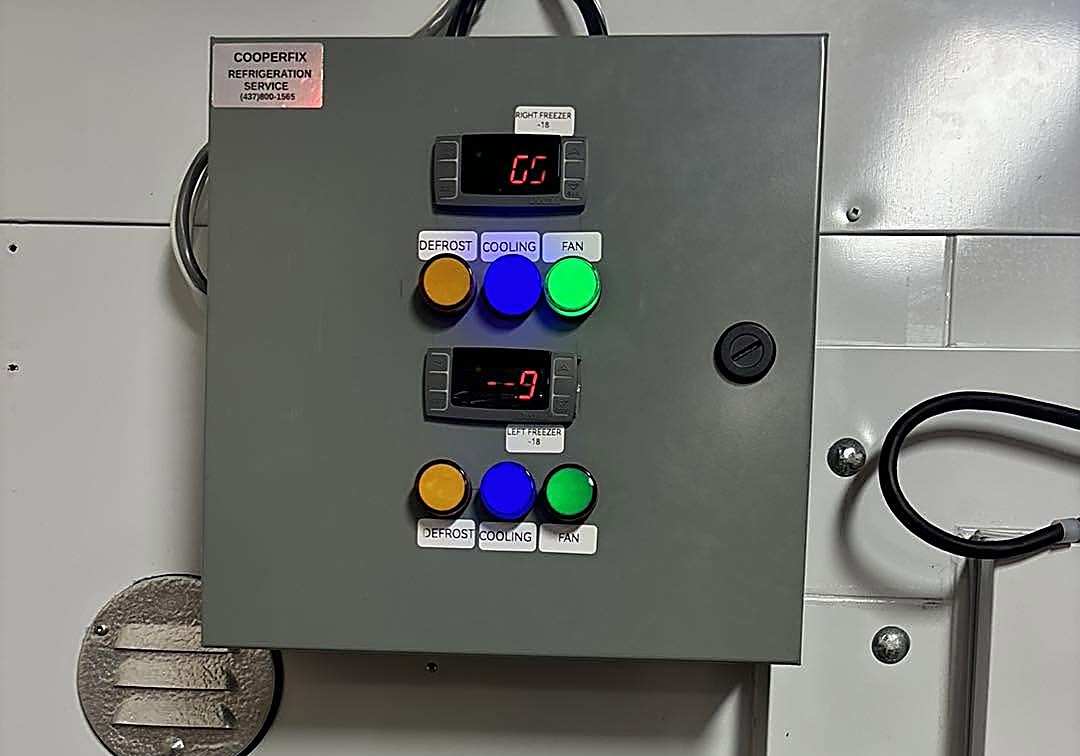
CooperFix control panel with two digital refrigeration controllers for walk-in freezers
Control panel with two digital controllers, one per walk-in freezer.CooperFix · Toronto & GTA
Service request

Book Controller Service

647-483-3777

    Please prove you are human by selecting the car.

    CooperFix services commercial refrigeration equipment only.

    What this service covers

    Establish what the control must run

    A controller can command a compressor or solenoid, coordinate evaporator fans, start and terminate defrost, and respond to alarms or protective devices. The functions needed depend on the refrigeration equipment. A simple commercial unit, a medium-temperature walk-in cooler and a low-temperature freezer do not have identical sequences. CooperFix maps the installed equipment and its connections before choosing or programming a controller. This prevents a replacement from being configured for the wrong system.

    If the request follows erratic temperatures, the mechanic first distinguishes a control problem from a refrigeration problem. A failed probe can give the controller false information. A fan or solenoid can fail to respond even when the controller output is correct. A control replacement chosen from the display alone may leave the original fault untouched. The service scope explains which part of the sequence is faulty and whether installation, programming or separate refrigeration repair is required.

    Controller compatibility is more than a matching faceplate

    Inputs, outputs, voltage, relay capacity, probe type and programming range must suit the equipment. CooperFix checks the old control’s function and the current system requirements before proposing a replacement. A unit with fewer outputs may not manage the required fan or defrost sequence. A probe of the wrong type may report a plausible but incorrect temperature. The chosen controller must also be serviceable and documented for the installed application.

    An existing mechanical thermostat can be appropriate for some equipment. Replacing it with a digital control is a project decision, not an automatic upgrade. CooperFix discusses the specific operational need and what changes in wiring, probes and sequence would be involved. If the present control is functional and the cooling problem lies elsewhere, the mechanic defines that finding rather than presenting a new control as a cure.

    Preserve the control sequence the equipment requires

    A replacement controller must be configured for the refrigeration system it will operate. CooperFix identifies the connected compressor, fans, defrost components and protective inputs before programming outputs. A familiar display or matching enclosure does not establish that the control sequence is correct. The mechanic sets the relevant functions for the installed equipment and verifies their response as part of the controller installation.

    Probes need the right role and location

    The controller acts on what its probes report. One may represent the refrigerated space, another the evaporator coil or defrost termination, and another a safety or monitoring function where fitted. Their type, position and wiring must align with the controller and equipment design. CooperFix assesses which readings the system requires and installs or retains probes accordingly. A probe placed where it does not represent the intended condition can lead to short cycling, extended cooling or a poor defrost decision.

    After installation, the mechanic compares controller indications with independent measurements and checks whether the control responds at the expected points in its sequence. A numerical setpoint is not sufficient evidence. The service record identifies the probes’ functions and any limitation in the conditions observed during the visit. Future repair work can then interpret the controller’s readings with the actual installation in mind.

    Wiring and outputs must match the installed components

    The controller’s outputs need to operate the devices specified by the refrigeration design. CooperFix traces the existing connections and checks the applicable electrical requirements before rewiring or replacing a control. The mechanic distinguishes the controller’s command from the response of a contactor, fan motor, solenoid or defrost component. That separation is important when an output appears active but the equipment does not run.

    Where protective devices are fitted, their function remains part of the system. Programming should not defeat a safety or protection sequence merely to make the compressor start. After connection, CooperFix verifies the commanded output and the equipment response as appropriate. Any electrical work outside the agreed refrigeration-control scope is identified as a separate dependency before an installation proceeds.

    Cooling parameters belong to the equipment

    Setpoint, differential, anti-short-cycle timing, fan behaviour and alarm thresholds affect how a commercial system operates. CooperFix programs the selected controller according to the equipment, intended temperature and manufacturer requirements. A value copied from another site can create unstable operation because the loads and refrigeration components differ. The mechanic documents the settings relevant to the installed system and tests their effect during commissioning.

    The observed result is interpreted in context. A controller can call for cooling correctly while the room still warms because the refrigeration circuit cannot deliver capacity. Conversely, a capable system can be stopped too early by an incorrect probe or parameter. CooperFix’s control work includes checking that the settings produce the intended sequence, while any separate mechanical fault is described for a repair decision.

    Defrost programming for the applicable system

    On a low-temperature freezer, defrost can involve several stages: stopping cooling, applying the selected defrost method, ending the cycle at the appropriate condition and returning fans and cooling to normal operation. Some medium-temperature equipment has a different defrost strategy. CooperFix programs only the sequence required by the selected system. The controller, probe, heater or other fitted component must work together; a timer change alone may not resolve a defrost fault.

    Commissioning checks the controller’s transitions when the site conditions allow. The mechanic observes whether outputs change as expected and whether the equipment actually follows. A frozen evaporator that never clears may have a component fault; a coil that clears but fails to resume cooling may indicate a control or fan-delay problem. The report states which parts of the cycle were demonstrated and which could not be observed during the visit.

    Alarm outputs have to match the connected system

    Where the installed controller uses alarms or protective signals, CooperFix checks how those outputs relate to the refrigeration equipment and the site’s existing control arrangement. A displayed alarm code by itself is not proof of a defective controller. The installation work confirms the inputs and outputs that apply to the system being served. This keeps the new controller tied to the actual unit instead of using a generic setting list.

    A control installation on a connected site

    Some businesses have several units or rooms with separate controllers and shared refrigeration equipment. CooperFix identifies which controller serves which circuit before work. A replacement on one branch should not be assumed to correct a fault at the common condensing unit. If controls interact with a building monitoring or alarm arrangement, the installation assessment records that interface and any testing required within the agreed scope.

    Clear identification matters to operations and future service. The mechanic records the installed controller, its equipment association and the relevant settings. For a multi-unit site, those records reduce ambiguity when another unit develops a separate fault. The business receives a defined control change instead of a generic statement that the site has been “reprogrammed.”

    CooperFix brings 20+ Years of Experience to commercial refrigeration controller installation and commissioning. An Ontario 313A licensed mechanic installs and programs the controller as part of the equipment’s refrigeration system, then checks its response to the functions included in the project.

    CooperFix · Refrigeration Experts

    Controller installation checked against the system

    20+Years of experience
    313AMechanic
    ODP/ODSCertified
    Emergency

    Emergency calls when a controller fails

    A controller that has locked the system out or is holding the wrong setpoint with product at risk is an emergency call: 647-483-3777. Emergency calls are received and assessed 24/7. Availability and response depend on location, workload and the repair required. Controller installation and programming on a working system are booked through the request form.

    Service request

    Request the right service for the fault

    Request controller installation or programming for a specified refrigeration unit. CooperFix will assess its probes, wiring and cooling or defrost sequence before commissioning the control.

    647-483-3777

      Please prove you are human by selecting the plane.

      CooperFix services commercial refrigeration equipment only.

      When Controller Installation Is the Correct Service Scope

      Controller installation and programming are appropriate when a control has failed, is incompatible with the application, or must be added as part of a defined refrigeration installation. A present cooling failure may require commercial refrigeration repair before any controller replacement decision. A complete equipment project belongs under commercial refrigeration installation. CooperFix’s mechanics can identify the correct scope after assessing the site.

      When requesting service, give the business location and the equipment or room affected. A description of the observed operating problem is useful, but the customer does not need to interpret alarm codes or provide wiring measurements. CooperFix performs the professional assessment.

      If an alarm interface is part of the agreed controller project, CooperFix checks that the installed device reports the intended condition under the tests available at commissioning. An alarm indication is not automatically a proof that the refrigeration circuit itself is failing; it depends on probe inputs, programming and the connected equipment. The handover identifies the alarm function tested and any scenario that could not be reproduced. That lets a future mechanic interpret an alarm against the actual installed program.

      Commission the system after programming

      The final test follows the refrigeration equipment, not only the controller display. CooperFix checks that sensors report credibly, outputs act at the intended points, the compressor or solenoid responds, fans operate and temperature moves as expected. Defrost and alarm functions are assessed where fitted and where the available conditions allow. The mechanic distinguishes an observed operating response from a scenario that was not present during commissioning.

      The handover records the installed control, settings and checks made. If a fault is found in the refrigeration equipment rather than the control, that separate repair need is explained. If a part or a longer operating observation is required, that limit is stated. A business can then decide on the appropriate follow-up using the evidence from the actual system.

      For sites with several controllers, a documented program also reduces the risk of later changes being applied to the wrong unit. The record associates each device with the equipment it commands and explains the intended role of its probes and outputs. If a future service visit changes a parameter, the mechanic can compare it with the commissioned setting and state the reason for the change. CooperFix still verifies the refrigeration system at that later visit; a setting history is context, not a substitute for diagnosis.

      Record settings that will matter on a later visit

      After programming, the service record should identify the controller and the key operating settings applied to the refrigeration equipment. CooperFix documents the functions checked during commissioning and any condition that could not be observed at that moment. If a later technician investigates a cooling or defrost issue, that record gives a starting point grounded in the installed system. It is distinct from promising that a new control will prevent every future fault.

      Questions

      Controller installation questions

      How does CooperFix decide which controller fits my equipment?

      The mechanic identifies the refrigeration system and its required inputs, outputs, probes, electrical characteristics and operating sequence. The replacement or new control must support those functions and the manufacturer’s requirements. A faceplate that resembles the old control is not enough to establish compatibility.

      Should a working mechanical thermostat be replaced?

      That depends on the equipment and the reason for the proposed change. A functioning thermostat may be appropriate for its application. CooperFix discusses the operational goal, the required wiring and probe changes, and the effect on the refrigeration sequence before recommending an installation.

      Can a bad probe look like a controller fault?

      Yes. A probe may report a temperature that does not represent the intended condition, while the controller follows that information correctly. CooperFix checks probe type, placement, wiring and readings before deciding whether the control itself has failed.

      Where are the probes installed?

      Their positions depend on their functions: a space probe, an evaporator or defrost probe, or another specified input may each require a different location. CooperFix installs them according to the controller and refrigeration equipment requirements and checks the indications against independent measurements.

      Does programming include defrost?

      Where the equipment has a controlled defrost sequence, CooperFix programs the appropriate stages and checks the equipment’s response under available conditions. A freezer and cooler can need different methods. The work scope identifies the functions included for the particular system.

      Can changing a setting repair a warm room?

      It can correct an inappropriate control parameter, but a warm room can also result from a fan, electrical or refrigerant-circuit fault. CooperFix diagnoses the equipment before presenting programming as the repair. The final check looks at the system’s cooling response, not only the value shown on a display.

      What is documented at handover?

      The installed controller, its relationship to the equipment, relevant settings and the observed operating checks are recorded. Any condition that could not be tested during the visit is identified. This gives the business and future mechanics a useful basis for service.

      What should I provide when requesting controller work?

      The business address, contact and the equipment affected are enough to start. If a controller was replaced or settings were changed, that history helps CooperFix focus the visit. The mechanic identifies the device, tests the connected system and determines the applicable programming or installation work.