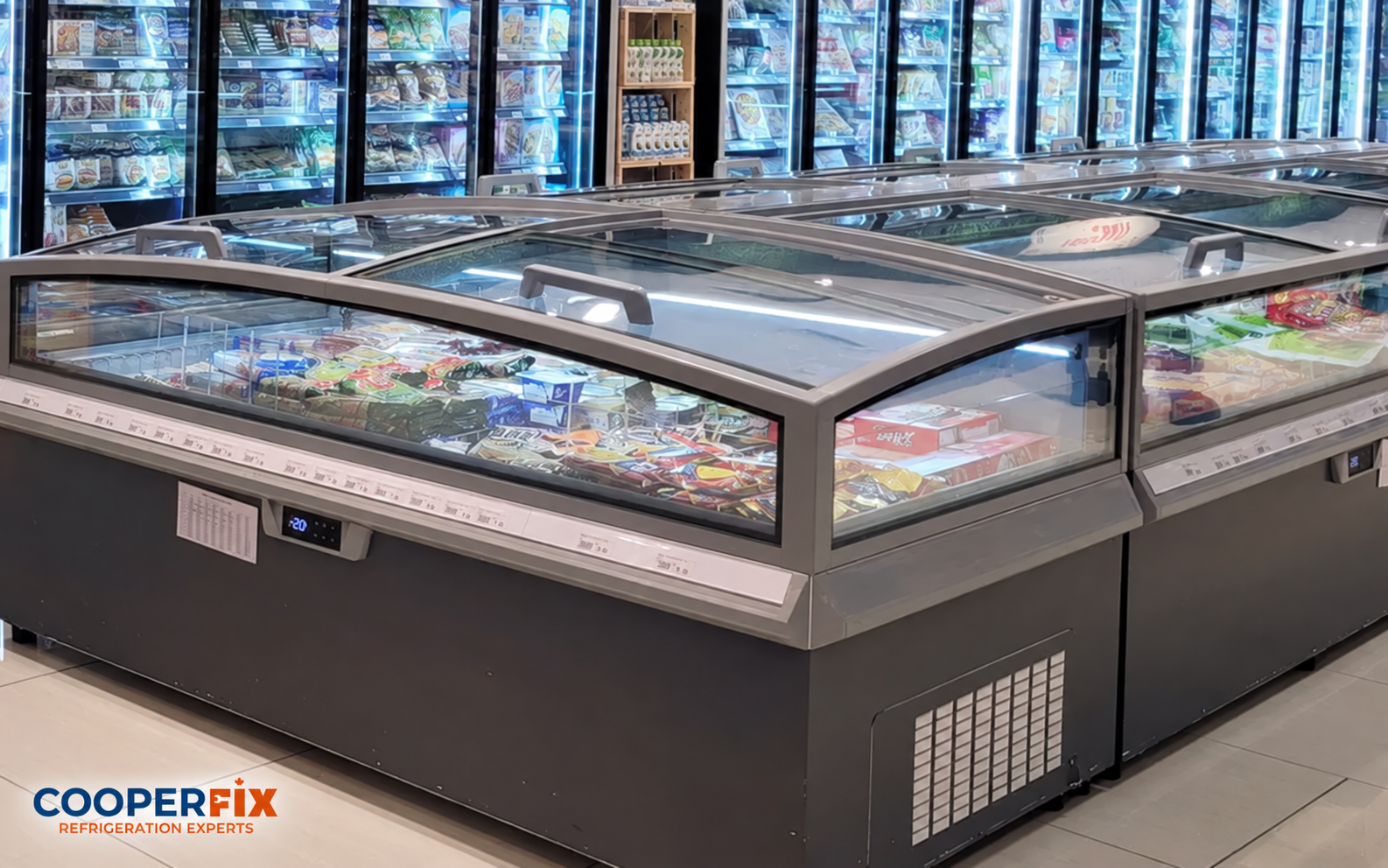
Identify the freezer configuration before testing
A self-contained commercial freezer and a unit connected to remote refrigeration equipment can present the same warm-product complaint. CooperFix identifies the installed configuration and the components serving the freezer before choosing a test sequence. This keeps a unit symptom from being mistaken for proof of a unit-only fault. The mechanic’s finding names the equipment and circuit actually investigated, giving the business a defined route to repair.
When the unit runs but cannot reach its condition
A freezer that runs continuously may be responding to an unresolved cooling shortfall. CooperFix checks whether heat can be rejected at the condensing section, whether the evaporator receives appropriate refrigerant feed and whether fans distribute cold air through the product area. Controls and sensors are compared with actual operation. The mechanic looks for a restriction, confirmed leak, failing motor, weak compressor performance or equipment-specific load condition as the evidence directs. Continuous operation alone does not condemn the compressor.
For a food retailer or food-service site, the practical problem is whether the freezer can support its normal product load. A unit may seem to recover when the site is quiet and lose ground during working hours. CooperFix relates that reported pattern to the unit’s measured performance. The business receives a specific finding and proposed repair, rather than an instruction to lower the setpoint and hope that the equipment catches up.
Recovery under load differs from an idle reading
A freezer may appear to recover when lightly used yet struggle during normal business demand. CooperFix assesses the available operating history and measures the unit under conditions present at the visit. Compressor response, airflow and the low-temperature control sequence are considered together. The result distinguishes an active refrigeration fault from a single temperature reading taken without its operating context.
Frost that returns after the unit is restarted
Repeated evaporator ice can restrict airflow and make the freezer warm despite refrigeration still operating. CooperFix examines the defrost call, heaters or other model-specific defrost components, termination method and fan restart. The mechanic also considers whether a refrigeration or airflow fault is causing abnormal frost accumulation. Clearing ice alone can make the unit appear better briefly while the sequence that allowed the ice remains defective. The service identifies and repairs that cause.
The pattern may affect one section or the whole unit. On a multi-section freezer, one fan or coil area may fail while another continues to cool. CooperFix compares the weak area with the rest of the unit and checks the components serving it. The finding determines whether a local part or a wider system problem needs work. A single patch of frost is useful context, but it is not a final diagnosis without testing.
Frequent starting, stopping and protective trips
A freezer that clicks, tries to start and stops may have a starting, motor, compressor, pressure-control or heat-rejection problem. The mechanic checks the actual electrical demand, the control instruction and the refrigeration conditions at the time of the event. A compressor that stops on protection may be reacting to another fault rather than being the primary failed part. CooperFix distinguishes those possibilities before recommending a major replacement.
Intermittent events can be harder to capture during one visit. CooperFix uses the observed sequence and available control history as evidence, and states when a fault has been reproduced or when the conclusion is based on a measured condition that explains the complaint. A service account should not present an unobserved future cycle as already verified. The business can then understand what was repaired and what further observation may still be needed.
The fan stops or one section stays warmer
An evaporator fan may fail to start, slow under load or be held off by a control sequence. In a freezer, fan timing after defrost can be intentional; a missing airflow path beyond that point is a different problem. CooperFix checks power, motor operation, control state and the evaporator condition to determine why cold air is not moving as designed. A new fan alone will not solve a coil blocked by repeated ice or an underlying control problem.
Uneven product temperature can also arise when only one section of a multi-section unit is affected. The mechanic compares positions and links the difference to the local fan, coil, sensor or distribution path. This matters for a business that cannot use one part of the freezer even though other shelves appear normal. Troubleshooting identifies the weak function and then supports a targeted repair.
Water or refreezing within the freezer equipment
Defrost water should leave the evaporator area through the equipment’s intended drain path. When a drain component or heater fails, water may refreeze within the unit and interfere with normal operation. CooperFix checks the defrost sequence and the relevant drainage components as part of the refrigeration service. The mechanic distinguishes the source of the water from a general loss of freezer capacity. Any work follows the confirmed refrigeration-system cause.
Refreezing can recur if the original component remains defective. The post-repair check therefore considers whether defrost and drainage operate together, not only whether visible ice was removed. Where a model uses different components or sequence, the equipment’s own information guides the test. This is one reason professional troubleshooting is more useful than treating every water complaint as the same repair.
Defrost restart belongs in the diagnosis
On a commercial freezer, a cooling interruption around defrost can involve heaters, termination controls, fan delay or the return-to-cooling sequence. CooperFix checks the functions that apply to the installed unit instead of treating visible frost as a complete diagnosis. The mechanic identifies which stage failed and whether another refrigeration issue is also present. That finding supports a repair aimed at the actual sequence, not repeated manual resets.
From the finding to the freezer repair
CooperFix summarizes the equipment, observed fault, test results and recommended work. A fan, starting component, sensor, defrost component, refrigerant leak, restriction or compressor-related fault may each lead to a different repair path. The mechanic selects parts to match the freezer model. Where the refrigerant circuit is opened, the work requires correct handling, tightness checks and charge for that system. Where controls or fans are changed, the relevant operating sequence is verified afterward.
The result is checked against the original complaint. A freezer that was warming after defrost needs a defrost and recovery check; one that was short cycling needs a stable operating observation; one that had a warm section needs that section reassessed. The duration of a site visit may not include every future product load, so CooperFix explains exactly what was verified. The commercial freezer repair page gives the broader repair details.