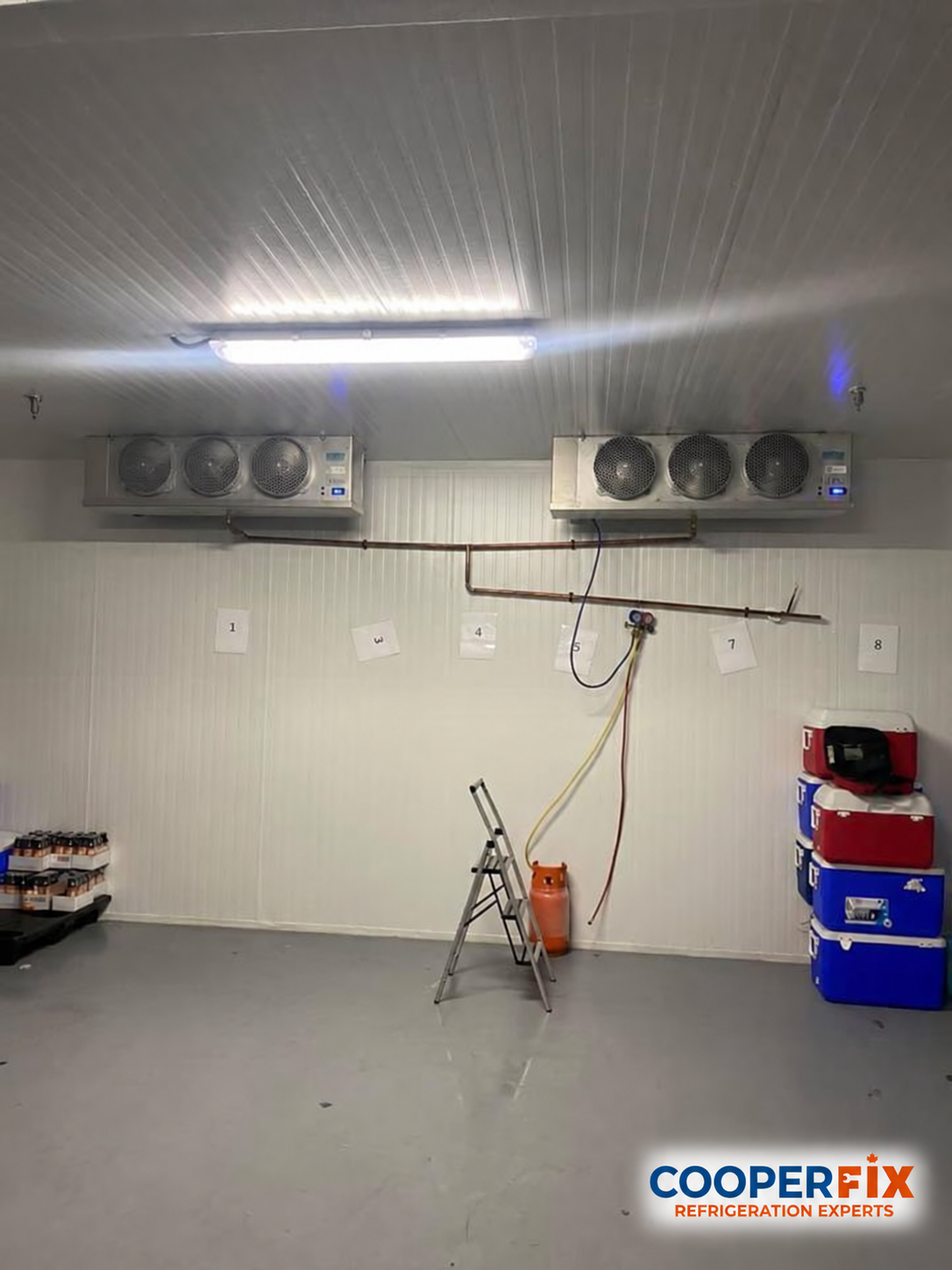
Remote condensing units: the system on the roof
Larger rooms run a condensing unit on the roof or at grade, with a line set to the evaporator inside. Faults spread out: a leak anywhere on the line set, a low-ambient control that fails in winter, a crankcase heater gone, an expansion valve at the coil starving it, a solenoid that does not close for pump-down. The mechanic works both ends — readings at the unit, readings at the coil — and repairs the component the readings point to. Winter setup is included when the season requires it.
Multiple rooms on one system
Two rooms on one condensing unit, or several rooms on a rack, share the compressor and the condenser and have their own evaporators, solenoids and controls. One warm room is its own circuit — solenoid, valve, fans, defrost. All rooms warming together is the shared side — charge, condenser, compressor, oil. The mechanic tells the two apart by measuring each circuit. Where the installed piping, service valves, controls and repair scope allow safe circuit isolation, work may proceed on one circuit while others remain in service. If shared equipment must be stopped, CooperFix explains the affected rooms before authorized work begins.
On every system
A compressor is condemned only after the electrical and operating tests applicable to the installed compressor and system. Pump-down is used only where the system design and the manufacturer’s operating envelope permit it; the symptom alone does not condemn the compressor. Leaks are found and repaired; after the leak repair and evacuation, charge is restored and verified by the method applicable to the installed system — nameplate quantity, receiver and sight-glass condition, subcooling, superheat and manufacturer data as applicable. Controllers — Dixell, Carel, Danfoss, Elitech — are programmed and replaced as part of the repair. A fitted component retains the applicable manufacturer’s parts warranty. CooperFix’s completed work on the identified shared or room-specific circuit carries the 90-Day Parts & Labour Warranty under its stated terms.
The measurements that tell the three systems apart
- Suction pressure at the compressor and superheat at the coil: whether the coil is fed and whether the compressor can pull the room down.
- Head pressure and subcooling at the condenser: whether heat is being rejected and whether the charge is right.
- Amperage on the compressor and every fan: what is working and what is on its way out.
- Temperature across each evaporator: which circuit is doing its share on a multi-room system.
- The controller’s alarm history: when the fault appears and what the system was doing.
- Pump-down behaviour: whether the solenoids close, and how the circuit behaves against the specified low-pressure cut-out, timing and subsequent pressure equalization or leakback, while keeping the compressor within the manufacturer’s operating envelope.
The pattern across those readings says self-contained, remote or shared — and which component failed.
Walk-in refrigeration faults repaired most often
- A packaged unit that runs hot and trips. Condenser, condenser fan, start components, head pressure.
- A remote unit that fails on the first cold night. Low-ambient control, head-pressure control, crankcase heater.
- One room warm on a shared system. Its solenoid, expansion valve, fans or defrost.
- Every room warm on a shared system. Charge, condenser, compressor, oil return.
- A leak that keeps coming back. Topped up instead of repaired; found and repaired, evacuated, and charge restored by the method applicable to the installed system.
- A compressor that will not start. Start components, contactor, a locked-out control, a seized compressor — in that order.
- A room that pumps down and never restarts. Pressure control, solenoid, controller output.
- Frost or water at the evaporator. Fans, charge, defrost setting, drain.
Repair after someone else’s work
A charge topped up without a leak repair, a compressor changed without an acid test or new driers, a fan wired to run backwards, a controller left on factory defaults. The mechanic checks the system against how it should be set up — charge and refrigerant feed verified by the method applicable to the installed system (nameplate weight, receiver and sight-glass condition, subcooling, superheat and manufacturer data as applicable), fan direction, drier condition, controller parameters against the equipment — and corrects what was left wrong.
Why CooperFix for walk-in refrigeration repair
- Ontario 313A licensed and fully insured on every commercial walk-in refrigeration call.
- 20+ Years of Experience on packaged, remote and rack-fed walk-in refrigeration.
- A tripped packaged unit or a remote unit down on a cold night is treated as an emergency call; the emergency section further down this page says how those calls are handled.
- Both ends of the system are measured before any part is replaced.
- All makes: Heatcraft, Bohn, Larkin, KeepRite, Trenton, Master-Bilt, Copeland, Tecumseh, and every common controller.
- For a repair involving connected walk-in refrigeration equipment, CooperFix records the circuit corrected, the component fitted and the verification completed. The applicable manufacturer’s parts warranty covers the replacement component; the 90-Day Parts & Labour Warranty applies to CooperFix’s completed work under its terms.
Walk-in refrigeration repair for multi-room sites
Commissaries, grocery back rooms, food plants and distribution sites run several rooms on shared condensing or a rack. The mechanic measures each evaporator and identifies the failed circuit. Where the installed piping, service valves, controls and repair scope allow safe circuit isolation, work may proceed on one circuit while others remain in service; if shared equipment must be stopped, CooperFix explains the affected rooms before authorized work begins. The report shows every circuit’s readings, not just the one that failed.
Walk-in refrigeration repair for single-room businesses
A restaurant or a corner store with one packaged unit on the roof of its cooler has no spare capacity. The mechanic diagnoses from the unit itself — head pressure against the air it breathes, fan, start components, charge — and repairs the failed part. For connected rooms, CooperFix identifies which storage areas a shared-equipment shutdown would affect and explains that interruption before the business authorizes the circuit work.
Industries CooperFix serves with walk-in refrigeration repair
- Restaurants with connected walk-in refrigeration circuits
- Grocery businesses operating multiple refrigerated rooms
- Catering sites with shared walk-in refrigeration equipment
- Food processors using room-specific evaporator circuits
- Distribution facilities with connected refrigerated storage zones
- Meat and seafood operations with walk-in refrigeration systems
- Produce and floral wholesalers with several chilled rooms
- Hotels and event venues with shared refrigeration equipment
- Institutional sites operating multiple refrigerated storage rooms
- Beverage producers and distributors with connected walk-in systems
Walk-In Refrigeration Repair Parts and Coverage
Walk-in refrigeration repair is used when the fault crosses the boundary between the room and the equipment serving it. The repair scope may involve an evaporator branch, liquid-line solenoid, expansion valve, filter drier, line set, pressure control, compressor, condenser fan or system controller. CooperFix identifies whether the loss is local to one room or shared by connected equipment, then matches any replacement to the installed system and verifies the repaired circuit through an operating cycle. The customer receives the relevant findings and the proposed scope before a part is ordered. Any replacement component retains the applicable manufacturer’s parts warranty. For a confirmed shared or room-specific circuit repair, CooperFix records the completed work under its 90-Day Parts & Labour Warranty, subject to the applicable terms. Service is scheduled for approved commercial locations in Toronto, Vaughan, Markham, Barrie and the wider GTA. Related routes include walk-in refrigeration troubleshooting, walk-in cooler repair, walk-in freezer repair and commercial refrigeration installation.