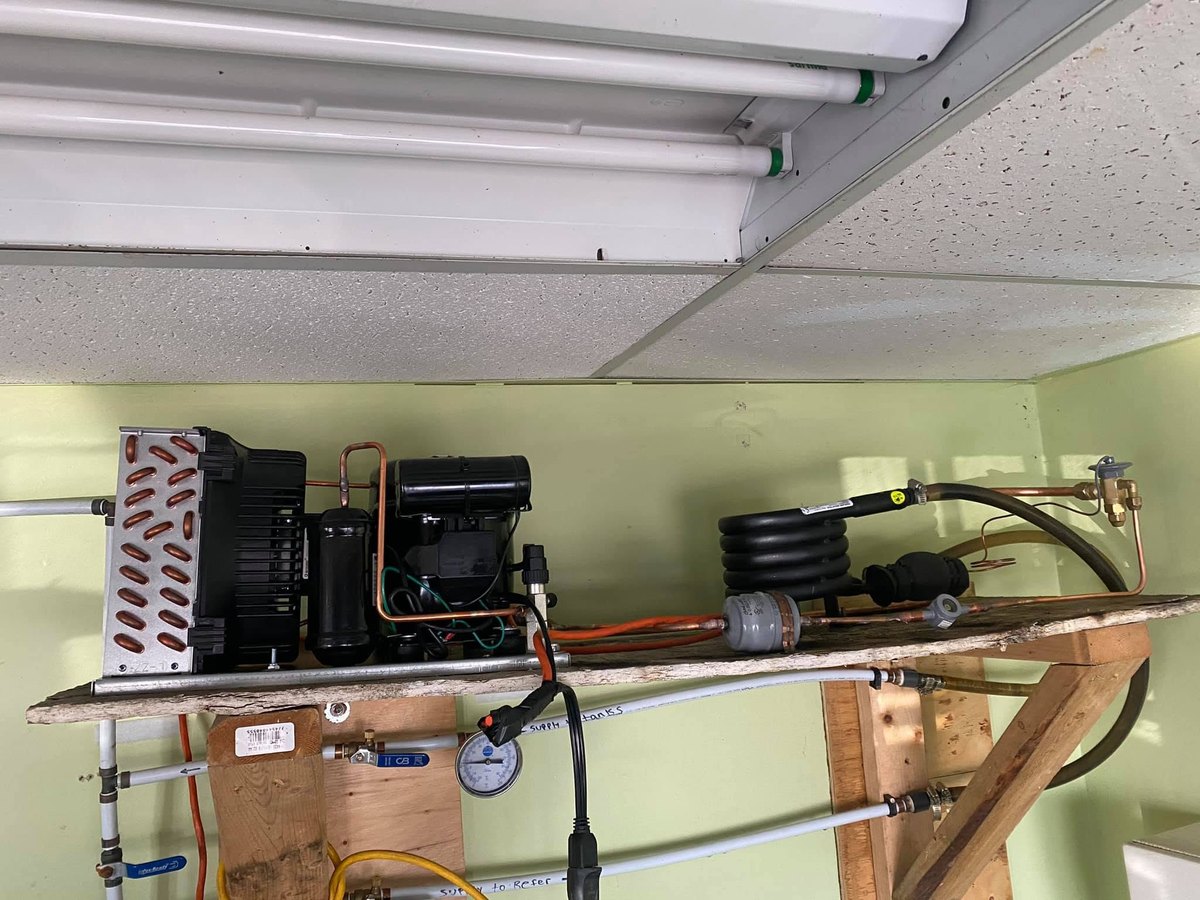
Where a commercial circuit may lose refrigerant
Compact units and service fittings
Reach-in fridges, prep tables and self-contained merchandisers place joints, fittings and the condensing assembly in a compact space. Vibration, previous service work or ageing components can affect a connection. Access fittings and valve cores also require attention because they form part of the sealed circuit. CooperFix checks suspected points using methods suited to the system rather than assuming every leak is at a service port. A fitting can be repaired or replaced only after its condition and accessibility are established.
Remote piping and connections
A walk-in or display system may have a remote condensing unit connected by a longer line set. A leak can occur at a joint, valve or section of piping exposed to vibration or contact with surrounding structure. The mechanic traces the circuit and isolates suspected sections where appropriate. A visible oil trace may guide the search, but it is not a complete test of the system. Once the defect is identified, CooperFix determines whether the section can be repaired soundly or requires replacement and support to prevent the same mechanical stress recurring.
Evaporators and other circuit components
An evaporator coil, valve or other refrigerant-carrying component can also leak. The decision between an accessible localized repair and replacement depends on the component’s condition, the position of the leak and whether the remaining material is sound. Multiple weak points can change that decision. CooperFix explains the reason for the chosen scope. The presence of a leak does not automatically mean the compressor or every connected part must be replaced; other damage is assessed on its own evidence.
Prior refrigerant additions are part of the service history
If a circuit has been recharged before and its performance has declined again, CooperFix treats that history as a reason to investigate the cause of refrigerant loss. A prior addition does not identify the leaking joint, line or component. The mechanic assesses the installed circuit and uses appropriate professional leak-location methods before proposing repair. This gives the business a path beyond another temporary change in charge and helps distinguish a confirmed leak from a different capacity problem.
How the leak is located
The mechanic identifies the system configuration and refrigerant designation from the equipment information. Operating measurements show whether the circuit behaves as a low-charge system and whether another fault may be involved. Electronic detection, bubble testing, pressure testing and isolation of sections may be used as appropriate to the equipment and access. The goal is to locate an actual loss point, not just establish that performance is poor. On a larger circuit, a systematic search prevents a convenient visible fitting from being declared the sole cause while another section is still leaking.
Leak location is also a repair-scope decision. A service fitting, accessible connection, piping run and coil present different work. CooperFix considers whether the component can be restored reliably and whether the repair will address the reason it failed. An isolated reading or one test method may need confirmation. The mechanic can then explain the options supported by the circuit’s condition before the system is opened for repair.
Isolating the affected branch on a connected site
Some commercial sites have more than one evaporator or refrigerated area served by related equipment. A change in one area can therefore have a local cause or involve a common refrigerant circuit. CooperFix maps the affected branch and the connected equipment before defining where leak testing and repair are needed. The work plan follows the actual system configuration, so a business is not told that every unit needs the same intervention because one area has warmed.
Repair, test and recharge as one service
Once the leak is identified and the repair scope is agreed, the refrigerant is handled in accordance with the equipment and applicable requirements. CooperFix repairs or replaces the affected component as indicated. The repaired section and the wider circuit are then checked for tightness using a suitable method. If the circuit has been opened, the mechanic prepares it for operation, including evacuation and relevant component replacement where indicated, before charging with the refrigerant specified for that equipment. The amount and verification method follow the system design and manufacturer information rather than a universal number copied from another unit.
Charging is the final part of restoring a sound circuit. The mechanic checks the operating conditions after charging and evaluates whether the unit is recovering. Superheat, subcooling, pressures, temperatures and current draw can be useful where the system design makes them applicable, but no single value proves that every part of every system is correct. CooperFix interprets the readings together and checks for a continuing leak at the repair. A system that still underperforms may have a separate fault requiring its own diagnosis; adding more refrigerant would not correct that.
Why the exact refrigerant matters
“Freon” is a familiar search term, but commercial refrigeration equipment uses different specified refrigerants. CooperFix identifies the designation and relevant charge information for the actual unit before circuit work. The refrigerant type affects how the system is handled, charged and evaluated. A name on a service request cannot replace the equipment’s own data, and one unit’s charge quantity cannot be assumed for another. This is particularly important on sites with a mix of older units, newer self-contained cases and remote walk-in systems.
The mechanic also considers the circuit’s configuration. A compact self-contained unit and a remote multi-component system can respond differently to the same visible loss of cooling. Work must be based on that equipment, its refrigerant and the observed defect. CooperFix’s ODP/ODS certification and commercial refrigeration focus support this controlled approach, while the actual repair decision remains site and equipment specific.
Business consequences of an unresolved leak
A continuing leak can leave a site with recurring warm stock, unpredictable recovery and repeated interruptions to the work that depends on the unit. A food-service operator may shift product between units, while a retailer may lose usable display space. A walk-in system may seem to improve after attention and then deteriorate again as the charge is lost. CooperFix explains the fault in operational terms: which equipment is affected, what was found and what the repair addresses. That gives a manager a clearer decision than another short-lived recharge.
The service also separates the confirmed leak from possible secondary damage. A system that has been operated with insufficient refrigerant may have other performance problems, but those must be tested. The mechanic tests for secondary damage on the affected equipment. If the equipment has multiple issues, the business can understand the immediate leak repair and any separate work needed to restore reliable operation.