
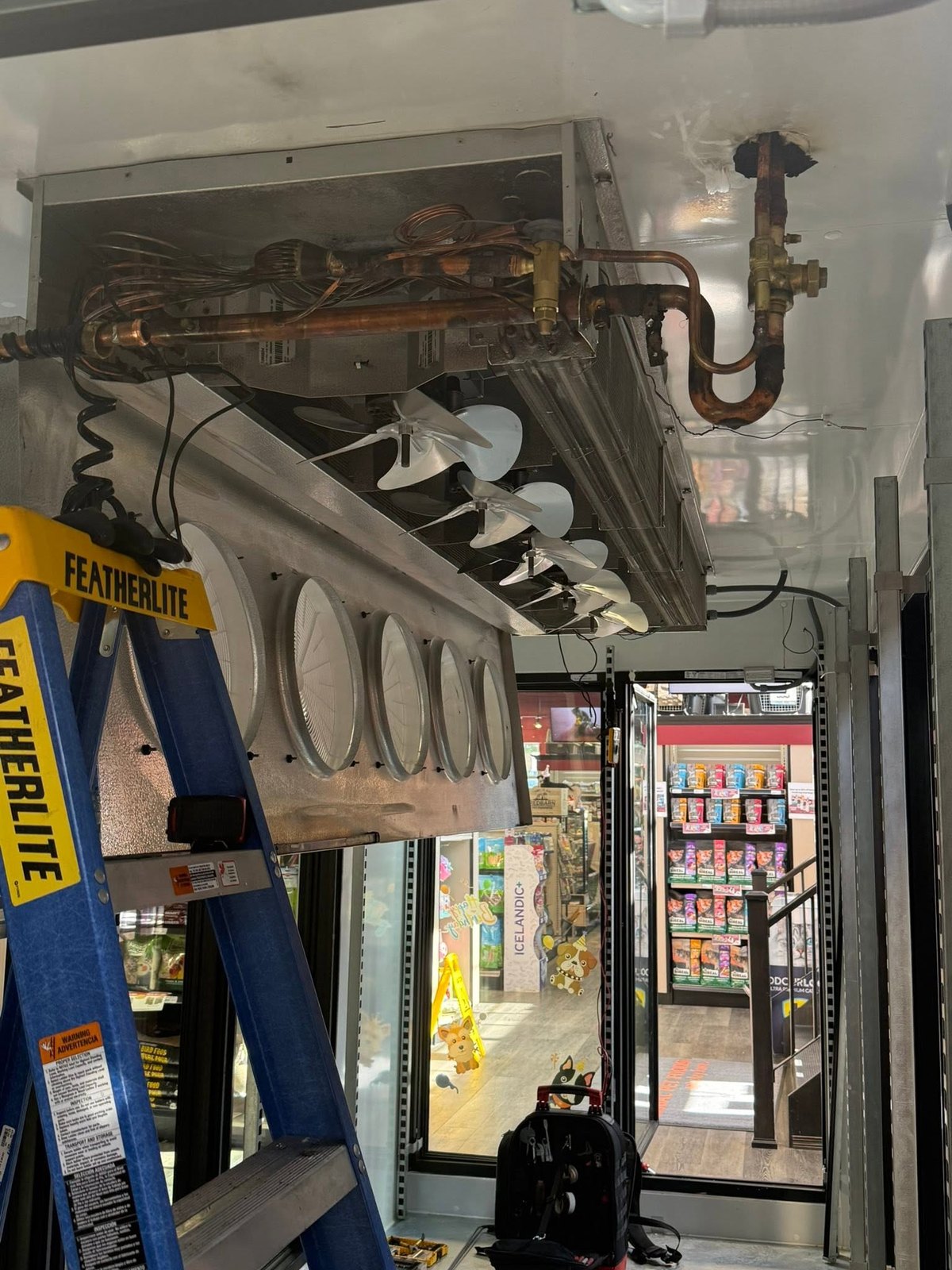
Retail case diagnosis
Commercial Display Refrigerator Repair and Temperature Mapping
For food businesses in Toronto, CooperFix diagnoses and repairs commercial display refrigerators used to hold chilled products for staff or customer access. Shelf-level readings, air paths and the case format are documented before the repair scope is defined.
Request Display Refrigerator Service Call 647-483-3777Refrigeration down? Call us now.
Commercial refrigeration repair across Toronto and the GTA. Emergency calls are received and assessed around the clock.
- Walk-in coolers & freezers
- Reach-in fridges & freezers
- Display cases
- Beverage coolers
- Prep & sandwich tables
- Compressors, condensers, evaporators
- Digital controllers & sensors
- Defrost systems & door gaskets
- Same-Day Service
- Mechanic 313A
- ODP/ODS Certified
- Toronto & GTA
Request Service
Tell us the equipment and the problem — we will get back to you.
Glass-Door Merchandisers
Door sealing, frame condition, fans, product clearance and heat rejection are reviewed with the temperature pattern.
Open Display Cases
The designed supply and return-air path, loading line, night cover and surrounding air movement affect the diagnostic record.
Service and Retail Cases
Multi-deck and counter cases require readings that identify the exact shelf, deck or service zone.
Build a Reproducible Temperature Map
| Zone | Record | Operating context |
|---|---|---|
| Upper | Independent reading and product position | Supply air and loading clearance |
| Middle | Independent reading and access frequency | Door or open-front exposure |
| Lower | Independent reading and drainage observation | Return air and drain area |
When to Escalate the Record
- Readings rise outside the business’s required range
- The case does not recover after normal access
- Frost restricts a designed air path
- Water collects near the case or drain
- A fan, control or compressor sound changes
Display Refrigerator Diagnostic Sequence
- Confirm the case and application. Record make, model, set point, loading pattern and mapped readings.
- Inspect the display boundary. Review doors, frames, shelves, grilles and the marked loading line.
- Trace airflow. Check accessible fans, coil condition and designed supply and return paths.
- Compare controls and readings. Observe sensors, controller values and electrical sequence.
- Evaluate refrigeration performance. Take measurements appropriate to the case design and verified symptom.
- Define and verify the work. Document the finding, authorized repair and post-work temperature pattern.
Possible Repair Scope
Confirmed work may involve a door or gasket, fan, sensor, control, electrical component, drain, evaporator component, condensing component or another measured refrigeration fault.
Operations Handoff
Give the site team a record of the affected case, mapped readings, approved work and the verification condition. If product temperature may be outside the required range, the business’s food-safety process remains the controlling action.
Request Display Refrigerator Service
Provide the customer site, case type, make, model, set point, mapped readings and the temperature, airflow, frost, door, fan or drainage condition.
Display Refrigerator Questions
Why map temperatures by shelf or case zone?
A single reading can hide a local airflow or loading pattern. A zone map shows whether the condition is local or case-wide.
Does glass condensation prove a refrigeration fault?
No. Door sealing, surface temperature, infiltration and surrounding humidity can contribute, so the enclosure and refrigeration operation are reviewed together.
What should a retail team record before requesting service?
Record the case type, make, model, set point, readings by zone, loading line, alarm state and the time the condition appears.
