
Commercial Refrigeration / Commercial Walk-In Cooler Repair
Commercial Walk-In Cooler Repair
Staff may first notice that chilled stock is no longer holding its intended positive temperature, even though the walk-in cooler continues running. CooperFix uses this repair page specifically for medium-temperature cooler failures, separating them from freezer operation. Attention stays on whether evaporator airflow is restricted, the TXV is feeding the coil correctly, or compressor cycling is reducing available capacity during the room’s normal commercial load.
Book Service Call 647-483-3777Prepare These Details
- Room size and set point
- Current air and product temperature
- Condensing unit location and access
- Door, gasket and closer condition
- When the temperature change started
Two coils, one room
A walk-in cooler with two evaporators. Split coils keep the temperature even in a long room, but they also mean two defrost circuits, two drains and two fan sets to check. CooperFix tests them separately — a cooler that is warm at one end and correct at the other is almost always one coil, not the condensing unit.
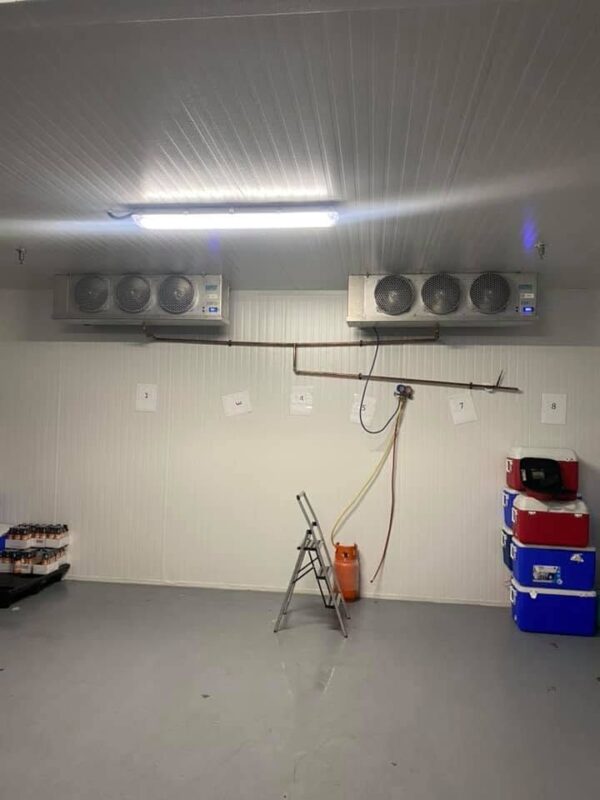
Two evaporators inside a walk-in cooler.
Refrigeration down? Call us now.
Commercial refrigeration repair across Toronto and the GTA. Emergency calls are received and assessed around the clock.
- Walk-in coolers & freezers
- Reach-in fridges & freezers
- Display cases
- Beverage coolers
- Prep & sandwich tables
- Compressors, condensers, evaporators
- Digital controllers & sensors
- Defrost systems & electrical controls
- 24/7 Emergency Calls
- Mechanic 313A
- ODP/ODS Certified
- Toronto & GTA
Request Service
Tell us the equipment and the problem — we will get back to you.
Walk-In Cooler Components We Assess
Condensing Unit
Compressor, condenser coil, fans, controls and refrigerant-side condition. Location matters: rooftop, remote and self-contained units behave differently in summer heat.
Evaporator and Air Path
Coil condition, fan operation, air throw across the room, drain line and pan. A medium-temperature room depends on steady airflow more than on aggressive defrost.
Enclosure, Door and Controls
Panels, gaskets, closers, hinges, sweeps and the temperature controller or sensor. Door traffic and infiltration change the load the system has to carry.
Signs That Need Diagnosis
- Product temperature rises above the set point
- The room recovers slowly after deliveries or busy service
- Condensation or water appears on the floor or ceiling
- Ice forms on the evaporator coil in a room that should stay above freezing
- A fan becomes noisy, slow or stops
- The door does not seal, drags or stays ajar
- The controller reading differs from a measured thermometer
- The condensing unit runs continuously without reaching the set point
Conditions That Can Produce Similar Symptoms
A warm walk-in cooler can be caused by a airflow or drainage fault, blocked return air, a dirty condenser, evaporator condition, fan operation, a sensor or controller, an electrical component, a drainage problem, product overloading or a refrigeration-side fault.
The symptom alone does not confirm which part should be replaced. Measurements and inspection are used to isolate the cause before any part is ordered.
Walk-In Cooler Diagnostic Process
- Identify the room. Record set point, room size, product type and loading pattern.
- Measure actual conditions. Compare air temperature, product temperature and the controller reading.
- Inspect the enclosure. Doors, gaskets, closers, sweeps, panels and visible infiltration.
- Check airflow and heat rejection. Evaporator fans, coil condition, return air path, condenser cleanliness and clearance.
- Test controls and electrical operation. Sensors, controller, contactors, relays and defrost timing where fitted.
- Measure refrigeration performance. System checks required by the confirmed symptom.
- Document the result. Cause, authorized repair and post-repair verification.
Repair Scope
Depending on the diagnosis, repair may involve a fan, coil, control or drain, an evaporator or condenser fan, a coil condition, a sensor, controller or relay, a drainage condition, a condensing-side component, a compressor or another confirmed refrigeration fault.
Part selection and refrigerant-side work follow the identified equipment and the measured condition. Refrigerant handling is performed by a certified mechanic.
Preventive Maintenance for Walk-In Coolers
Planned checks track condenser condition, evaporator fans, coil cleanliness, drain lines, door hardware, gaskets and controller accuracy. Service records make it possible to see whether a condition is new or has been developing.
Scheduled visits are arranged around the site operating hours so the room is not opened during service periods.
Maintenance Does Not Replace Active-Fault Diagnosis
If product temperature has already changed, the current condition must be tested. Cleaning or adjustment should not be presented as verification that the refrigeration circuit is sound.
An active fault is diagnosed first. Maintenance follows once the room holds its set point.
Businesses Using Walk-In Coolers
Walk-in coolers support restaurants, grocery and specialty retailers, bakeries, butchers, caterers, commissaries, bars, breweries, florists, institutions and workplace food service across Toronto and the GTA.
Walk-In Cooler Service Areas
Service is organized across Toronto and the approved surrounding areas. No service-area page represents a separate branch office.
Request Walk-In Cooler Service
Provide the site, room size, set point, current readings, door condition and a short description of what changed.
Walk-In Cooler Questions
Why does the room warm up only during busy hours?
Door traffic, deliveries and warm product all add load at the same time. A system that is marginal will hold overnight and fall behind during service. Measurements taken during the busy period show whether capacity, airflow or infiltration is the limiting factor.
Why is there ice on the coil if the room stays above freezing?
Coil surface temperature can be below freezing even when room air is not. Restricted airflow, a fan fault, a drain problem or a refrigeration-side condition can all produce coil ice in a medium-temperature room.
Does a worn gasket always mean refrigeration work?
A gasket or door fault allows infiltration and increases run time, but the rest of the system is still checked when temperature control has changed.
Can water on the floor come from the cooler itself?
Yes. A blocked drain line, a full or misaligned condensate pan, or condensation caused by warm humid air entering the room can all put water on the floor. The source is identified before any part is replaced.
Need Walk-In Cooler Service?
Tell us the room set point, the current reading and what changed.