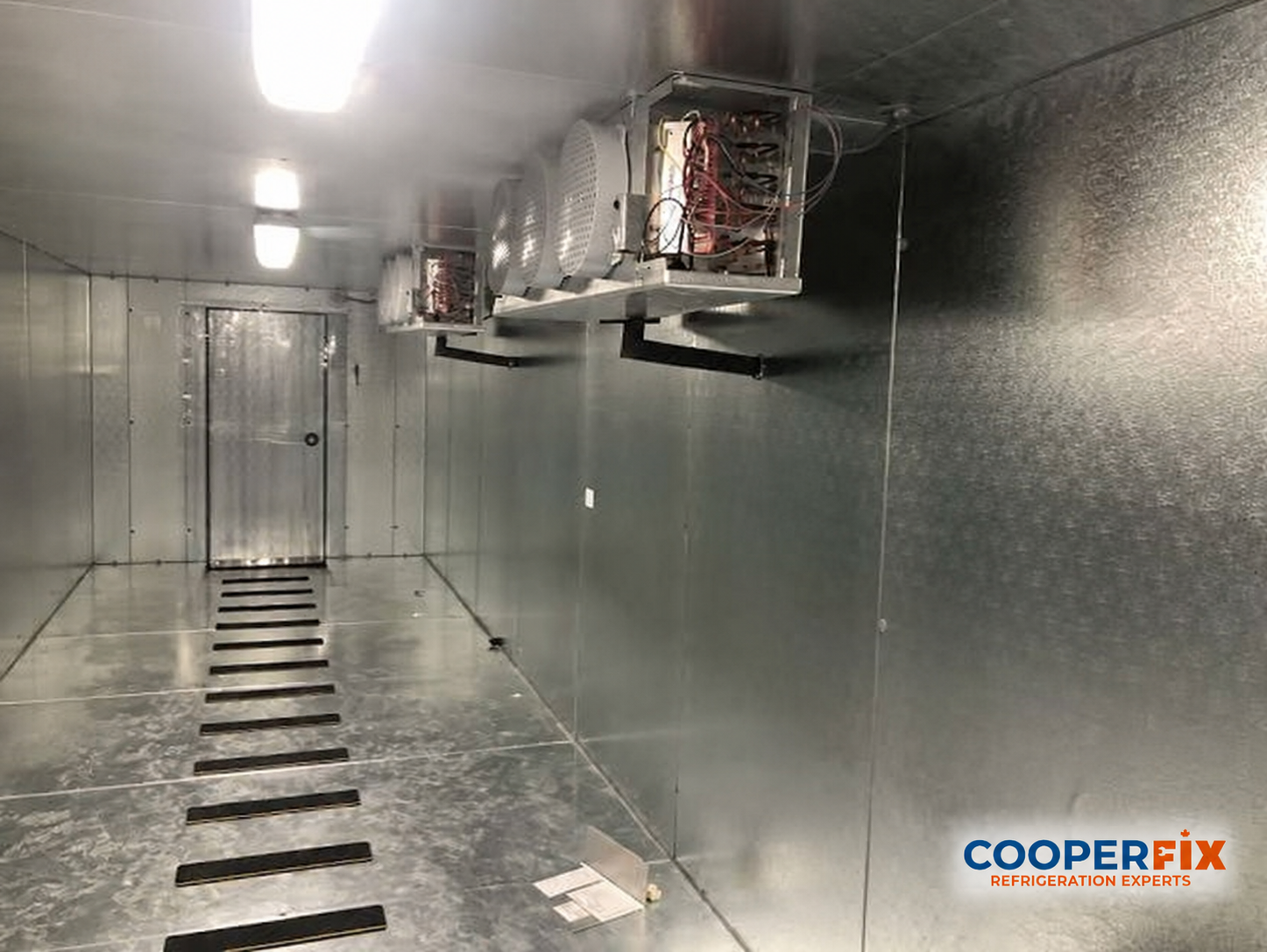
Walk-in cooler maintenance
Walk-in cooler maintenance concerns the refrigeration serving chilled storage. The assessment needs to connect the evaporator inside the room with the equipment serving it, especially where those components are separately located. Identify the room and its normal use so observations made at the refrigeration equipment can be related to what the business is seeing in storage.
Evaporator checks include fan condition, unusual vibration, visible coil condition and whether condensate can leave the drain pan. Worn or damaged fan components and a drain that does not clear need distinct attention. The inspection should identify the affected part and the observed condition, rather than recording the entire evaporator as either satisfactory or faulty.
The service record should distinguish a reported warm area from a measured finding. Note where the concern occurs, when it is noticed and whether the storage arrangement has changed. This gives a specific location and operating context for the assessment. It also helps the business understand what has been investigated and whether another observation is needed under normal working conditions.
For example, a complaint near the receiving side of a cooler should remain associated with that location and the time it occurs. A single reading taken elsewhere does not answer the original question. Maintenance is more useful when the final record explains which equipment checks were relevant to the concern and which questions, if any, remain open.
Walk-in freezer maintenance
Walk-in freezer maintenance needs an account of the defrost arrangement as well as the refrigeration operation. Identify the installed controls and the equipment they operate. The maintenance scope should allow the technician to assess the relevant stages, with any stage that could not be observed recorded as an outstanding limitation.
Where electric defrost is fitted, the applicable inspection includes heater condition and operation, defrost controls and abnormal ice patterns. These checks serve different purposes: a control setting describes the intended action, while an operating check establishes what the equipment actually does. The model documentation governs the assessment; one freezer’s settings should not be copied to another.
Tell CooperFix whether ice has been appearing in the same location and whether earlier work changed the pattern. A description such as “ice returned below the left evaporator after the last visit” is more useful than “freezer needs maintenance.” It preserves the relationship between a particular location, a previous action and the condition requiring review.
The business also needs to arrange a suitable opportunity for the work. If stock or access restrictions prevent part of the freezer equipment being assessed, identify that restriction before the visit. Where the work requires an interruption, agree how the site will manage stored products and when the equipment can be made available. This keeps the maintenance task tied to a realistic operating window.
Commercial cooler maintenance
Commercial cooler maintenance covers refrigerated cabinets and displays used for chilled products. Each cabinet should be identified separately, including similar units positioned next to one another. A maintenance finding belongs to the specific cabinet assessed, with its model and location recorded so later recommendations reach the correct equipment.
Condensate handling deserves a functional check. For applicable cabinets, the maintenance assessment includes the condensate route, its collection area and the arrangement provided for draining or evaporating it. Cabinet level can affect drainage, so a unit that has been moved should be assessed in the position it now occupies rather than against its original installation.
Air access at the cabinet’s refrigeration equipment is another technical consideration. Follow the model’s ventilation arrangement and assess whether it remains available in the current location. Manufacturer guidance for Slate cabinets, for example, requires the grille area to remain unobstructed. A change to surrounding displays or storage can therefore be relevant even when the cabinet itself has not been modified.
Make the follow-up specific. A restricted grille, a soiled condenser and a blocked condensate route are different findings. The record should explain which condition was present, which action was completed and whether a separate repair is recommended. That gives the manager something concrete to check against the next visit without treating every cabinet issue as the same maintenance task.
Commercial freezer maintenance
Commercial freezer maintenance concerns complete cabinets used for frozen stock. The correct model reference is particularly useful when checking controller behaviour. Similar-looking freezers can have different fan and defrost sequences, so a stopped fan or an active defrost indication needs to be interpreted within the relevant operating stage.
Beverage-Air’s HF instructions, for example, link evaporator-fan operation to compressor and access conditions and describe a separate defrost-heater sequence. A maintenance check therefore compares the observed action with that model’s documentation. It should not label a fan defective solely because it is stationary when someone first looks inside the cabinet.
For applicable air-cooled cabinets, the condenser’s condition is part of the refrigeration assessment. Deposits on the coil require an appropriate maintenance response without damaging the fins or nearby components. Beverage-Air’s FB instructions also caution that adding an air filter can restrict cooling airflow. An improvised filter should not be assumed to improve the cabinet’s maintenance arrangement.
Record what happened after any maintenance action and which operating condition was observed. If the original concern involved an intermittent event, retain that distinction in the findings. The absence of the event during a short observation should not be written as proof that it cannot recur. Identify any follow-up needed to answer the original concern under the relevant conditions.
Assess the condition without creating unnecessary work
Inspection and corrective work should have a clear relationship. An observed condition provides the reason for the proposed action; the action should then be recorded against that condition. This is useful for seemingly small items as well as major components, because it lets the business see which findings were resolved during maintenance and which require a separate decision.
Avoid treating every unit of a similar age as if it needs the same parts. The equipment record should explain the condition found on the particular unit. Where the observation is inconclusive, identify the additional assessment needed. A recommendation is easier to evaluate when it distinguishes confirmed damage from a symptom whose cause has not yet been established.
This approach also keeps technical coil maintenance in proportion. It is one equipment task whose relevance depends on condition and manufacturer instructions. It should have a defined purpose and an appropriate method within the maintenance scope, alongside the other applicable checks. The business needs an account of refrigeration condition, including issues that require a different kind of attention.