Commercial Refrigeration / Commercial Refrigeration Service
Commercial Refrigeration Service
A control panel and condensing unit appear together in the page image, illustrating why planned service examines connected operating conditions rather than one active fault. CooperFix records selected readings and compares commercial refrigeration behaviour with operating requirements. Changes in fan operation, controls, drainage, or defrost can then be identified for corrective planning. The preventive purpose is to give facility teams evidence for maintenance decisions before temperature control is lost.
Book Service Call 647-483-3777Have This Ready
- List of refrigeration equipment on site
- Set points for each unit or room
- Operating hours and quiet periods
- Any unit that has given trouble before
- Site access details
Control is half the system
A control panel and condensing unit on the wall of a plant room. Refrigeration faults are as often electrical as mechanical: a contactor, a pressure switch, a sensor reading a value the controller then acts on. CooperFix works through the control side and the refrigerant side together.
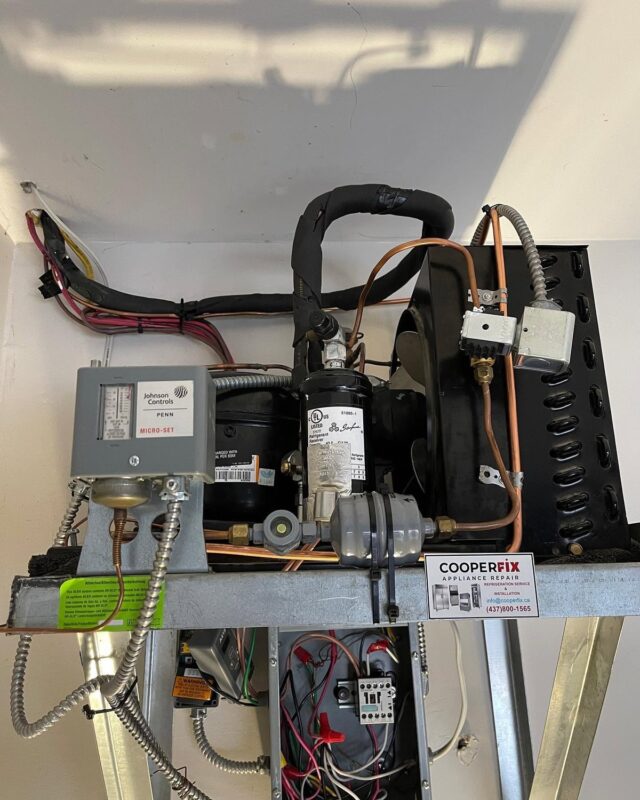
Control panel and condensing unit.
Refrigeration down? Call us now.
Commercial refrigeration repair across Toronto and the GTA. Emergency calls are received and assessed around the clock.
- Walk-in coolers & freezers
- Reach-in fridges & freezers
- Display cases
- Beverage coolers
- Prep & sandwich tables
- Compressors, condensers, evaporators
- Digital controllers & sensors
- Defrost systems & electrical controls
- 24/7 Emergency Calls
- Mechanic 313A
- ODP/ODS Certified
- Toronto & GTA
Request Service
Tell us the equipment and the problem — we will get back to you.
What a Commercial Service Visit Covers
Heat Rejection and Airflow
Condenser cleanliness and clearance, evaporator fans, coil condition and the return air path around product and shelving.
Doors, Gaskets and Drains
Gaskets, closers, hinges and sweeps; drain lines and pans cleared before they back up into the room.
Controls and Readings
Controller settings compared against measured temperature, defrost timing and any sensor drifting away from reality.
Equipment Covered on a Service Cycle
- Walk-in coolers and walk-in freezers
- Reach-in refrigerators and freezers
- Display cases and merchandisers
- Beverage coolers
- Prep and sandwich tables
- Undercounter and worktable refrigeration
Service Versus Repair
If a unit has already lost temperature, that is a repair call and it is diagnosed on its own terms. Cleaning and adjustment must never be presented as proof that the refrigeration circuit is sound.
Service resumes once the fault is confirmed corrected and the equipment holds its set point.
Who This Is For
Restaurants, cafes, grocery and specialty retail, bakeries, butchers, caterers, bars, breweries, convenience stores, workplace and institutional food service across Toronto and the GTA.
Fault Patterns and What They Mean
The pattern matters more than the symptom. When it fails, and how it recovers, narrows the cause faster than the temperature alone.
- Equipment that holds overnight and drifts through trading hours. Load and envelope rather than capacity — doors, closers, sweeps, gaskets.
- Slower recovery after every delivery. The earliest measurable sign of lost capacity, and the cheapest point to repair.
- Continuous running with no off cycle. Undercharge, condenser fouling, or restricted airflow.
- Uneven temperature inside one cabinet or room. Airflow: a failed fan, an iced coil section, or blocked return air.
- Ice that survives the defrost cycle. Defrost failure or a schedule that does not match the real moisture load.
- Repeated safety trips and resets. A fault being masked; each reset costs compressor life.
- Water present with the equipment still cold. A drain fault.
- Rising energy use with no change in load. Almost always a fouled condenser or an iced evaporator working against itself.
What Gets Measured On Site
These readings turn a description into a diagnosis. They are taken in this order every time.
- Actual product temperature confirmed with a calibrated thermometer, next to whatever the controller is reporting.
- The current state of the system: cooling, in defrost, off on control, or locked out on a safety.
- Suction and discharge pressures, converted to saturation temperature.
- Superheat and subcooling, which is what separates a charge problem from an airflow problem.
- Supply voltage on every leg and running amps against the nameplate.
- Condition of contactors, relays, capacitors and overloads.
- Airside: condenser coil, evaporator coil, every fan individually, defrost operation, drain line and drain heater.
- Envelope: evaporator fans, coils, controls and drainage, load line and anything adding heat or humidity.
Checks You Can Safely Do First
None of these needs a tool or an open panel, and they regularly find the cause before anyone is dispatched.
- Confirm the door closes and latches and that nothing is propping it or blocking the sweep
- Check the evaporator coil for even frost, ice build-up or blocked fins
- Check that product is not stacked against the coil, over the return air path or above the load line
- Look at the condenser coil — grey with dust, grease or lint means airflow is already restricted
- Clear anything blocking airflow around the condensing unit
- Look at the drain pan and drain line for standing water or ice
- Read the setpoint and confirm nobody changed it
- Confirm no breaker has tripped
What not to do: do not open electrical panels, do not touch refrigerant lines or service valves, do not chip ice off a coil with a tool, do not reset a tripped safety repeatedly, and do not keep running equipment that is tripping a breaker.
Common Misdiagnoses
These are the wrong conclusions that cost the most on this equipment.
- Judging system health by the display. Product temperature, measured with a calibrated instrument, is the only reading that matters.
- Deferring condenser cleaning as cosmetic. It is capacity, energy and compressor life.
- Topping up refrigerant instead of finding the leak.
- Replacing parts in sequence until the symptom stops. Readings first, part second.
- Treating repeat icing as a site quirk. It is an unaddressed moisture source.
- Assuming equipment is undersized. Capacity is measured under real load before anyone recommends new equipment.
Frequently Asked Questions
What does a service visit actually include?
Measured product temperature against the controller, pressures, superheat and subcooling, electrical readings, an airside inspection and an envelope inspection — then a diagnosis with the readings behind it.
Do you offer planned maintenance as well as repair?
Yes. Planned maintenance is aimed at catching developing faults and restoring lost capacity, and it produces written readings to compare between visits.
What equipment do you service?
Commercial refrigeration: walk-in coolers and freezers, reach-ins, refrigerated display and prep units, shock freezers, and the condensing units behind them.
How are emergency calls prioritised?
By product risk: temperature, product type and how much time it has left.
Do you work across Toronto and the GTA?
Yes, plus York Region and north through Bradford, Innisfil, Barrie, Alliston, Angus and Essa.
Request Commercial Refrigeration Service
Tell us what equipment is on site, your operating hours and how often you want attendance.
Put Your Equipment on a Service Cycle
Send the equipment list and your hours and we will propose a schedule that does not interrupt service.