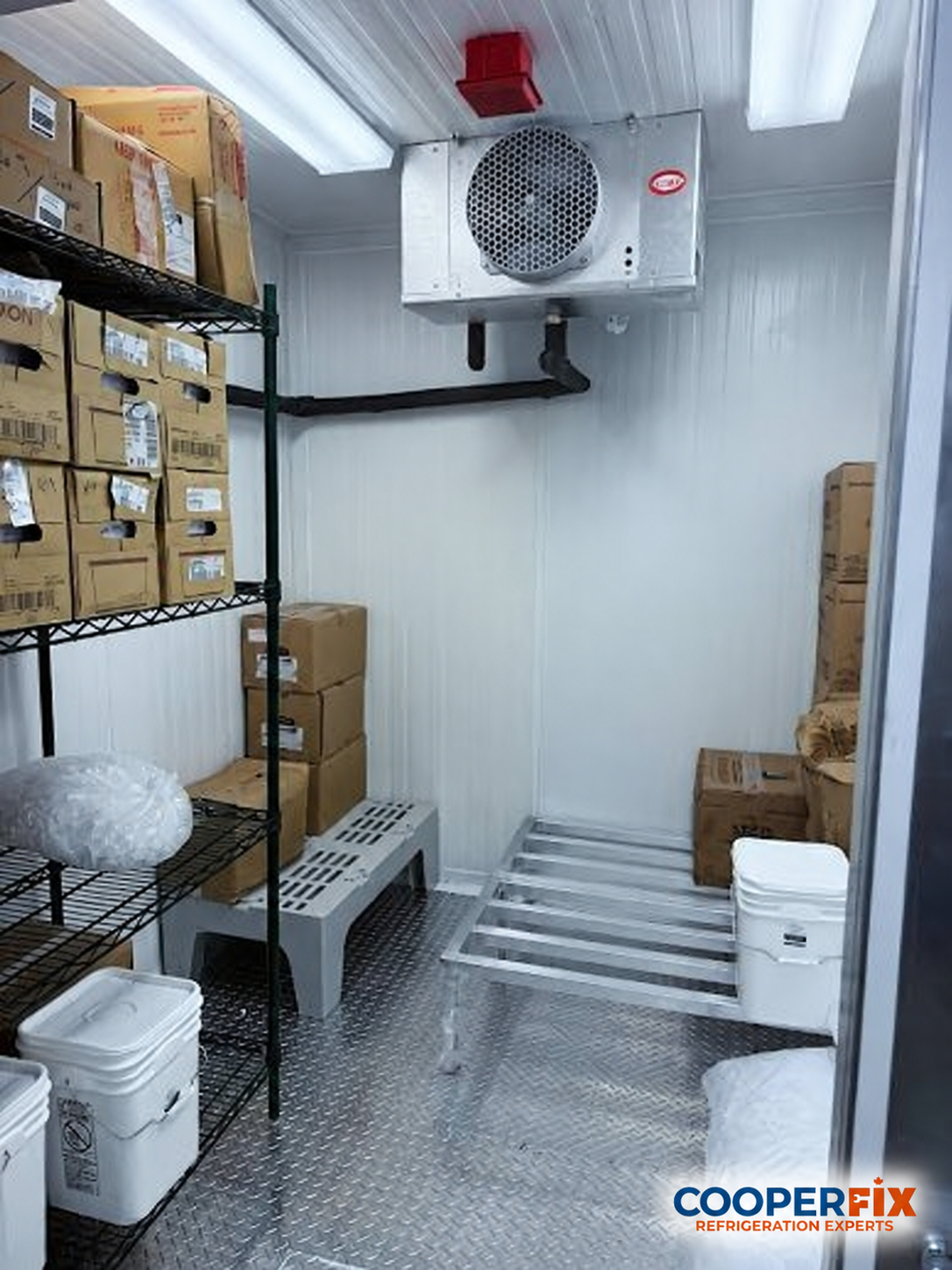
Stock arrangement and the air path
A problem that appears after restocking does not establish that staff caused it. The technician needs to assess the arrangement alongside the condition of the operating equipment. A fan fault or loss of cooling performance may become noticeable during the same period. The timing supports investigation; it does not settle responsibility or diagnosis.
Describe which positions were occupied when the issue appeared. If products have been relocated under the business’s stock procedures, a photograph or simple location note can retain useful context. The diagnostic account should state whether the equipment was assessed with its usual stock arrangement or under different conditions.
Slow recovery after deliveries
Product quantity, temperature on arrival and access frequency all affect the refrigeration demand. Danfoss’s application guidance treats these as separate sizing factors. The dimensions of a walk-in fridge alone do not explain how much cooling its current use requires, and a room used for holding already chilled goods should be assessed against that intended duty.
A business may see readings remain elevated longer after a delivery or notice that the usual recovery pattern has changed. Compare similar operating periods where records exist. Note whether the delivery quantity, incoming condition or access pattern differed, rather than assuming the system has suddenly lost capacity.
The technician can use that history when assessing performance under load. If the equipment previously handled comparable conditions, the investigation needs to address that deterioration. If usage has changed materially, the repair explanation should identify the effect on the assessment without presenting a capacity change as an established mechanical failure.
Displayed temperature, sensor readings and alarms
A controller’s temperature information depends on its sensor inputs and configuration. Danfoss’s fault guidance calls for assessment of sensor location, calibration, setpoint and differential when room temperature is unstable. A sensor affected by discharge air, door openings or an obstruction may not describe the storage conditions that concern the business.
The technician compares the reported temperature problem with what the control is measuring and how it responds. A replacement sensor needs a confirmed reason; a discrepancy between two readings first requires consideration of where and how they were obtained. Keep the display photograph with the time and measuring location of the other observation.
Heatcraft QRC instructions distinguish temperature alarms from input faults. Interpret the message using the installed controller documentation; an alarm identifies a condition to investigate, not a confirmed failed part.
Fans that appear to stop between cooling periods
Fan operation can change with the control sequence. Some controls provide an optional fan-cycling function while the compressor is off. Heatcraft describes that function for its QRC system, with operation depending on configuration. Staff noticing a quiet interval should report its timing and accompanying display state rather than assuming a motor has stopped permanently.
The assessment needs to establish whether the observed behaviour matches the installed equipment’s intended sequence. A recurring complaint during these intervals deserves attention even when a control feature explains why the fans stopped. Explaining the operating state and checking the reported storage problem are related parts of the visit.
If noise or operation differs between fans, describe the difference without removing guards. A short recording from a safe position may preserve an intermittent sound. Include whether it occurs during cooling, at a transition or after a long quiet period so the technician can connect it with the equipment’s operation.
Frost, weak circulation and changing room readings
Persistent evaporator icing can accompany restricted airflow, moisture entering through the door, unsuitable operating conditions or refrigerant-feed problems. The fact that a defrost cycle appears to run does not eliminate those possibilities. A technician assesses the actual coil condition and operation instead of treating every recurrence as proof that the defrost timer needs replacement.
For a stocked fridge, explain whether the temperature differences appeared before the frost was noticed or developed alongside it. Record what is visible from a safe position and how the condition changed after previous service. A clear timeline helps avoid combining separate observations into an assumed cause.
Electronic controls can coordinate more than room temperature. Some manage refrigerant superheat and defrost as well, so an operating problem may involve the relationship between inputs and control functions. The installed configuration matters when interpreting that behaviour. Do not copy settings from another room because the controller face looks similar.
A compressor that does not start or stops again
A fridge that is quiet and warming needs an assessment of both demand and operation. Manufacturer troubleshooting includes control sensing, supply conditions, relays, starting components and protective shutdowns among the possible reasons a compressor does not run. A motor that is not running has not, by that fact alone, been proved defective.
The technician checks whether cooling is being requested, what is preventing operation and whether a protective device has acted. If a shutdown follows an attempted start, the sequence matters. The repair explanation should distinguish a failed component from a device responding to another problem.
Staff can provide the display state, the timing of any audible start attempt and whether the condition followed an interruption to power. Avoid repeated resets as a way to keep operation going. A history of which protection operated and what happened next is more useful for diagnosis than a room that has been restarted several times without records.
Refrigerant flow and an underperforming evaporator
The expansion valve controls refrigerant entering the evaporator. A filter drier has a different role, protecting the circuit by removing moisture and contaminants. These functions help explain why poor cooling requires assessment of the refrigerant path, not an automatic assumption that the system needs additional refrigerant.
A technician considers refrigerant supply, the valve and possible restrictions together. An evaporator receiving insufficient refrigerant can need investigation of the valve setting or a blocked refrigerant path, alongside charge condition. Those are different repair directions. The findings should identify which condition was established and how it explains the poor cooling, rather than using a warm room as the reason for adding refrigerant.
Retain earlier service findings if refrigerant or valve work has already been performed. Distinguish the items actually replaced from those previously suggested. That record lets the current assessment address a returning symptom against known work instead of treating each visit as an unrelated failure.