Commercial Refrigeration / Controller Installation & Programming

Controller installation & programming · Toronto & GTA

Commercial Refrigeration Controller Installation & Programming

A powered display alone does not confirm correct control.

Programming is a system-specific task: the settings must correspond to the equipment and the operating purpose of each room. Probe placement, output configuration, defrost programming, alarm behaviour and compressor protection are all part of the installation.

CooperFix installs, wires and programs digital refrigeration controllers and the panels they sit in, for commercial operators in Toronto and the GTA.

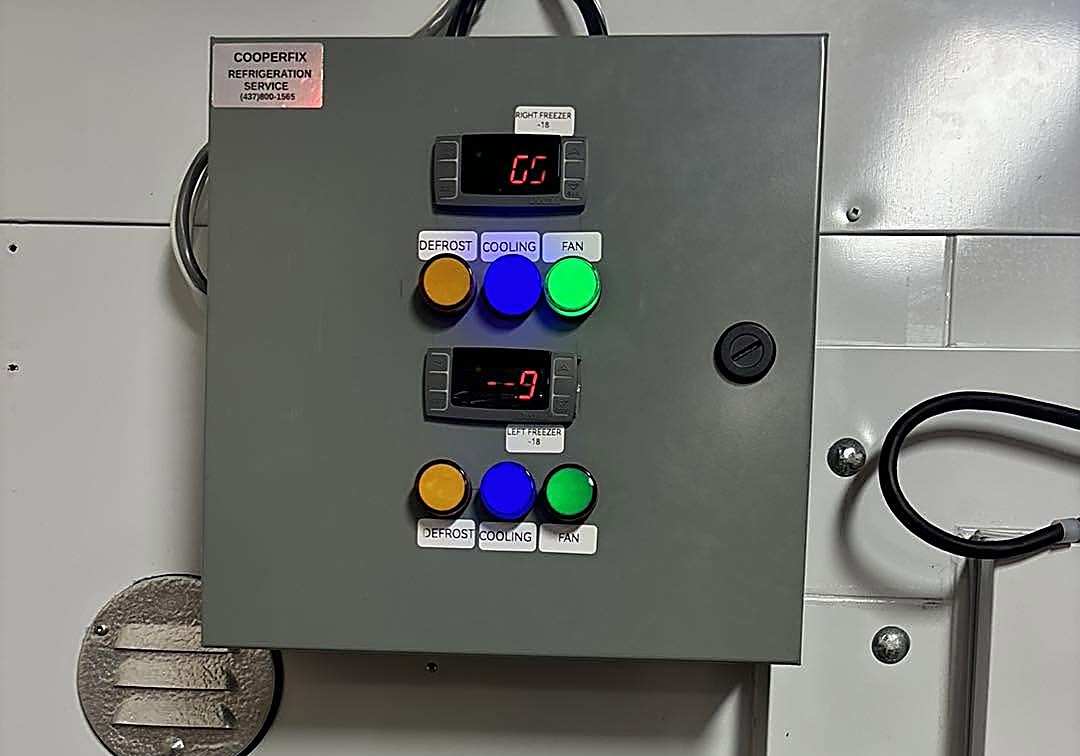
CooperFix control panel with two digital refrigeration controllers for walk-in freezers
Control panel with two digital controllers, one per walk-in freezer.CooperFix · Toronto & GTA
Service request

Book Controller Service

Tell CooperFix what the display shows, what a thermometer shows in the room and whether the coil is iced.

647-483-3777

    Please prove you are human by selecting the truck.

    CooperFix services commercial refrigeration equipment only.

    What this service covers

    One panel, two rooms, two set points

    A control panel built and wired by CooperFix for two walk-in freezers gives each room its own controller, its own probe and its own defrost schedule, and the lamps show at a glance which stage the room is in: defrost, cooling or fan. Where two rooms previously shared one crude control, staff had no way of knowing which room was in trouble. With separate control, the reading on the door is the reading inside the room, and an alarm is visible from the corridor.

    What the controller actually decides

    A digital controller is not a thermometer. It reads one or more probes and then switches the compressor, the fans and the defrost circuit according to values that somebody entered. Those values are what make the difference between a room that holds temperature and a room that runs all night:

    • Set point and differential. The temperature the room is asked to hold, and how far it is allowed to drift before the system starts again.
    • Defrost. How often defrost runs, how long it lasts, how it is ended, and how long the fans stay off afterwards.
    • Probe assignment. Which probe controls the room and which one only watches the coil. A probe in the wrong place gives a correct reading of the wrong thing.
    • Compressor protection. Minimum off time and minimum run time, so the compressor is not short-cycled into an early failure.
    • Alarms. High and low limits, and the delay before an alarm is raised, so a real problem is seen and a door left open for two minutes is not.
    Controller and system checks

    What the control is doing now

    When the controller is the problem

    • The display and an independent thermometer disagree.
    • The room is cold but the product is freezing, or the opposite.
    • Defrost never seems to run, or runs so often the room never recovers.
    • The coil ices up again a day after it was cleared.
    • The compressor starts and stops every few minutes.
    • The display is blank, frozen, flashing an error code, or the buttons do nothing.
    • Nobody knows what the settings are because the last person to change them is gone.

    Mechanical control

    • One switch point with a wide, fixed swing. The room drifts further above and below the temperature you actually want.
    • Defrost runs on a clock. It starts whether the coil needs it or not, and runs for the full set time even after the ice is gone.
    • No fan delay. Fans restart on a wet coil and blow water onto the product.
    • No compressor protection. The compressor can restart against pressure and short-cycle.
    • No display. The only way to know the temperature is to put a thermometer inside and come back later.
    • No alarm. A failure is discovered when somebody opens the door.
    • Adjustment is a screw and a guess. Nothing is recorded and nothing can be restored.

    Digital controller

    • Set point and differential are entered as numbers. The room is held closer to the temperature the product actually needs.
    • Defrost is ended by temperature, not only by the clock — it stops as soon as the coil is clear.
    • Fan delay after defrost lets the coil drain before the fans restart, so less water ends up on the product.
    • Minimum off and run times protect the compressor from short-cycling.
    • The temperature is on the display, readable without opening the door.
    • High and low alarms with a delay: a real fault is seen, an open door for two minutes is not.
    • Error codes point at the failed probe or circuit.
    • The settings are values that can be written down, handed over and restored exactly.

    Custom made for your system

    Every CooperFix control panel is custom made — designed and built for the equipment it will run. The number of controllers, which probes go where, how defrost is staged between rooms, which indicators appear on the door and what triggers an alarm are decided for that installation.

    A two-room freezer with one shared compressor is not wired the same way as a display line, and a panel that ignores that difference is the reason rooms drift apart.

    Where mechanical is still fine

    On small, low-value equipment that runs above freezing and is opened rarely, a mechanical thermostat is simple and cheap to replace. CooperFix will say so if that is the honest answer for the unit.

    The case for a digital controller is strongest on walk-in rooms, on freezers, and anywhere the product in the room is worth more than the controller.

    CooperFix · Refrigeration Experts

    Know who you are calling.

    20+Years of experience
    313AMechanic
    ODP/ODSCertified
    Service request

    Request Controller Installation

    Send the controller model if available, the equipment it serves and any displayed message.

    647-483-3777

      Please prove you are human by selecting the car.

      CooperFix services commercial refrigeration equipment only.

      Assessment and recommendation

      What we do on a controller job

      1. Measure first. Room temperature, coil temperature and the controller reading are compared before anything is changed.
      2. Check the probes. Position, condition and resistance. A failed or badly placed probe is replaced or moved.
      3. Decide: program or replace. A working controller with wrong settings is programmed. A dead or obsolete one is replaced and rewired.
      4. Set the values. Set point, differential, defrost cycle, fan delay, compressor protection and alarm limits, matched to the equipment and to what the room is used for.
      5. Prove it. Watch a full cycle, including a defrost, and confirm the room recovers to set point.
      6. Write it down. The values are recorded and left with the customer, so the next person does not start from zero.

      What that means in practice

      Tighter temperature control means the product sits where it is supposed to sit. Defrost that ends on temperature and fans that wait means less ice, so the coil is cleared less often and the room recovers faster. Compressor protection means fewer starts, and starts are what wear a compressor out. An alarm on the wall is the difference between a service call and a load of spoiled product.

      What the industry measures

      KaTom, a commercial equipment supplier, states that electronic controls hold the internal temperature within about 2 to 3 degrees of the set mark, while a mechanical cut-in thermostat swings between a wider upper and lower limit, and that some electronic controls run adaptive defrost. Danfoss, one of the controller manufacturers, reports a test on display merchandisers in Baltimore where an electronic controller managing compressor, evaporator fan, defrost and lighting together cut energy use by up to 33% against a conventional thermostat. Those are their figures on their equipment, not a promise about yours — what a unit does depends on its condition, its load and how it is used. They are quoted because they show where the difference comes from: a mechanical thermostat controls one thing, an electronic controller coordinates several.

      Controllers we install and program

      CooperFix works with Dixell, Carel, Danfoss and Elitech digital controllers, and with the panels they sit in. Where a controller is obsolete or no longer supported, it is replaced with a current model and rewired, rather than patched.

      Your request

      What to tell us when you call

      Four things make the first visit shorter: what the controller display shows right now, what an independent thermometer shows inside the room, whether the coil is iced, and what the equipment is used for. If there is an error code on the screen, read it out — it usually points straight at the probe or the circuit that failed.

      Questions

      Controller installation questions

      What controller information should I provide?

      Include the controller model if available, the equipment it serves and any displayed message.

      Should an existing controller be replaced before assessment?

      The controller and the refrigeration system need to be assessed before replacement is recommended.

      What operating changes should I describe?

      Explain changes in temperature, fan operation or defrost behaviour and when they began.