
Walk-In Freezer Repair Service in Toronto & the GTA
CooperFix repairs low-temperature walk-in freezer rooms and the equipment that supports them across Toronto and the GTA — evaporators, condensing units, defrost systems, controls, fans, doors and drainage.
A freezer is not a colder cooler. Defrost timing, heated drains, door heaters and line insulation all decide whether the room holds −18 through a busy delivery day. Those are the first things looked at, not the last.
Book Service Call 647-483-3777Have This Ready
- Room set point and measured temperature
- Evaporator and condensing unit data plates
- Defrost and alarm history
- Door, floor and drain observations
- What changed and when it started
Frost is evidence, not a diagnosis
A four-fan evaporator bank in a walk-in freezer. When frost keeps coming back after it is cleared, the cause is usually the defrost cycle, a heater, a drain that refreezes, or a door letting warm moist air in — not the compressor.
CooperFix watches a full defrost cycle before deciding anything, then confirms the room pulls back down to set point.
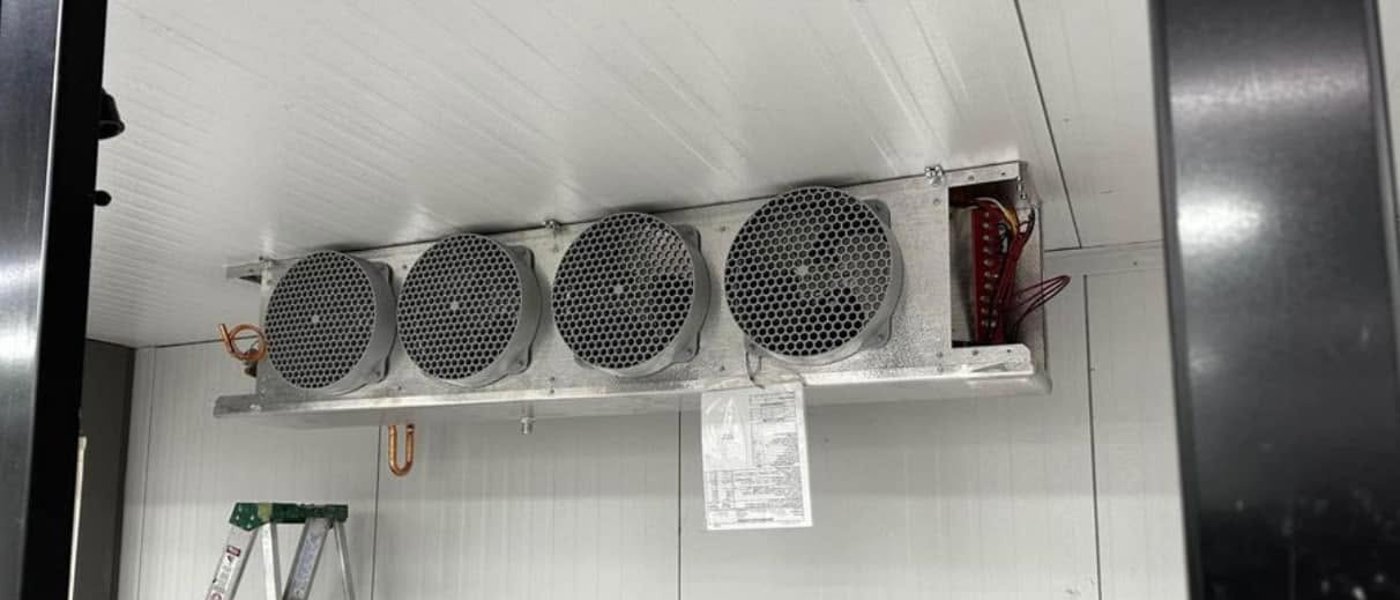
Four-fan evaporator in a walk-in freezer.
Signs a Walk-In Freezer Needs Service
- Temperature rises or recovers slowly after loading
- Frost returns within days of being cleared
- Ice restricts the coil, fan guard or drain
- An evaporator fan is noisy, slow or stopped
- The door no longer seals or closes correctly
- Water or ice appears near the drain or on the floor
- The controller reading differs from a measured thermometer
- The condensing unit runs without reaching set point
Why Low Temperature Changes the Job
At freezer temperatures every drop of water becomes ice somewhere. Drain lines need heat trace, door frames need heaters, suction lines carry heavier insulation and defrost has to end on temperature rather than on the clock. A repair that ignores those returns as the same call a month later.
How the Repair Visit Runs
- Confirm the room and equipment. Set point, load pattern and system data plates.
- Inspect the enclosure. Door, hardware, gasket, sweeps, panels and product clearance.
- Assess airflow and defrost. Frost pattern, fans, coil condition, heaters and drainage.
- Test electrical and refrigeration operation. Components and system conditions relevant to the fault.
- Prove the result. Watch a full cycle and confirm the room recovers.
- Document it. Confirmed cause, authorized work and verification readings.
Repair Scope
Depending on the diagnosis, work may involve door hardware or gaskets, fans, sensors, controllers, defrost components, drainage, an evaporator-side or condensing-side component, or another confirmed refrigeration fault. Parts and refrigerant-side work follow the identified equipment and the measured condition.
Who This Is For
Restaurants, grocery and specialty retailers, caterers, commissaries, bakeries, institutions, food production operations and other businesses that hold frozen inventory across Toronto and the GTA.
Request Walk-In Freezer Service
Tell us the room set point, current readings, defrost behaviour and what changed.
Freezer Not Holding −18?
Tell us what the room reads now and when it started.