Display refrigerator repair · Toronto & GTA

Commercial Display Refrigerator Repair in Toronto & the GTA

The front of a display case is where customers see the product.

The refrigeration system behind that presentation must also maintain suitable conditions throughout the product area, not only at the controller sensor. CooperFix repairs commercial display refrigerators for food retailers and other businesses in Toronto and the GTA. Our mechanic assesses the case design, the pattern of warming and the refrigeration components before recommending a repair. A case that is warm at one shelf, one end or one period of the day deserves a different diagnosis from a case that has lost all cooling. Request display refrigerator service through the form or call (647) 483-3777.

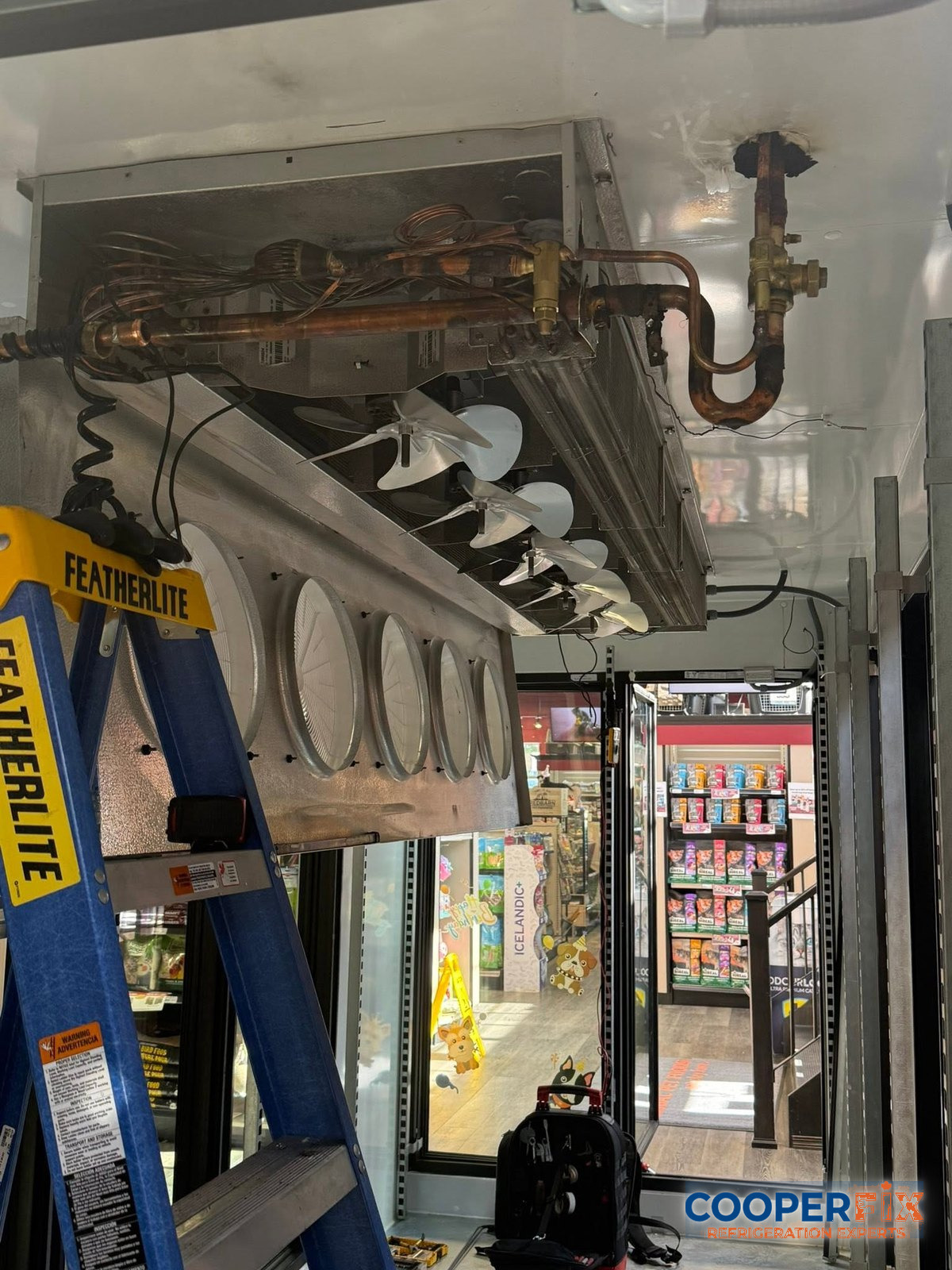
Display refrigerator evaporator opened for commercial refrigeration service
Display refrigerator refrigeration equipment under service.CooperFix · Toronto & GTA
Service request

Book Display Case Service

647-483-3777

    Please prove you are human by selecting the tree.

    CooperFix services commercial refrigeration equipment only.

    What this service covers

    Display refrigeration is a whole-case problem

    A display refrigerator is built around the relationship between the evaporator, the way air moves through the product area and the load imposed by the store. Depending on the case, cold air may be distributed through ducts and shelves, returned through a separate grille or directed across an open front. A self-contained case rejects heat at the unit; a remote case depends on a system beyond the sales floor. The thermostat or controller reading is useful, but it describes one measuring location. It cannot by itself show whether the product level at the far end of the case is receiving the same cooling.

    CooperFix diagnoses the operating case as it is installed. The mechanic considers product-level temperatures, discharge and return conditions, fan operation, evaporator condition, defrost and the refrigeration circuit. That combined view helps avoid replacing a control because one shelf is warm when the actual problem is uneven distribution. It also avoids treating a local airflow problem as a refrigerant shortage. The case’s type and layout guide which measurements are relevant.

    Cases and business settings covered

    Glass-door display refrigerators, open multideck cases, grab-and-go displays and service cases are used differently. A glass-door case may be accessed repeatedly throughout trading hours. An open case depends heavily on its designed air pattern. A service counter can have distinct product zones and a schedule driven by preparation and sales. CooperFix services the refrigeration systems of these commercial cases, including self-contained equipment and cases connected to remote condensing systems where the site configuration supports that work.

    Food retailers need usable product space, not simply a green controller display. A case that repeatedly loses one shelf affects merchandising and may require stock to move. A service business may experience a problem only during its peak operating period. A site manager may have several cases in one row but only one with a fault. The repair begins by understanding how the affected case performs relative to its own design and to adjacent equipment, rather than assuming the entire lineup needs the same work.

    This page focuses on refrigerated display cases holding food for presentation and sale. Beverage cooler repair treats bottle and drink equipment as its own category. Open refrigeration repair addresses the specific operating demands of open-front systems. The links help a business reach the most relevant service detail without collapsing every case into one generic description.

    Open and enclosed displays behave differently

    An open refrigerated display depends on a stable air path across exposed product positions, while an enclosed glass-front case has a different airflow pattern and control response. CooperFix identifies the actual case construction before interpreting a warm shelf or uneven product temperature. That first distinction keeps the investigation focused on the equipment in front of the mechanic. It also keeps the repair page relevant to retailers with different kinds of display refrigeration on one sales floor.

    When the warming pattern identifies the right investigation

    One shelf or one end is warmer

    Uneven temperatures may follow an airflow path. A failed fan, an obstructed discharge, a partly iced evaporator or a distribution problem can leave one part of the case short of cooled air. CooperFix measures conditions at product level and compares positions across the display. The mechanic then checks the fans, coil and control sequence that serve the weak area. Where a remote system feeds several cases, the local case condition must be distinguished from a shared supply problem.

    The front of the case warms while the rear stays cooler

    The front of an open or glass-front display is exposed to the surrounding store conditions. In an open case, the designed air curtain depends on the discharge and return path working together. A reduced fan output or a return path affected by the way the case is operating can change that pattern. CooperFix assesses airflow at the case and investigates the component or refrigeration fault behind the difference. A cold rear reading does not establish that product at the front is at the intended condition.

    The case warms after defrost or at a recurring time

    A timed pattern can point toward the way the case enters and leaves defrost or how it copes with changing load. A fan that does not resume correctly, an evaporator that remains iced or a control that ends defrost at the wrong condition can delay recovery. At another time of day, higher store load can expose a condenser or remote-system capacity problem. CooperFix observes the sequence relevant to the fault before selecting a repair. The repeated time is context for professional diagnosis, not proof of one particular component.

    Merchandising load and case airflow in the service assessment

    The way a display case is used affects what a mechanic can observe during a visit. Product positions, busy trading periods and case airflow form the operating context, but none of them substitutes for professional measurements. CooperFix checks the refrigeration equipment and the air movement through the case, then relates those findings to the reported temperature pattern. The resulting recommendation addresses the faulty case or connected system rather than treating every warmer shelf as an identical repair.

    What CooperFix examines at the case

    The mechanic first identifies the case type, operating temperature and refrigeration arrangement. Product-level readings across the display show whether the loss of performance is even or localized. Air temperatures at the discharge and return help show what the case delivers and receives. Fan operation and the condition of the evaporator help explain how cooling reaches the product area. The technician compares those observations with the controller’s calls and the defrost cycle. On a self-contained unit, condensing performance can be assessed at the case; on a remote arrangement, the supply to the case also matters.

    Electrical and refrigeration measurements are made where indicated by the symptoms. A fan may have power but fail under load. A sensor may report a misleading condition that changes when the system runs. Low refrigerant feed can reduce evaporator performance, but airflow and defrost faults must be separated from it. CooperFix ties the repair to the measured cause. A temperature map is a diagnostic tool used within that service: several locations are compared over the relevant operating period. It is not a separate product or a request for the customer to take measurements.

    Controls and lighting can change the apparent fault

    A display refrigerator can show an active light and still have a refrigeration fault; a visible controller reading can also fail to describe conditions at every product position. CooperFix tests the control call, fan response and cooling operation separately. This distinction matters to a retailer deciding whether the case can remain in use while the service issue is assessed. The mechanic’s findings, not the appearance of the display alone, define the repair scope.

    Repair work follows the cause

    If a fan or its control has failed, the repair addresses that assembly and verifies that cooled air again reaches the affected zone. If defrost is the issue, the mechanic checks the relevant heater, sensor, termination or control sequence for the specific case and confirms recovery. If the refrigeration circuit is underperforming, the investigation may move to heat rejection, refrigerant feed, restrictions or a confirmed leak. Any circuit work must match the equipment and its refrigerant specification. CooperFix explains the finding before parts are replaced.

    Some cases are part of a larger lineup. The presence of adjacent warm cases can change the diagnosis from one local fault to a shared supply issue, while one warm case among normal neighbours can point toward its own controls or air distribution. The mechanic distinguishes these possibilities instead of recommending the same component for every case. If several faults are found, the work is scoped so the business understands which repair addresses each operating problem.

    CooperFix · Refrigeration Experts

    Qualified service for customer-facing display cases

    20+Years of experience
    313AMechanic
    ODP/ODSCertified
    Emergency

    Urgent display case repair requests

    If a display warms, contact CooperFix with its location. Emergency calls are received and assessed 24/7. Availability and response depend on location, workload and the repair required.

    Service request

    Request display refrigerator service

    Give CooperFix the location, case type and a short description of the problem. You may mention an obvious business effect, such as a display section taken out of use or repeated warming during trading hours. The mechanic performs the temperature and refrigeration measurements; the customer is not asked to create a map or decide which component failed. Call (647) 483-3777 or use the service form to arrange an assessment in Toronto or an approved GTA service area.

    647-483-3777

      Please prove you are human by selecting the tree.

      CooperFix services commercial refrigeration equipment only.

      Verify the product area, not only the display value

      After repair, CooperFix checks whether the affected case responds as intended. The mechanic compares the positions that were weak before the work with the case’s behaviour afterward, observes the relevant fan and control sequence, and checks how temperature is recovering under the conditions available during the visit. Where defrost caused the loss of cooling, the sequence through defrost and restart matters. Where refrigeration capacity was the problem, the mechanic confirms the circuit’s corrected operation and the direction of temperature recovery. The service account should state what was observed, rather than claim that one brief reading proves performance under every future trading load.

      A display refrigerator can appear cold at an empty shelf while product conditions differ under a working load. That is why CooperFix treats product-level conditions as part of the diagnosis and verification. The result gives the site a more useful explanation than “the controller reads correctly.” It also gives the business a clear account of whether the diagnosed defect was corrected and whether any separate problem remains.

      A display case repair within the wider site

      A display case often shares a site with walk-in storage, beverage coolers or other units. If only the case is affected, CooperFix concentrates on its distribution and refrigeration arrangement. If several systems are affected together, the mechanic considers any shared control, power or remote refrigeration relationship. The commercial refrigeration repair overview helps route multi-unit requests. A failed reach-in storage unit has a different use and repair path; its commercial fridge repair page covers that equipment.

      The business can request a repair for a present fault and discuss planned refrigeration maintenance separately for the working cases. CooperFix identifies the affected display case and the fault to be addressed. The company has 20+ Years of Experience, uses Ontario 313A licensed mechanics and backs its repair work with a 90-Day Parts & Labour Warranty under its terms. Case-specific diagnosis determines the work required.

      Questions

      Display refrigerator repair questions

      Why can one section of a display case be warm while another is cold?

      Cooling is distributed through a designed airflow path, and not every position receives the same air if part of that path or the evaporator is underperforming. A fan, defrost condition, obstruction or control issue can create a local difference. CooperFix compares product-level conditions and investigates the component serving the affected section. The pattern narrows the work but does not, on its own, prove which part needs repair.

      Does a normal controller reading mean the whole case is operating correctly?

      No single sensor describes every product position in a display refrigerator. A controller may report the condition at its probe while the front or far end of the case is warmer. CooperFix checks temperatures across relevant product locations, then relates any difference to airflow, evaporator performance and controls. The diagnosis considers the case design and actual operating cycle rather than relying only on the displayed number.

      What is a temperature map during a display case repair?

      It is a comparison of readings taken by the mechanic at relevant locations in the product area and air path. It shows whether cooling is even, localized or changing during a refrigeration or defrost cycle. CooperFix uses the result to guide the repair and to compare the affected positions afterward. The map is part of the professional service, not a separate service the business must buy or prepare.

      Can CooperFix repair both self-contained and remote display cases?

      Yes. CooperFix services self-contained display cases and cases served by remote refrigeration. The diagnostic route differs. A self-contained case has its heat-rejection equipment at the unit, while a remote case may depend on shared equipment elsewhere at the site. CooperFix identifies that arrangement before diagnosing a weak case, particularly when neighbouring cases are also affected.

      Why does a display refrigerator warm after defrost?

      Some warming during the designed defrost period can be part of normal operation, but delayed or incomplete recovery calls for service. An evaporator that remains iced, a fan that resumes at the wrong point or a control that does not manage termination correctly can reduce cooling afterward. CooperFix assesses the case’s actual sequence and repairs the confirmed fault. The answer depends on the case design and observed operating conditions.

      Is this the right page for a beverage cooler?

      This page focuses on commercial display refrigerators used to present refrigerated food. CooperFix has a separate beverage cooler repair page for drink-focused cases, including back-bar and merchandiser equipment. Some case designs overlap visually, so the equipment’s intended use and configuration guide the service request. CooperFix can confirm the most relevant page when you describe the unit.

      How does CooperFix check a case after repair?

      The mechanic revisits the positions and behaviour that were abnormal before the repair. This may involve product-level readings, airflow, fan operation, control response and the defrost sequence, depending on the fault. The check shows whether the identified problem is resolving under the conditions present during the visit. CooperFix explains the observed result and any additional issue found, without treating a single controller value as proof of every future operating condition.

      What should a business provide when requesting display refrigerator repair?

      Provide the site address, contact information, the type of case and a plain description of the disruption. Mentioning whether one case or several are affected helps CooperFix route the visit. Technical measurements, controller interpretation and identification of a failed part belong to the mechanic. Use the form or call (647) 483-3777; CooperFix will establish the diagnostic scope for the equipment.