
Commercial Freezer Repair in Richmond Hill
A commercial freezer may be highly visible in a Richmond Hill sales area or nearly invisible in a stock room, but the same standard of diagnosis applies: identify the installed cabinet, establish the failed function and explain the repair that the evidence supports. CooperFix repairs standalone commercial freezers used by businesses. A machine that still runs may not perform its intended duty; an alarm may not name the failed part.
Richmond Hill has retail and commercial activity around Yonge Street and Highway 7 as well as business parks. A display freezer may affect customer presentation; a reserve-stock cabinet may affect replenishment. CooperFix brings 20+ Years of Experience to commercial refrigeration service. Covered completed repair work is subject to the 90-Day Parts & Labour Warranty under its applicable terms. We explain findings and the freezer’s actual post-work status for the operator’s inventory decisions.

Report the affected commercial freezer clearly
Give CooperFix the Richmond Hill service address, affected equipment, observed change and contact who can provide access.
- Equipment label, make and model when safely visible
- Directions to the evaporator, condensing equipment, defrost controls and electrical disconnect and the authorized access contact
- Setpoint, compartment temperature, alarm, frost pattern, water and run time, with the time observed
Request commercial freezer service in Richmond Hill
Product handling decisions stay with the responsible site person. Include a phone number and email address for service coordination.
What a Richmond Hill Freezer Request Leads To
For a Richmond Hill freezer, say whether the affected unit is a customer-facing merchandiser, a reserve-stock cabinet or a compact tenant unit. Note the warning or temperature change; the technician determines which installed function points to the right repair.
1. Explain which cabinet is interrupting business
The business can provide its Richmond Hill address, an authorized contact, the affected freezer and the interruption. A known model is useful but not required. A public display and a reserve-stock cabinet may create different operational consequences despite a similar warning. Staff do not need to inspect wiring or interpret an error code. The opening conversation identifies the machine; technical fault finding belongs to the technician.
2. Assess the installed freezer under the relevant duty
CooperFix examines how the freezer is designed to operate and which functions are involved in the reported complaint. The professional assessment may consider its control response, electrical start and run functions, evaporator and fan operation, defrost where fitted, and the refrigeration circuit. One display value, a sound or an area of frost is not sufficient to select a component.
3. Authorize a defined repair and receive a specific status
When findings support repair, CooperFix explains the failed function, proposed work and any component or access dependency. Work proceeds with authorization. The technician then states what was completed and what response could be evaluated. A separate concern remains separate; required further work remains open. The operator decides about products and schedules under its own procedures. Freezer service does not certify stock.
The Cabinet Format Shapes the Repair Evidence
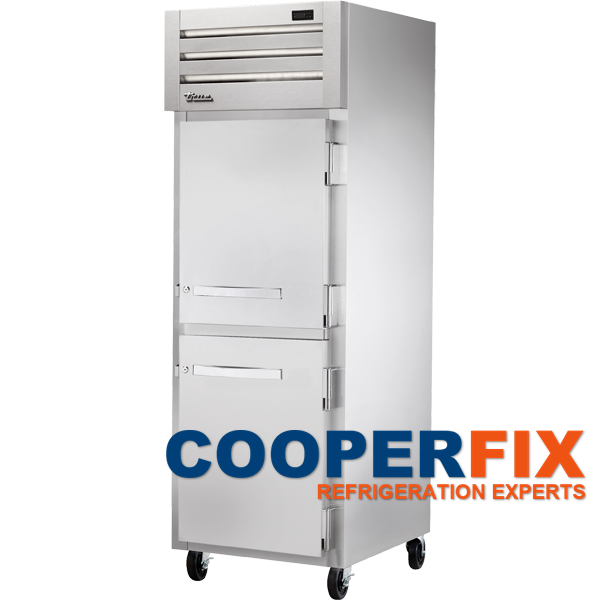
Solid-door reach-in freezer for reserve stock
A reach-in freezer used for reserve stock may have shelf areas dependent on designed fan circulation. If one area is affected, CooperFix evaluates whether air movement, control demand or refrigeration performance explains it. A door being closed does not prove the cabinet is maintaining its intended function, and a warm shelf does not by itself establish a circuit failure. The technician relates professional findings to the model’s layout and duty.
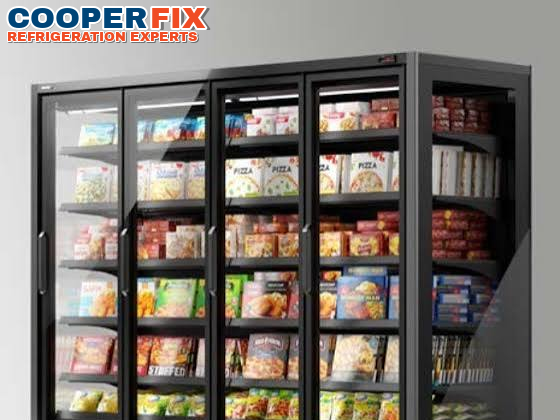
Glass-door freezer merchandiser for customer access
The merchandiser puts a freezer problem in public view. Customer access can change operating demand without establishing that the machine is defective or sound. CooperFix examines the actual cabinet, including its model-specific control, fan, defrost and refrigeration behaviour as relevant. A front display reading is a useful indication but does not establish the condition of every product position.
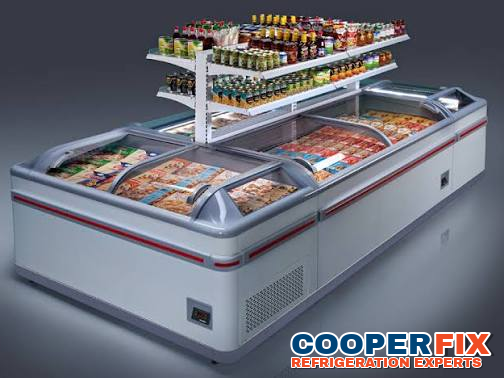
Open-top or island freezer with a different air boundary
An open-top island-style unit has a different cabinet geometry and customer interaction from an upright with doors. Its air distribution and intended load require assessment against the actual model. CooperFix does not carry a reach-in assumption across to a different freezer type. A visible difference near the top of an island cabinet may reflect normal air patterns or an equipment problem; professional examination distinguishes them.
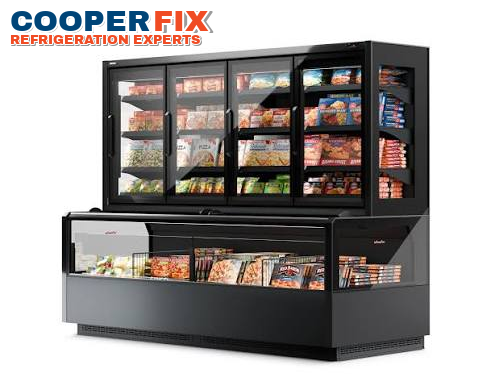
Commercial freezer in a fixed work position
A freezer assigned to a fixed work position may support a separate part of the stock plan. Identify the unit and describe the effect of its current condition. This photograph illustrates commercial freezer equipment. The installed model, access arrangement and recorded operating change guide the assessment of the actual refrigeration system.
CooperFix at Work: Separate Cabinet Appearance From Function
Frozen-looking stock, a running motor and a bright control display can each create an impression that a commercial freezer is sound. None is a complete equipment finding. CooperFix evaluates the functions relevant to the reported concern and the installed model. For a reach-in unit, the technician may need to distinguish air-distribution behaviour from the refrigeration circuit’s capacity to perform.
The technician connects the finding to repair. A failed control or electrical function is explained in those terms; a supported circuit fault changes the scope. An intermittent complaint not established during attendance remains open. A short normal interval after work is an observation, not a promise about every future period.
Keep the technician’s findings and any pending part or return visit with that unit. Do not move fixed equipment to obtain more detail.
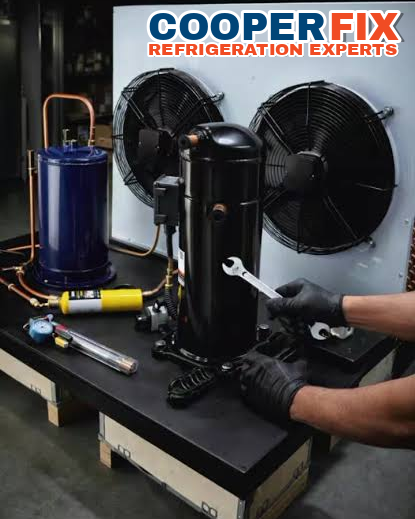
Make the complete system accessible
Identify the on-site contact and any property-management step needed to reach the full system. Point out known controls, disconnects and remote components without opening protected equipment.
Four Fault Patterns That Need Different Repairs
Equipment type, application, operating history and current findings all affect the next step for a commercial freezer.
The cabinet appears active but is not maintaining its duty
A fan or compressor sound tells CooperFix that something is operating; it does not prove sufficient freezer performance. The technician examines the controls, air movement and refrigeration circuit as appropriate to the model to determine why the intended low-temperature duty is not being met. A supported fault may involve one function or an interaction between them. The repair is not selected because the cabinet is noisy or silent alone.
One part of the cabinet behaves differently from another
An uneven result across shelves or display positions can point to airflow, control placement or another condition in the installed freezer. CooperFix examines the model’s intended air distribution and operating sequence before recommending a fan or other component repair. A single reading near one position cannot define the whole cabinet. After authorized work, the technician reports what area and function could be evaluated.
Electrical response interrupts an otherwise usable unit
A freezer may fail to start, stop unexpectedly or resume after a pause. CooperFix investigates the relevant control demand and electrical start-and-run functions rather than treating a restart as proof of repair. The fault may be upstream of a major component, within its electrical support or at the component itself. Parts are specified only for a supported failure and the actual model.
Defrost and return to low-temperature operation do not align
Where the freezer has automatic defrost, its control sequence must support the intended cabinet operation before and after that event. Frost accumulation or a post-defrost complaint does not identify a heater, sensor or controller by itself. CooperFix examines the installed arrangement and determines which function fails when evidence permits. The repair may address a supported electrical, control or refrigeration issue.
Richmond Hill Business Uses That Change the Service Conversation
A freezer merchandiser near Richmond Hill Centre customer activity
The City describes Richmond Hill Centre around Yonge Street and Highway 7 as an area already containing retail and commercial uses. If a business there depends on a visible freezer display, an equipment interruption is also a customer-presentation decision. CooperFix assesses the merchandiser and explains the work the findings support.
A stock freezer at a business-park premises
Richmond Hill’s business parks differ from public display settings. A tenant using a freezer for reserve stock may need its cabinet, fault and status identified for replenishment decisions. CooperFix evaluates that unit under its actual duty.
A multi-tenant commercial unit with a compact freezer
Some Richmond Hill business premises may have shared property contacts while the affected freezer belongs to one operator. CooperFix identifies the cabinet and confirms who can authorize its service. Restricted access around an undercounter unit can be addressed as a practical service dependency, not assumed to be the cause of failure.
A customer order schedule depending on frozen inventory
A business handling planned collections may depend on a standalone freezer even though customers never see it. An apparently short interruption can matter to the next order period. CooperFix determines what the cabinet actually does and what fault is supported, then reports whether repair was completed or remains dependent on a part or further evidence.
Separate a merchandiser warning from its repair status
A freezer merchandiser near customer activity can appear active while an alert remains unexplained. Note the cabinet, indication and observed stock-area change. CooperFix reports whether the warning led to a supported repair, a further assessment or an open issue; the operator handles display decisions.
Make stock-freezer dependencies explicit
At a business-park premises, identify the reserve cabinet and any access or part dependency. The technician reports the freezer’s known condition and proposed work. The business plans delivery and stock handling from that status, without assuming repair by a particular arrival time.
Reach the correct compact freezer in a multi-tenant unit
Give the technician the tenant location, affected cabinet and authorized contact. A compact freezer’s position may affect access, but it does not establish the fault. The service account should keep this operator’s equipment distinct from neighbouring tenants’ units and state what work can proceed.
Avoid a fixed-time promise for customer orders
When frozen inventory supports scheduled orders, the operator needs an honest equipment status rather than a predicted finish. CooperFix identifies the repair, any outstanding dependency and the operation observed after authorized work. The business makes commitments and product decisions under its own procedures.
Richmond Hill Commercial Freezer Repair: Frequently Asked Questions
These answers explain what to report and how access is planned. The installed system still requires an on-site assessment.
Which commercial freezers does this page address?
It addresses standalone commercial freezer cabinets, including business storage units and customer-facing merchandisers. CooperFix assesses the installed model and the fault affecting its operation. A compact undercounter cabinet and a larger display unit can require different access and component decisions; one generic diagnosis does not cover both. This page does not replace a professional examination of the actual machine.
Why can a freezer still need repair when it appears to run?
Operation of one component does not prove the cabinet is meeting its intended low-temperature duty. The problem may involve control response, air movement, the electrical path or refrigeration performance, depending on the model. CooperFix assesses the relevant functions and explains what findings support a repair. A sound or display value alone is not a whole-cabinet conclusion.
Does frost always mean the defrost component has failed?
No. Frost can arise in more than one operating condition, and its location or timing requires professional interpretation. CooperFix examines the installed freezer’s defrost arrangement, fan and control relationships, and the refrigeration system as relevant. A replacement is proposed only when the fault is supported. If the specific transition associated with the complaint cannot be observed, the technician states that limit.
Can CooperFix assess an intermittent freezer complaint?
Yes, an intermittent concern can be assessed, but it is not always possible to reproduce every reported event during one attendance. CooperFix evaluates the model and available evidence, explains what was established and identifies any remaining diagnostic dependency. A freezer that runs for a short interval is not automatically declared sound. The business is not assigned a series of technical tests in place of professional service.
Will you work on a freezer located in a shared commercial property?
CooperFix can discuss service for the identified commercial freezer at a Richmond Hill business premises. Access and authorization need to be clear where property and operator contacts differ. The technician assesses the machine itself and explains the work that requires approval. A neighbouring unit or shared address does not make another operator’s equipment part of the scope. If access prevents a complete assessment, that is recorded.
What happens if the repair needs a part or further assessment?
CooperFix explains the supported fault, the part or further technical work required and which elements are not yet complete. The operator can make its own business decisions from that status. No fixed completion time is promised because the required work depends on the installed model, findings, availability and authorization. A pending dependency is not represented as a finished repair.
How does the 90-Day Parts & Labour Warranty relate to freezer repair?
The 90-Day Parts & Labour Warranty applies to covered completed CooperFix repair work under its applicable terms. It is not a blanket promise about every component in a freezer or the condition of stored products. The technician’s account identifies what work was completed and whether a separate concern remains open. If a different fault appears, it needs its own assessment.
Request Richmond Hill Commercial Freezer Service
Call CooperFix with the Richmond Hill service address, affected unit and contact who can provide access.
Emergency calls are received and assessed 24/7. Availability and response depend on location, workload and the repair required.
Send the Richmond Hill service details
Identify the on-site contact and any property-management step needed to reach the full system.