
Walk-In Freezer Repair in Thornhill
A walk-in freezer depends on a refrigeration circuit and control sequence that connect equipment in different places. The storage space may be where a Thornhill business notices a problem, yet the supported repair could be at the condensing unit, refrigerant feed, evaporator or controls. CooperFix repairs walk-in freezer refrigeration systems by identifying the installed arrangement and tracing the relevant functions professionally.
Thornhill extends along both sides of Yonge Street across the municipal boundary, as municipal planning material describes it. An exact address helps coordinate a service request; the refrigeration equipment determines the technical work. CooperFix draws on 20+ Years of Experience when tracing the serving circuit from controls to condensing unit and evaporator. Covered completed CooperFix repair work is subject to the 90-Day Parts & Labour Warranty under its applicable terms.

Report the affected refrigeration system serving the walk-in freezer clearly
Give CooperFix the Thornhill service address, affected equipment, observed change and contact who can provide access.
- Equipment label, make and model when safely visible
- Directions to the evaporator, condensing equipment, controls, refrigeration lines and electrical disconnect and the authorized access contact
- Room temperature, controller alarm, ice pattern, water, fan sound and run time, with the time observed
Request walk-in freezer service in Thornhill
A photograph is useful only when it can be taken safely. Include a phone number and email address for service coordination.
Trace the Serving Refrigeration Circuit Before Defining Work
For a Thornhill walk-in freezer, identify the room and access to its condensing unit, refrigerant line set, evaporator and controls. CooperFix follows the serving circuit rather than assuming an alarm or stock interruption points to one component.
1. Identify the walk-in freezer and its serving equipment
CooperFix confirms the Thornhill site, the affected frozen-storage space and a business contact authorized to discuss service. The technician identifies the condensing equipment, evaporator and controls that belong to that walk-in freezer. The operator can describe the interruption and arrange access without mapping refrigerant lines or performing measurements. If more than one storage system exists at the address, the request remains attached to the correct one.
2. Separate control demand from circuit performance
The technician assesses whether controls call for refrigeration and how the condensing unit, refrigerant circuit and evaporator respond. Electrical functions, protective devices, refrigerant metering, air movement and defrost operation can be relevant according to the installed design and complaint. CooperFix traces the supported cause rather than treating an alarm label or a running compressor as a complete explanation.
3. Authorize the scope and describe the result
CooperFix explains the repair supported by its findings and obtains authorization for the refrigeration-system work. After repair, the technician evaluates the relevant operating response and reports what can be demonstrated. A compatible component, remote-equipment access or further assessment may remain necessary; the business receives that status rather than an assumed completion. The operator decides how to manage inventory and business commitments.
Four Parts of the Walk-In Freezer Refrigeration Path
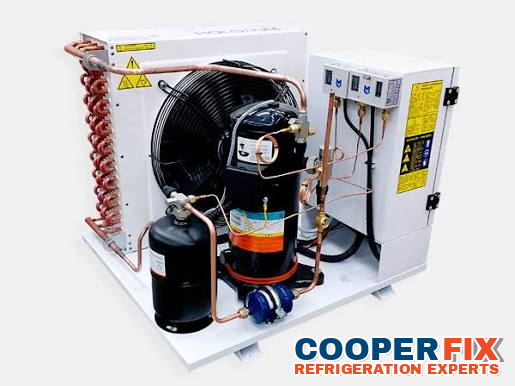
Condensing unit and compressor
The condensing unit supports the refrigerant circuit and may be located away from the frozen-storage space. CooperFix assesses its electrical, control and refrigeration response in relation to the complaint. A compressor that runs does not prove that the circuit is performing as intended, while a stopped unit does not prove compressor failure. The technician identifies the supported fault and the scope of repair.
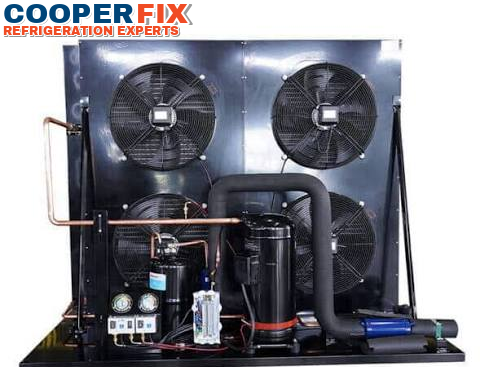
Refrigerant line set and metering function
The circuit between condensing equipment and the evaporator carries refrigerant under the system’s operating conditions. Metering components influence the feed into the evaporator. CooperFix examines this path professionally when the evidence points to it. Inadequate frozen duty can have several causes; it does not automatically prove a leak or a defective valve.
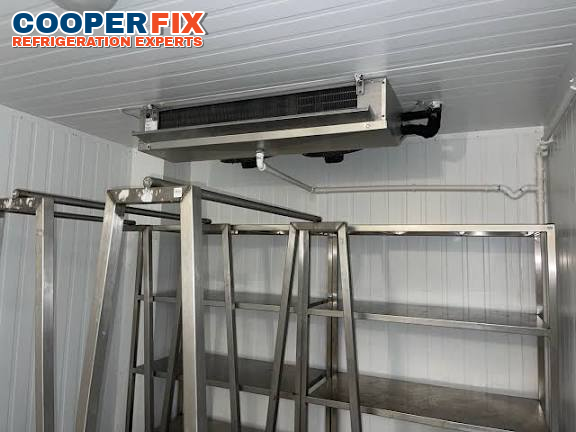
Evaporator and air movement
The evaporator transfers refrigeration effect into the walk-in freezer, with fans distributing air through the storage space. CooperFix evaluates refrigerant feed, fan operation and relevant controls in their installed relationship. Frost or uneven storage effects can identify an area to investigate but cannot alone name the failed part. The technician determines whether a local evaporator function or wider circuit condition is supported.
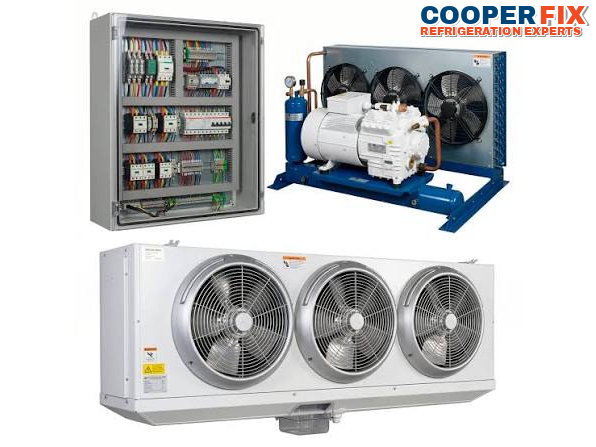
Controls, sensors and defrost functions
Controls determine when refrigeration is demanded and how the system moves through defrost where fitted. Sensors and electrical components affect those decisions. CooperFix assesses the installed sequence when a displayed value, alarm or operating change is part of the complaint. One reading cannot represent every part of the refrigeration circuit. The technician explains a supported control or defrost fault and the response demonstrated after work.
CooperFix at Work: Follow the Fault Across the Circuit
CooperFix begins with the serving equipment and traces the relationship between a control call, condensing-unit operation, refrigerant feed and evaporator response. A fault affecting frozen storage can appear at a different location from its cause. If the system runs without adequate duty, the technician investigates circuit and air movement functions rather than assuming a specific leak.
The Thornhill walk-in record connects the supported fault to its place in the refrigeration path. After authorized work, CooperFix reports the control, condensing or evaporator response observed and states any system condition that remains unverified.
Preserve a separate history for each refrigeration system at the address. Product handling decisions stay with the responsible site person.
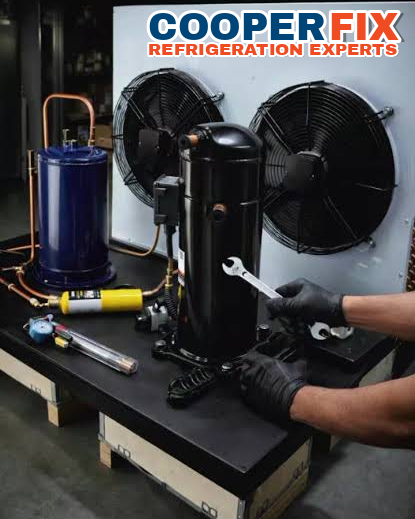
Make the complete system accessible
Name the contact who can provide entry to equipment, electrical disconnects and remote components. Point out known controls, disconnects and remote components without opening protected equipment.
Different System Faults Behind Similar Storage Effects
Equipment type, application, operating history and current findings all affect the next step for a refrigeration system serving the walk-in freezer.
The unit receives a call but fails to start
When the control sequence calls for refrigeration but condensing equipment does not respond as intended, CooperFix assesses electrical supply at the equipment, control and protective functions, and component response. A silent unit is not necessarily a failed compressor. The technician determines which finding supports repair and explains how the relevant response will be assessed after work. The operator receives a specific scope tied to the actual system rather than a generic replacement decision.
The compressor runs without sufficient refrigerant feed
An operating compressor does not prove that the evaporator is receiving refrigerant as designed. CooperFix evaluates the circuit, metering arrangement, controls and installed conditions when the evidence points there. Capacity loss may have more than one possible cause, and the technician avoids naming a leak or valve fault without support. The proposed work addresses the established function.
Refrigerant feed is present but air delivery is poor
If the evaporator receives feed yet the storage space does not experience the intended air movement, CooperFix examines the installed fans, controls and defrost interaction. The technician determines whether a local electrical or air-moving fault is supported or whether the circuit still requires assessment. A symptom in one storage area cannot prove the condition of every component.
Control or defrost transitions interrupt frozen duty
The system may move through defrost or protective operation and fail to resume refrigeration as intended. CooperFix traces the installed control sequence, relevant sensors and electrical functions. A displayed alarm may guide assessment, but it does not select a part. The technician explains the supported failure and the authorized repair, then states whether the relevant transition could be demonstrated afterward.
Thornhill Business Reasons for a Precise System Finding
Several frozen product groups depend on one circuit
Thornhill has established business activity along Yonge Street and Centre Street. A business there may keep several frozen product groups in one walk-in freezer. A refrigeration-circuit concern can therefore affect more than one internal stock plan, while still requiring one precise technical assessment.
An alarm must be linked to the correct serving system
Where a premises has more than one refrigeration system, a control indication needs to be associated with the equipment that serves the affected walk-in freezer. CooperFix identifies the condensing unit, evaporator and controls involved before attributing the storage effect to a component.
A major component proposal needs a supported scope
Replacing a condensing unit, evaporator or important control is a consequential business decision. CooperFix first identifies which refrigeration function has actually failed and what repair the evidence supports. A storage symptom or alarm alone is not enough to justify a major component recommendation.
A compatible component is needed before work can close
A supported circuit or control fault may require a compatible component that is not immediately available at the site. CooperFix explains the technical finding, the work authorized and the dependency that remains. The operator can then make its own stock and scheduling decisions using an honest open equipment status.
Relate several product groups to one circuit
Different frozen product groups may depend on the same walk-in freezer system. The operator decides how to handle each group, while CooperFix identifies the serving circuit and supported fault. The service account names the system function assessed rather than inventing a separate machine problem for every stock category.
Trace an alarm to the correct walk-in system
At a site with neighbouring refrigeration equipment, note the alarm source and affected freezer room. A nearby unit’s condition cannot be inferred from one signal. CooperFix connects the finding and authorization to the serving system so later service conversations remain precise.
Support a major component proposal with evidence
A proposed compressor or other major component repair needs a finding tied to the installed refrigeration circuit. The technician explains the scope and any part dependency before authorization. After work, the record should describe the system response actually demonstrated, not a broader assumed outcome.
Keep an ordered component distinct from completed work
Identifying a compatible component does not mean the walk-in freezer has been repaired. State whether a part is required and what operation remains untested. When authorized work proceeds, CooperFix reports the response observed afterward so the system history stays continuous.
Thornhill Walk-In Freezer Repair: Frequently Asked Questions
These answers explain what to report and how access is planned. The installed system still requires an on-site assessment.
What walk-in freezer work does CooperFix provide in Thornhill?
CooperFix repairs the refrigeration system serving a walk-in freezer. Depending on the installed design and fault, professional work may involve the condensing unit, refrigerant circuit, evaporator, defrost arrangement or controls. The technician identifies the actual system and explains a repair supported by findings. The operator can describe the storage interruption and provide an authorized contact without selecting a part. The service account states the defined refrigeration-system scope.
Can the condensing unit run while the freezer underperforms?
Yes. Compressor activity is one element of a connected refrigeration process. CooperFix assesses control demand, refrigerant flow, evaporator response and air movement as relevant to the complaint. A running unit does not prove full frozen duty, and an underperforming room does not by itself name the failed component. The technician explains what evidence supports repair and any limitation in demonstrating the result. Product decisions remain with the operator.
Does low performance always indicate a refrigerant leak?
No. Controls, electrical response, metering, evaporator function, air movement and defrost can each affect performance. CooperFix evaluates the installed circuit professionally and names a leak only if the evidence supports that finding. An unverified assumption could lead to the wrong work. The repair proposal identifies the actual supported condition and the necessary scope; the handoff states what response could be assessed afterward.
Why does CooperFix identify the equipment serving the space?
A condensing unit, evaporator and controls may be physically separate, and a premises can have more than one refrigeration system. CooperFix connects the reported storage space to its serving equipment so diagnosis, authorization and any repair belong to the correct system. A symptom near one component is not necessarily caused there. The business can identify the affected walk-in freezer; the technician determines the equipment relationship and technical cause.
Can a control alarm define the repair on its own?
No. An alarm comes from a particular control and sensor arrangement and requires interpretation with the system’s operating response. CooperFix assesses what the controller commands and how the condensing unit, circuit and evaporator respond. The technician distinguishes a supported fault from an indication that only narrows the investigation. Staff do not need to decode an alarm or reset equipment repeatedly to make a professional service request.
How can a Thornhill business request emergency walk-in service?
Contact CooperFix with the exact Thornhill address, the affected walk-in freezer and a business contact authorized to discuss work. Describe the storage interruption in ordinary terms and identify practical access needs. CooperFix assesses the installed refrigeration system and communicates the supported scope or any remaining dependency. Technical measurements are the technician’s responsibility.
What does the 90-Day Parts & Labour Warranty apply to?
The 90-Day Parts & Labour Warranty applies to covered completed CooperFix repair work under its applicable terms. It does not automatically cover every refrigeration component, stored goods or an unrelated later fault. The service record identifies the work completed and any condition still open. A separate later concern requires its own assessment. CooperFix explains coverage in relation to the authorized repair rather than making a blanket statement about the complete system’s future operation.
Is walk-in freezer service available to Thornhill businesses?
CooperFix accepts walk-in freezer requests from businesses in Thornhill. Explain the effect on frozen inventory, storage access, production scheduling or business continuity; confirm the building, suite and internal equipment location at the start of the request. A repair is confirmed only after the installed equipment is assessed.
Request Walk-In Freezer Refrigeration-System Repair in Thornhill
Call CooperFix with the Thornhill service address, affected unit and contact who can provide access.
Emergency calls are received and assessed 24/7. Availability and response depend on location, workload and the repair required.
Send the Thornhill service details
Name the contact who can provide entry to equipment, electrical disconnects and remote components.