
Walk-In Freezer Refrigeration Repair in Vaughan
A Vaughan business may face an isolated walk-in freezer fault while every other system operates normally. It may also face a wider interruption after which the walk-in appears to recover while its own fault remains. CooperFix repairs the refrigeration system serving commercial walk-in freezers by isolating the present fault, defining authorized work and reporting the demonstrated result.
This distinction matters wherever frozen inventory supports a business decision. A manager may need to know whether the affected walk-in has an equipment fault, whether an authorized repair restored a specific function and what remains unproven. CooperFix provides professional assessment and repair of the installed refrigeration system, including relevant controls, electrical components, evaporator equipment, condensing equipment and refrigerant circuit when findings call for them.

Report the affected refrigeration system serving the walk-in freezer clearly
Give CooperFix the Vaughan service address, affected equipment, observed change and contact who can provide access.
- Directions to the evaporator, condensing equipment, controls, refrigeration lines and electrical disconnect and the authorized access contact
- Room temperature, controller alarm, ice pattern, water, fan sound and run time, with the time observed
- Equipment label, make and model when safely visible
Request walk-in freezer service in Vaughan
The request should not name a failed part unless a technician has confirmed it. Include a phone number and email address for service coordination.
From a Service Concern to a Walk-In-Specific Decision
A Vaughan walk-in report should identify the freezer system and what remained abnormal after any shared site interruption. CooperFix examines its present control and equipment response before connecting the complaint to a repairable system finding.
1. Define the affected system without assigning the fault
CooperFix begins with the Vaughan location, affected freezer and authorized contact. The walk-in may be the only affected system; an outage, protective stop or alarm may also be reported. None identifies a failed item. The business can provide access details without testing equipment. The technician establishes the walk-in refrigeration system’s boundaries and treats any known site event as context.
2. Isolate the present refrigeration-system fault
The technician examines the installed system’s current response. That may involve control demand, electrical path, protective devices, compressor, evaporator fans, defrost and refrigeration performance as evidence requires. This establishes where expected response stops or becomes inadequate; it is not a replacement list. After a shared interruption, CooperFix distinguishes normal restart behavior from a persisting fault.
3. Authorize supported work and qualify the outcome
CooperFix explains a supported repair for authorization. Completed work is evaluated against the specific failure it was meant to correct. Restored electrical response, compressor operation or evaporator activity can be documented, but each is narrower than sustained frozen-storage duty. If a second issue appears, it receives its own scope and decision. The handoff gives the business an honest basis for operating decisions without promising a recovery time.
Equipment Evidence Across the Walk-In’s Operating States
Local protection and switching for the walk-in system
The installed refrigeration equipment has switching and protective components. After an interruption, a contactor, control relay or protective device may explain why operation does not resume. CooperFix checks electrical response against the expected command. A protective stop may reveal a deeper refrigeration or motor condition, not simply a device to reset. The repair addresses the confirmed cause, not the most visible stopped component.
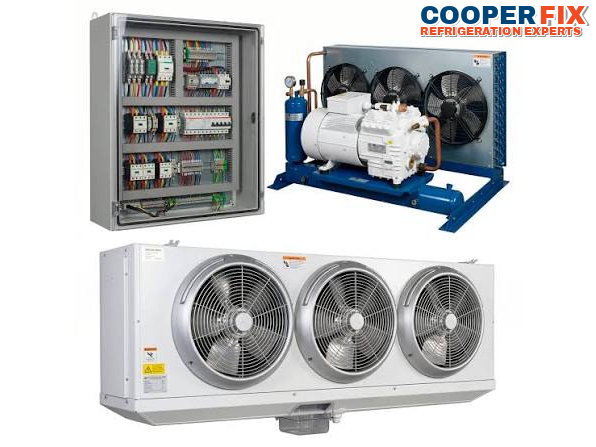
The control state that survives or changes
Walk-in controls can retain an alarm, move into defrost or resume a scheduled state after an interruption. A displayed value is useful but does not prove which component failed. CooperFix relates control state to actual system response. A cleared alarm may coexist with a persistent fault; a retained alert needs interpretation against current operation.
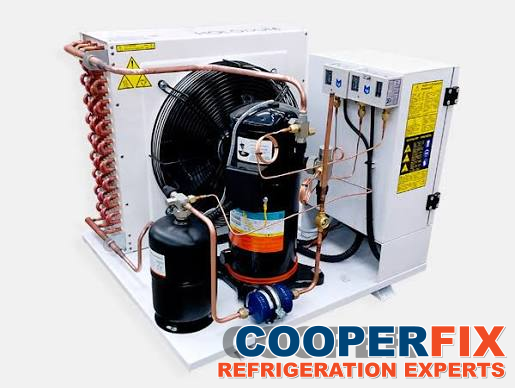
Condensing equipment during renewed demand
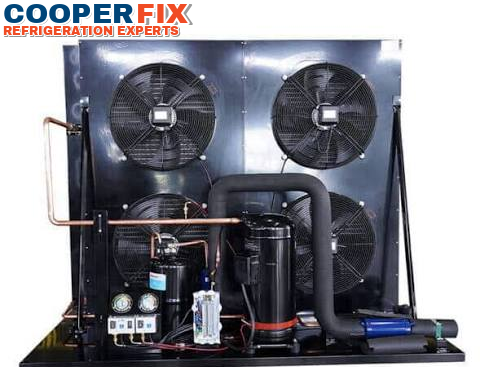
Condensing equipment must respond when the walk-in calls for refrigeration. A unit that restarts briefly and stops presents a different question from one that never receives demand. CooperFix considers its observed operation and protective response before defining work. Motor behavior, supply to the equipment and refrigeration conditions can all matter; sound alone does not establish performance. Remote equipment must be considered with the room-side effect.
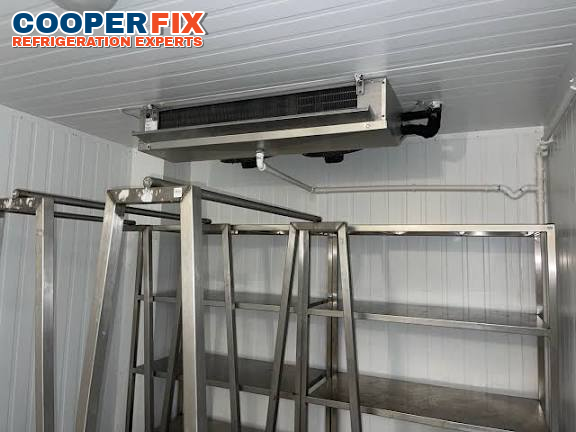
Evaporator and defrost functions during return to duty
The evaporator and fans must contribute to freezer operation after the system resumes. Defrost, where fitted, is part of that sequence. CooperFix evaluates whether the return to refrigeration is consistent with installed controls and equipment. A room may remain above its intended condition while components operate. Thus a corrected switching fault or audible fan does not prove that the system can maintain frozen-storage duty.
CooperFix at Work: Isolate the Fault That Persists
When site activity resumes but the walk-in remains abnormal, CooperFix does not assume the earlier interruption is its cause or has cleared completely from its equipment. The technician establishes present operation and follows control and equipment response. This avoids replacing a sound component because it was off during a wider event, or overlooking a persistent freezer fault because other systems restarted.
The repair record should identify the actual walk-in system, the finding supporting the authorized work and the response observed afterward. If the system cannot be observed through enough of its operation to support a wider conclusion, CooperFix reports that limit.
Maintain a unit-by-unit log when more than one refrigeration unit is involved. The business is not expected to perform technical tests.
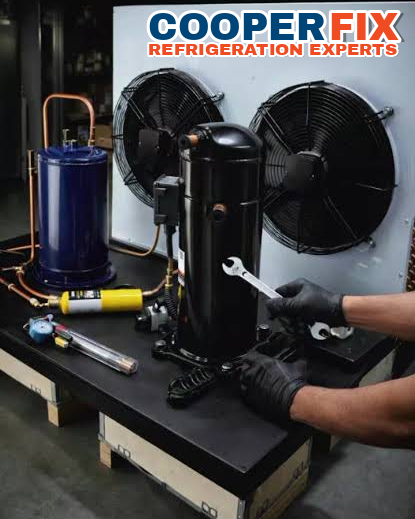
Make the complete system accessible
Coordinate the service entrance, roof or locked-area access with the responsible facility contact. Point out known controls, disconnects and remote components without opening protected equipment.
Four Evidence Questions That Define the Repair Scope
Equipment type, application, operating history and current findings all affect the next step for a refrigeration system serving the walk-in freezer.
Is there a current fault after the shared event has ended?
The first service question is whether the walk-in still has a fault of its own. A business may report several affected systems after an interruption, yet the freezer alone may fail to resume expected operation. CooperFix examines the walk-in’s present control, protection and equipment response to find a supported cause. If professional findings identify a failed walk-in component, repair can be proposed for that item.
Does a protective action point to another underlying condition?
A protective device may interrupt operation to prevent further damage. Treating the device itself as the entire repair can leave the real cause untouched. CooperFix assesses the relevant motor, electrical and refrigeration conditions as appropriate to the equipment and complaint. A supported repair may involve the protection circuit, but it may instead involve the condition that repeatedly causes it to operate.
Are two abnormal findings related or independent?
The technician may find that an electrical fault and a performance problem coexist. One could cause the other, or they could be separate. CooperFix evaluates their relationship before presenting a repair scope. For instance, restoring a control command may allow the system to run, revealing a separate limitation in refrigeration performance that could not be observed earlier.
What level of operating result is actually established?
The final service question concerns evidence, not optimism. An authorized component repair can often be checked immediately at the component or circuit level. Continued room-level performance may require an operating period or further evidence that is not available during the same attendance. CooperFix states what the system demonstrated, what remains uncertain and whether a further service decision is warranted.
Vaughan Business Situations Where Attribution Matters
A managed location in Vaughan Metropolitan Centre
Vaughan Metropolitan Centre is the city’s downtown core, with businesses and residences in a growing urban setting. At a managed premises there, a walk-in freezer request can involve both an operating business and property personnel who control equipment-area access. CooperFix needs the correct site contact and repair authority, especially if the condensing equipment is not beside the room.
A larger operation with multiple critical systems
Where a Vaughan operator has several systems affecting inventory and work schedules, a shared interruption can produce several alerts at once. The walk-in freezer still warrants an equipment-specific assessment. CooperFix defines which observations belong to its refrigeration system and which are merely part of the wider service history.
A property with separate access and decision authority
The staff member who notices a freezer concern may not be the person who can approve repair or provide access to the condensing equipment. CooperFix can receive the report, identify the affected walk-in and coordinate with an authorized site contact. The customer is not asked to gather electrical measurements or interpret alarms.
A freezer complaint that returns after operations resume
An issue noticed after the site returns to normal activity may be a persistent fault, a separate fault or an intermittent condition. CooperFix approaches the current walk-in response as new evidence rather than assuming that a previous event explains everything. Available service history can inform the investigation but cannot replace present findings.
Separate a building event from the walk-in fault
At a managed Vaughan Metropolitan Centre site, note any shared interruption and the subsequent freezer complaint. CooperFix determines whether a current fault remains in the serving refrigeration system. The location or building event alone cannot establish a cause or promise a response time.
Identify the affected system among critical equipment
A larger operation may run several important refrigeration systems. Name the walk-in freezer and its serving equipment, then keep its finding distinct from other systems. A precise scope helps the authorized contact decide what repair belongs to this request and communicate its status.
Route findings through the correct property contacts
Where a property contact controls equipment access and the business approves the repair, identify both roles. The technician explains the supported work before authorization. The final account should reach the operator responsible for the freezer rather than disappear into a general work order.
Report a recurring complaint without inventing a cause
A walk-in freezer complaint may return after operations resume but not recur during attendance. CooperFix should state what was observed, tested and still uncertain. That distinction supports a later service decision without an unsupported diagnosis or an unqualified assurance about future operation.
Vaughan Walk-In Freezer Refrigeration Repair: Frequently Asked Questions
These answers explain what to report and how access is planned. The installed system still requires an on-site assessment.
What does CooperFix repair on a commercial walk-in freezer?
CooperFix repairs the refrigeration system serving the walk-in freezer. The installed system may include control and electrical components, evaporator and fan equipment, condensing equipment, defrost functions and a refrigerant circuit. Professional assessment determines which of those functions is relevant to the reported fault.
Can a wider interruption hide a separate walk-in freezer fault?
Yes. Several systems may stop during one site event, but they do not necessarily return to proper operation together. A walk-in can retain a control, electrical or refrigeration fault after other equipment resumes. CooperFix assesses the walk-in’s present response and distinguishes what is demonstrated within that system from the wider history of the premises.
Does an alarm or a protective trip identify the repair?
No. An alarm reports a condition; a protective action shows that operation was interrupted for a reason that still needs assessment. Neither is a reliable instruction to replace one named part. CooperFix examines the relevant control, electrical and refrigeration conditions and determines whether a supported fault is present. A reset or cleared display is not the same as a completed repair.
What if the walk-in starts after the technician arrives?
A restart is useful evidence, but it does not by itself resolve a reported interruption. CooperFix considers whether the system can continue the expected refrigeration sequence and whether the reported issue can be demonstrated. If no fault is reproduced, the technician should describe the observations and limits rather than invent a cause.
Can CooperFix complete one repair while another issue remains?
It can happen that correcting one proven fault makes a second condition observable. The authorized repair should be described and its result assessed on its own terms. CooperFix can then explain the separate finding and any additional work that requires authorization. A business should not be told that its entire freezer duty has been restored merely because the first failed function now operates.
How are urgent Vaughan walk-in freezer requests handled?
CooperFix can identify the affected Vaughan site, the walk-in freezer and the authorized contact when arranging service. Professional assessment determines the repair scope after the installed system is examined. The business does not need to test components or present a technical diagnosis to make the request.
What does the 90-Day Parts & Labour Warranty cover here?
The 90-Day Parts & Labour Warranty applies to eligible completed CooperFix repair work under its applicable terms. It does not turn one authorized repair into a blanket assurance about every possible fault in a connected walk-in system. The work record should identify the repaired item or function and the response observed afterward. If another condition remains unassessed or needs a separate decision, CooperFix makes that distinction clear to the business.
Is walk-in freezer service available to Vaughan businesses?
A repair is confirmed only after the installed equipment is assessed. Record, without interpreting the evaporator, fan, condensing unit, control, defrost component or refrigeration circuit and include the room temperature, controller alarm, ice pattern, water, fan sound and run time. Explain the effect on frozen inventory, storage access, production scheduling or business continuity; state the building, department and equipment position instead of relying on a broad address alone.
Request Vaughan Walk-In Freezer Refrigeration Service
Call CooperFix with the Vaughan service address, affected unit and contact who can provide access.
Emergency calls are received and assessed 24/7. Availability and response depend on location, workload and the repair required.
Send the Vaughan service details
Coordinate the service entrance, roof or locked-area access with the responsible facility contact.