Commercial Refrigeration Repair | Diagnostics | Preventive MaintenanceEmergency calls are received and assessed 24/7. Availability and response depend on location, workload and the repair required.
Commercial Refrigeration Repair | Diagnostics | Preventive MaintenanceEmergency calls are received and assessed 24/7. Availability and response depend on location, workload and the repair required.
KeepRite commercial refrigeration service
KeepRite Commercial Refrigeration Repair & Service
KeepRite refrigeration equipment can place the evaporator, condensing unit and controls in separate parts of one commercial system. CooperFix services confirmed KeepRite unit coolers, air-cooled condensing units, relevant condensers and system controls that support walk-in and larger refrigerated spaces. The service path begins by identifying the complete system, not only the component nearest to the reported change.
A temperature concern, airflow change or defrost pattern can involve the unit cooler, the condensing side, the controls, operating conditions or a connection between them. CooperFix maps the installed KeepRite equipment, measures the relevant functions and explains the work supported by the test results. A family name helps organize the assessment; it does not identify the cause by itself.
Evaporator and condensing unit mapped together The evaporator, condensing unit, controls and temperature duty remain connected in the service record.
Airflow, defrost and heat rejection assigned to their components Airflow, defrost, heat rejection and control findings are assigned to the equipment that produced them.
Circuit measurements guide the KeepRite repair recommendation Professional measurements define the work proposed for the confirmed system.
Start with the KeepRite component set
Connect the request to the affected refrigeration system
Tell us which refrigerated space is affected and identify the KeepRite evaporator, condensing unit or control when that information is available. Include a readable model number if it can be obtained safely. CooperFix maps the connected equipment before selecting the relevant tests.
Request KeepRite Service
Name the KeepRite component or the refrigerated space it serves and describe what changed; CooperFix handles system mapping, testing and repair planning.
Organize evaporators, condensing equipment and controls by circuit role
Map the evaporator and condensing side before defining the recommended work
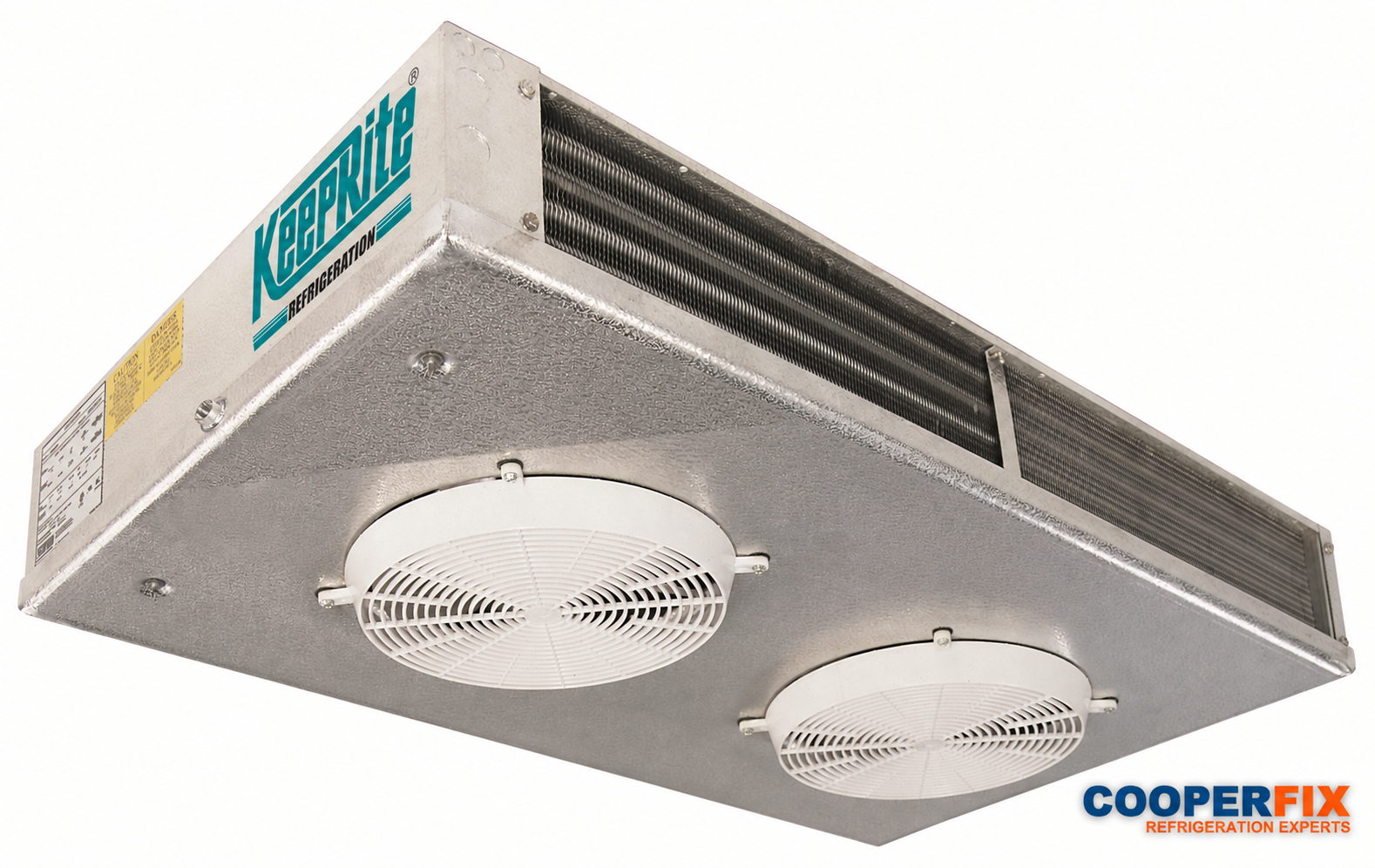
KeepRite documents several evaporator profiles and condensing-unit families for different temperature duties, air-distribution needs and capacity ranges. CooperFix separates these groups because a low-velocity evaporator, a compact low-profile unit and an outdoor scroll condensing unit do not present the same service access or operating conditions.
CooperFix evaluates the installed KeepRite components as one refrigeration system, not as interchangeable catalogue items. The technician compares nameplate data for the evaporator, condensing equipment and controls with the temperature duty, defrost arrangement and served space. Confirmed pairings guide parts research and testing; any unconfirmed connection is recorded for follow-up.
KLV low-velocity evaporators
KeepRite describes the KLV family for refrigerated spaces where low air movement, even temperatures and maintained humidity conditions matter. CooperFix confirms the installed model, temperature duty and defrost configuration before assessing coil condition, fan and motor operation, airflow distribution, sensing, controls, drainage and the refrigeration circuit serving the evaporator.
KTM two-way and KLP low-profile evaporators
The KTM family uses two-way air distribution and is documented for reach-in and walk-in cooler contexts. KLP low-profile evaporators use a compact, slim layout intended to preserve refrigerated storage space while distributing air through the coil. CooperFix records the exact family and installed orientation because discharge pattern, access, fan arrangement and defrost functions affect the assessment path.
KMP medium-profile and KEP extended-profile evaporators
KeepRite positions KMP equipment for larger walk-in applications and KEP equipment where a smaller footprint must still support longer air throw in larger refrigerated spaces. These families require model-level identification of capacity, temperature class and defrost arrangement. CooperFix does not apply a KLP service assumption to a KMP or KEP unit merely because each is an evaporator.
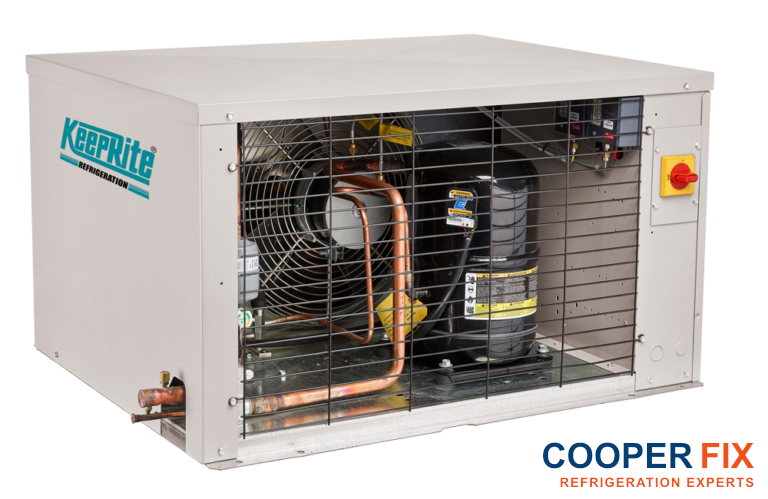
KeepRite KEH refrigeration condensing unit.
KEH, KEZ and KES condensing units
Current KeepRite references identify KEH hermetic, KEZ scroll and KES semi-hermetic air-cooled condensing-unit families. Model selection can also distinguish indoor and outdoor configurations and medium- or low-temperature duty. CooperFix confirms the installed family and paired system before assessing compressor operation, condenser airflow, controls, electrical functions, pressures, temperatures and refrigerant-circuit performance.
Condensers and relevant system controls
KeepRite also documents air-cooled condensers and refrigeration-control technologies. CooperFix services them only when the installed system confirms their presence. CooperFix records the controller model, sensor inputs and component relationships before using control behaviour as part of the test results.
The reported effect may appear away from its cause
Evaporator and condensing findings must be connected carefully
The unit cooler operates inside the refrigerated space while the condensing equipment rejects heat elsewhere in the system. Controls and piping connect their operation. A change observed at the evaporator can therefore require measurements on both sides, while a condensing-unit symptom may need comparison with airflow, load and defrost behaviour at the unit cooler.
CooperFix maps which components serve the affected space, confirms their model relationship and reviews the functions supported by that configuration. Temperatures, pressures, superheat or subcooling where applicable, fan operation, coil condition, control inputs, defrost sequence, electrical readings and refrigerant-circuit behaviour are interpreted together. The recommendation identifies the confirmed source of the condition and keeps unrelated observations separate.
Some installations use more than one evaporator or control point for a refrigerated space. CooperFix records which components operate together, whether they share condensing capacity and how their control sequence is arranged. Measurements remain attached to the correct circuit and operating stage. This prevents a local airflow observation from being mistaken for a whole-system conclusion and prevents one evaporator’s defrost behaviour from being assigned to another without separate testing.
Refrigerated spaces have different airflow and product priorities
Equipment profile matters to daily operation
A low-velocity unit may support products that benefit from gentler air movement. A low-profile evaporator may preserve usable storage height. Medium- and extended-profile equipment can support larger spaces and different air-throw needs. These distinctions affect how a business experiences a temperature or airflow change, but they do not replace technical findings.
CooperFix records the refrigerated space, equipment duty, access pattern, normal operating demand and timing of the reported change. That context helps interpret measured performance and establish service priorities while professional testing remains the basis of the work decision.
Access planning follows the installed equipment. The unit cooler may be above stored product, controls near an active doorway and condensing equipment in another service area. CooperFix coordinates safe access and any stock or workspace protection with the site. Staff can describe operating schedules, door activity and business impact, while the technician handles guards, electrical components and refrigeration tests. Those observations help plan the visit and reproduce the reported condition; testing determines the cause.
One request can include several connected components
Keep the system map and individual findings aligned
A single refrigerated space may involve a KeepRite evaporator, a separate condensing unit and dedicated controls. A larger operation may have several systems with similar housings or model families. CooperFix assigns every model, measurement and recommendation to the correct system so an observation from one circuit is not transferred to another.
If work is staged, the record distinguishes the component already assessed, the approved work, any follow-up measurement and any separate recommendation. This approach lets the business understand which refrigerated space is affected and which system decision remains open without merging unrelated conditions.
Control architecture also affects coordination. A sensor input, controller output and equipment response must be traced within the confirmed system rather than interpreted in isolation. CooperFix records the controller model and the component it commands, then compares that sequence with temperatures, airflow and refrigeration operation. If measurements justify work in more than one area, each action is described separately so approval remains clear and the post-work review can confirm the intended response.
Trace the refrigerated space through its KeepRite component set
How CooperFix maps KeepRite components to the refrigerated space they serve
01 — Record the KeepRite evaporator, condensing unit and controls
CooperFix records the KeepRite evaporator family, condensing-unit family, relevant controls, model numbers, temperature duty, defrost arrangement and the refrigerated space served by the system.
02 — Verify pairing, temperature duty and defrost arrangement
The technician maps the evaporator, condensing equipment, controls, sensors, fans, electrical feeds, drainage and accessible refrigeration circuit. Indoor or outdoor configuration and model-relevant options are verified from the installed equipment and current documentation.
03 — Compare airflow, controls and refrigeration-circuit response
Assessment can include space-temperature behaviour, coil and air temperatures, airflow, fan and motor operation, defrost sequence, drainage, control inputs and outputs, electrical readings, condenser airflow, pressures and refrigeration-circuit performance. The exact measurements follow the confirmed configuration and reported condition.
04 — Assign the work to the supported system component
CooperFix connects the test results to the affected component and the system response. A frost pattern, control indication, sound or temperature change provides useful context, but it does not determine a part or repair without professional testing.
Work remains specific to the equipment and test results
Component access does not change the need for system-level review
Depending on the findings, professional work may involve evaporator fans or motors, controls and sensors, electrical functions, defrost components, drainage, coil condition, condenser airflow, compressor operation or the refrigeration circuit. This describes assessment and work categories, not a claim that every KeepRite system needs each task.
After approved work, CooperFix retests the serviced KeepRite component and records the response in the refrigerated space. A separate fault elsewhere in the system is documented as a new recommendation and requires its own approval.
Operating load is considered when interpreting response. Door activity, product movement, evaporator airflow and defrost timing shape conditions in the space, while ambient conditions and condenser airflow affect the high side. CooperFix records that context alongside controls, electrical findings and refrigerant-circuit measurements. Context may explain when a problem appears, but it does not replace cause-finding. Work remains tied to the measured condition and confirmed component.
Keep the current circuit fault separate from planned coil or control care
Assign each decision to the evaporator, condensing unit or control involved
The immediate KeepRite repair addresses the measured fault in the mapped refrigeration circuit. Another accessible condition may be reserved for later inspection, cleaning or planned commercial refrigeration maintenance without enlarging the repair approval. Current work, future attention and added investigation remain clearly separated.
For connected equipment, the record also distinguishes component-level work from a broader system recommendation. A unit-cooler repair does not establish that condensing equipment requires replacement, and a condensing-side finding is not assigned to every evaporator served by similar equipment.
Record how the KeepRite components are paired for future service
Model, duty and paired components stay connected
CooperFix records the evaporator and condensing-unit identities, controls, temperature duty, defrost configuration, refrigerated space, reported change, measurements, approved work and post-work review. When several circuits or spaces are present, each retains a separate system map.
This history supports comparison during later service without turning a previous conclusion into a permanent assumption. Current operating readings, present equipment relationships and the new reported condition always determine the next recommendation.
The close-out record separates starting condition, authorized work, serviced component and observed response. It includes relevant temperature, airflow, defrost, control, electrical, condensing-side or refrigerant-circuit test results when those functions were included in the approved work. The result is limited to the equipment and observation window, not a guarantee of future performance. A later issue uses the baseline for comparison, but a fresh system map and new measurements still control the decision.
Which KeepRite evaporator and condensing families does CooperFix service?
CooperFix services confirmed KeepRite evaporators, unit coolers, air-cooled condensing units, relevant condensers and refrigeration controls serving walk-in and larger refrigerated spaces. The exact model families, temperature duty, defrost arrangement and system relationship determine the applicable assessment.
Why must the evaporator and condensing unit be identified together?
They perform different roles within one refrigeration system, and the effect reported at one component can depend on operation elsewhere in the circuit. CooperFix maps the paired equipment and controls so measurements, findings and recommendations remain connected to the correct refrigerated space.
How are KLV, KTM, KLP, KMP and KEP evaporators different for service planning?
KeepRite documents them as distinct profiles with different airflow patterns, space applications, temperature ranges, capacities and defrost options. CooperFix confirms the installed family and model before selecting relevant documentation, access planning and assessment points. One family’s layout is not assumed for another.
How does CooperFix track multiple KeepRite component sets on one site?
CooperFix builds a separate component map for each KeepRite system, linking its evaporator, condensing unit, controls, refrigerated space, reported condition, measurements and work decision. Similar housings or model families do not justify sharing a diagnosis between circuits, so every conclusion remains attached to the system from which its test results were collected.
Does a frost pattern or control indication identify the failed component?
No. It is recorded as part of the operating context. CooperFix evaluates the model-relevant airflow, defrost sequence, controls, sensors, fans, electrical functions, condensing operation and refrigeration-circuit measurements before explaining which condition is confirmed and what work it supports.
Which component-pairing details help prepare a KeepRite assessment?
Provide contact details and a short description of the affected refrigerated space and operating change. Include any model number that is readily available. CooperFix confirms the system components, performs technical testing and explains the proposed work from the findings.
Identify the evaporator, controls and condensing side serving the space
Begin with the refrigerated space and system that need attention
Identify the refrigerated space, the KeepRite equipment serving it and the operating change. If several circuits are involved, list them by model or served space when known. CooperFix confirms the component relationships, tests the affected system and explains the recommended repair.
Request Service for Your KeepRite Equipment
Identify the KeepRite system and describe the change in the refrigerated space; CooperFix handles component mapping, testing and professional diagnosis.
Professional service for the complete KeepRite system
Plan service around the mapped KeepRite refrigeration circuit
CooperFix maps the installed components, measures system operation and explains the work supported by professional findings.