Reach-in, prep and open-air format identified first
The model, cabinet family, door arrangement, control presentation and refrigeration-section layout are recorded before repair recommendations are made.

Norpole reach-in, undercounter, preparation, and display service
Norpole equipment can serve upright chilled or frozen storage, line-side ingredient access and open retail display. CooperFix assesses supported reach-ins, undercounter refrigerators, preparation tables, freezers and merchandisers with the service approach matched to each operating role.
The service path begins with the exact model and the job that the cabinet performs. A two-door storage reach-in should not be approached as though it were a mega-top prep table, and an open-air display has different airflow and customer-access conditions from an enclosed undercounter unit. CooperFix uses the exact model, operating context and technician measurements to prepare a supported repair recommendation.

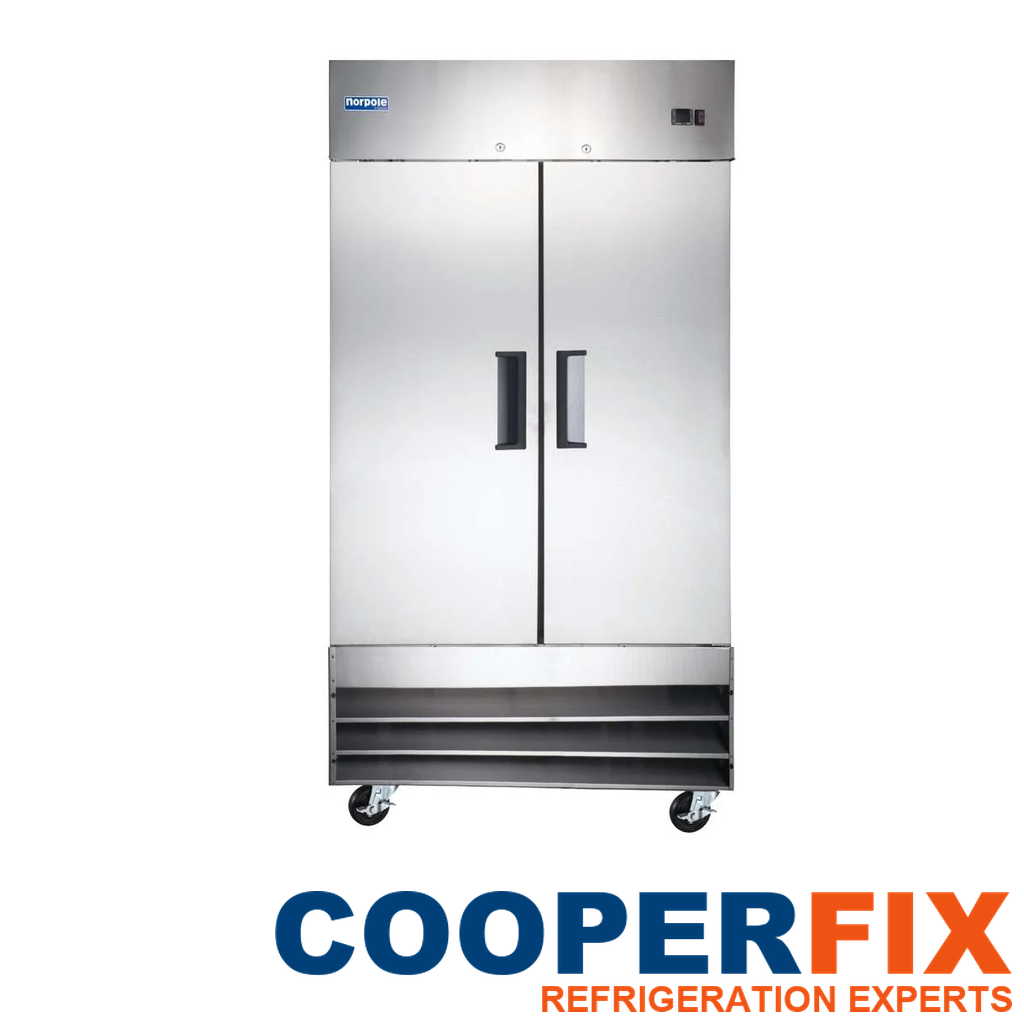
The model, cabinet family, door arrangement, control presentation and refrigeration-section layout are recorded before repair recommendations are made.
Service planning considers what the unit supports, when staff need access, which products are affected and how the work area can be approached safely.
Technician observations and measurements are separated from assumptions. Recommended work follows test results from the installed Norpole unit, not a generic symptom label.
Start with the Norpole cabinet and its access pattern
Identify the affected Norpole format and describe what changed. If its model can be copied from a normally accessible label or service record, include it without opening the cabinet. State whether the equipment supports cold storage, frozen storage, line preparation or open display. CooperFix uses those details for routing; technician findings determine the cause.
Refrigeration organized by enclosed, preparation, and open display duty
Norpole lists refrigeration in multiple commercial formats. Each format creates a different relationship among doors, drawers or open access, product load, airflow, controls and the refrigeration section. CooperFix confirms the installed model rather than treating every cabinet with a Norpole badge as the same system.
Upright reach-ins support protected refrigerated or frozen storage while staff open the cabinet throughout the workday. The Norpole NE2R is an official two-solid-door reach-in refrigerator model with a bottom-mounted refrigeration section, digital temperature control, adjustable shelving and self-closing doors. Norpole also lists freezer configurations, which require their own temperature and defrost context.
Service assessment can include cabinet temperature, pull-down and recovery behaviour, evaporator and condenser condition, fan operation, control response, door closure, defrost behaviour and refrigerant-circuit test results where applicable. These observations are interpreted together. A warm reading, frost pattern or unusual sound does not prove one cause without the rest of the system picture.
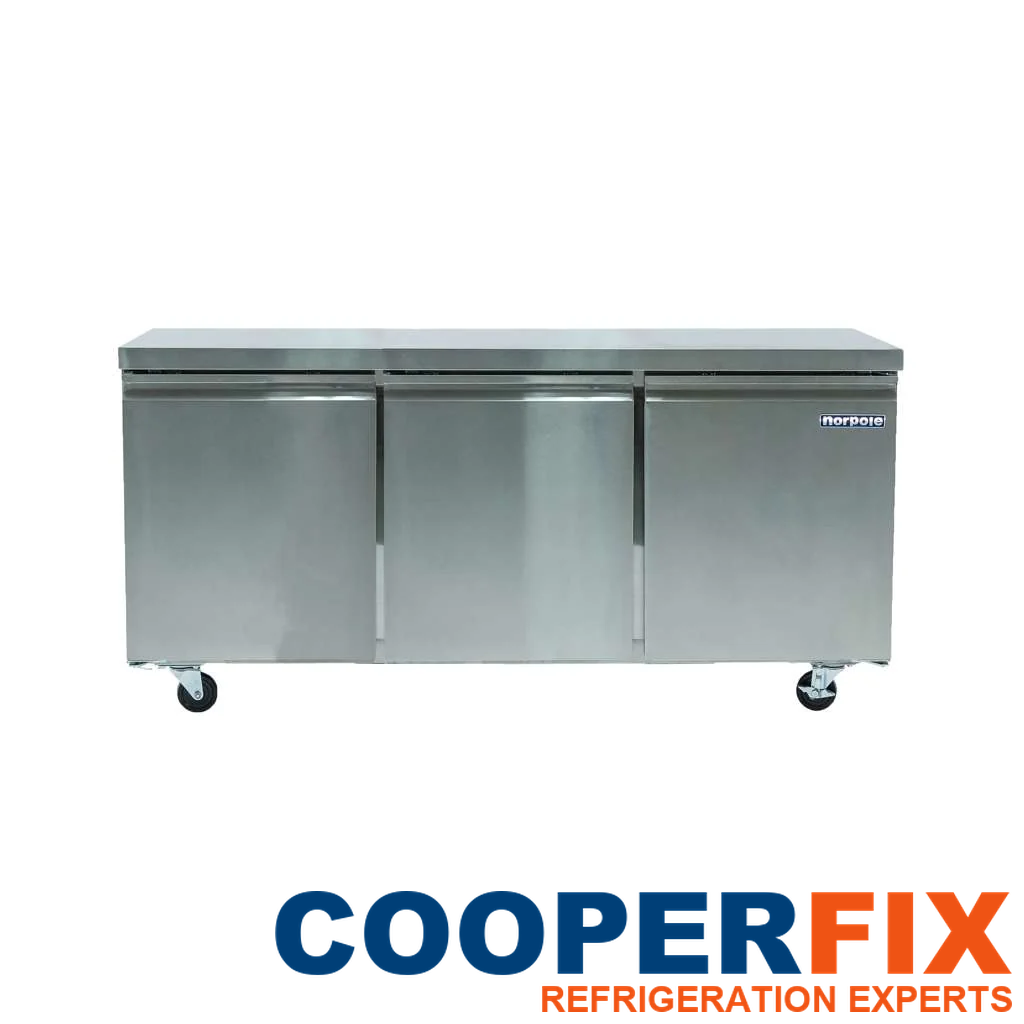
Undercounter cabinets place cold storage below a work surface and near a production position. The Norpole NP3R-72UC represents a three-door undercounter refrigerator with programmable electronic control, adjustable shelving, self-closing doors and a low horizontal cabinet format. That layout is materially different from an upright reach-in even when both units perform refrigerated storage.
Physical access, condenser airflow and surrounding equipment matter in this category. The technician records the available clearances, the refrigeration-section location, door operation, loading pattern and nearby heat or obstruction conditions. Staff are not asked to remove panels or perform technical testing; safe access and measurements remain part of professional service.
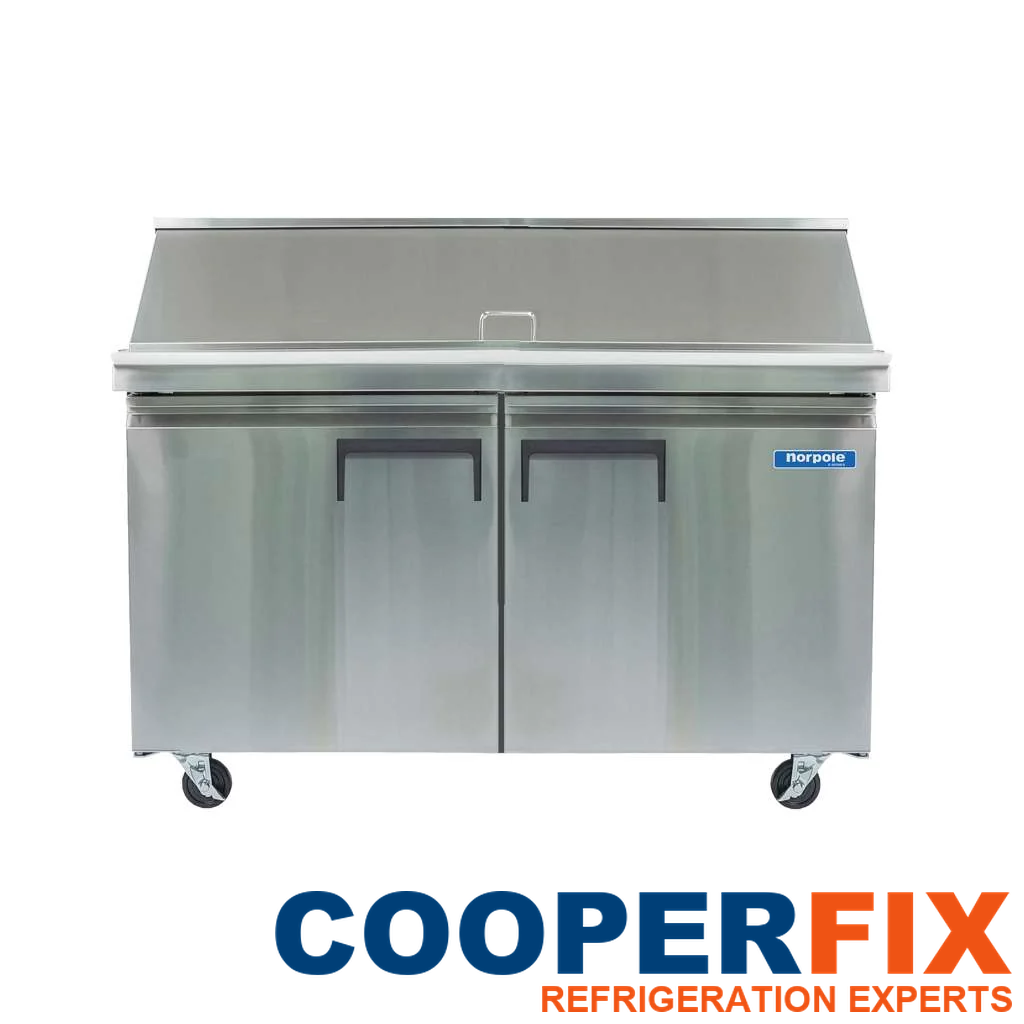
Norpole prep tables combine lower refrigerated storage with an upper ingredient rail and work surface. The NE2R-SWMT is a two-door mega-top model with a larger pan arrangement, digital control, a cutting-board work area and bottom-mounted refrigeration. Its service context includes both cabinet operation and the conditions around the upper rail.
Assessment may consider lower-cabinet temperature, rail performance, airflow, lids and doors, fans, controls, coils, drainage and the relationship between loading and recovery. The work surface and ingredient-access pattern make the unit operationally distinct from an ordinary undercounter cabinet, so findings are recorded against the correct zone of the equipment.
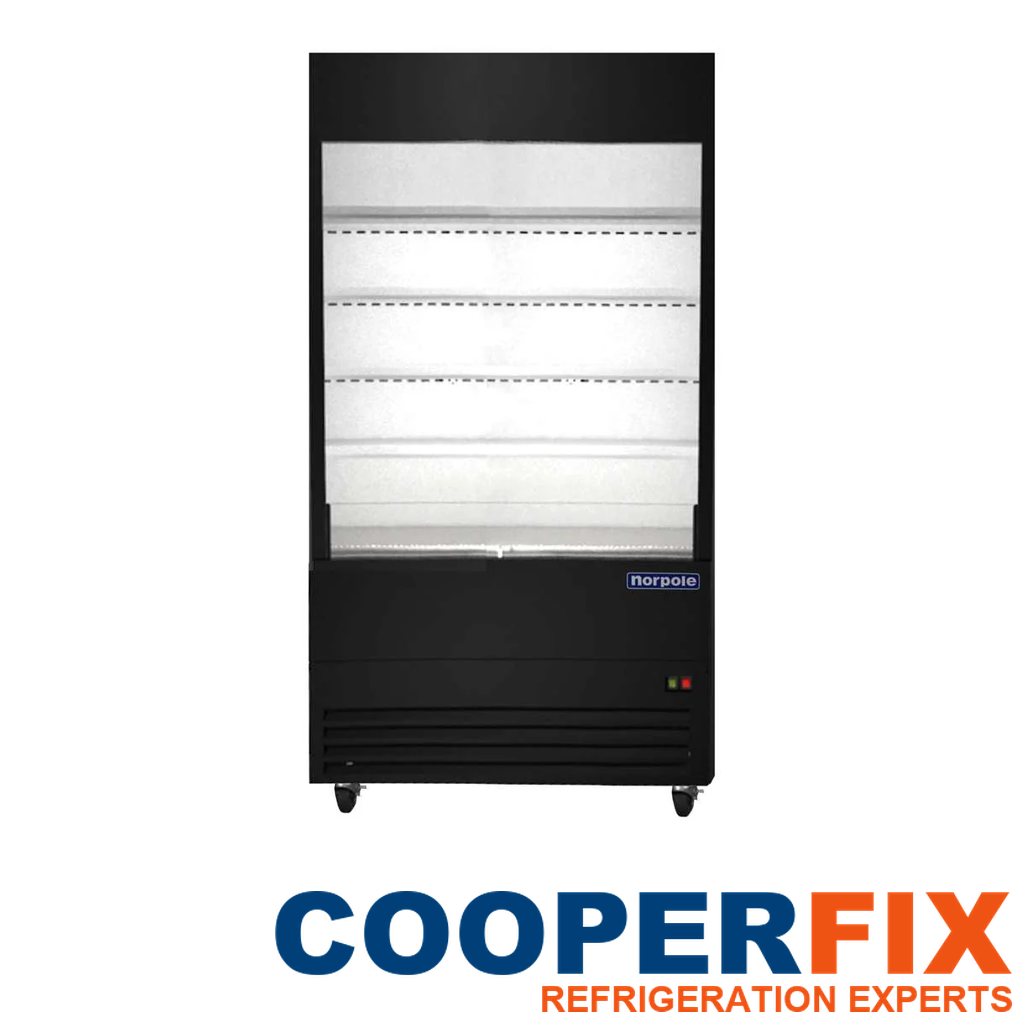
Open-air merchandisers keep displayed product accessible without a front door. The Norpole NPOA-48 is an official open-air model with LED-lit shelving, digital control, a night cover and a defined front-intake and rear-discharge airflow path. Because the product area is open, display loading and surrounding air conditions become especially important context.
Service separates refrigeration performance from lighting, shelving and presentation concerns. Air-path condition, return and discharge openings, fan operation, control response, coil condition, cabinet temperature pattern and night-cover use may all provide useful information. None should be treated as an automatic diagnosis in isolation.
Different access formats create different airflow conditions
Norpole equipment can look related while serving very different workflows. A reach-in protects bulk or staged inventory behind doors. An undercounter cabinet keeps product near one work position. A prep table combines cold storage with repeated access to an ingredient rail. An open merchandiser depends on an air curtain while customers or staff reach directly into the display.
Those differences affect what is measured and how observations are interpreted. Door closure matters directly on an enclosed cabinet; on an open merchandiser, unobstructed air paths and the display pattern become central. A prep table may require separate attention to the base and rail. An undercounter unit may have restricted service clearances that are not present around a full-height reach-in.
Model identification prevents features from migrating between families. The NE2R, NP3R-72UC, NE2R-SWMT and NPOA-48 are not interchangeable references. CooperFix records the exact unit before parts research, access planning or recommendations begin.
The cabinet role defines the operating impact
The practical impact of a Norpole refrigeration issue depends on the cabinet's role. A reach-in may hold prepared inventory for several workstations. A prep table may support a single high-activity production line. An undercounter refrigerator may keep frequently used items within immediate reach. An open merchandiser may connect refrigeration directly to customer selection and product presentation.
CooperFix confirms these operating details: which unit is affected, what it normally supports, when the change was first observed, whether the pattern is continuous or intermittent, and whether the cabinet was moved or worked on recently. Staff observations provide context, but they do not replace professional measurements. This distinction supports useful coordination without making unsupported claims about cause, timing or outcome.
Access planning is also part of the operating context. The business can identify busy periods, restricted aisles, product-handling considerations and nearby work activity. CooperFix uses that information to organize the visit while keeping diagnosis and technical decisions technician-led.
Multiple Norpole units require separate equipment records
A site may use several Norpole units with different temperature duties and access patterns. Recording only the manufacturer name is not enough. CooperFix separates each cabinet by model, equipment family, location within the operation and reported change before related units are grouped into one service request.
The service record should distinguish a reach-in with slow recovery from a prep table with an upper-rail concern or an open merchandiser with a changed temperature pattern. Similar descriptions across two cabinets do not establish a shared cause. Each system requires its own measurements, while shared room or electrical conditions are documented only as context.
When multiple cabinets are involved, the business receives a clearer picture when findings remain traceable to the exact unit. That supports parts research, repair recommendations and follow-up without transferring one model's condition to another Norpole cabinet.
From cabinet identity to airflow and refrigeration measurements
The technician verifies model and serial information, cabinet family, refrigerated or frozen duty, door or open-front arrangement, control layout and the unit's normal business role.
The Norpole timeline records staff observations and compares them with present cabinet behaviour. It separates temperature and recovery changes from cycling, fan or controller reports, door closure, condensation and display-specific observations.
Norpole testing can follow cabinet temperature and recovery, the relevant airflow path, coil and fan behaviour, control and electrical response, freezer defrost where fitted, heat rejection and refrigerant-circuit test results. The technician interprets the measurements as one installed configuration rather than isolated clues.
CooperFix explains the measured findings, recommended repair or maintenance work, relevant access or parts dependencies and any condition that requires a separate decision. If testing points beyond the authorized Norpole cabinet work, CooperFix explains the new boundary and obtains a separate decision before proceeding.
Professional work follows verified cabinet findings
Professional Norpole work is selected from verified cabinet test results. It may concern a door or drain, fan and airflow path, controller or electrical circuit, freezer-defrost function, heat-rejection section, compressor, piping or sealed refrigeration circuit. These categories describe capability; the installed NE2R, NP3R-72UC, NE2R-SWMT or NPOA-48 configuration determines the actual task.
During Norpole work, CooperFix protects the surrounding business area, keeps the exact model in the service notes and retests the functions covered by authorization. Any replacement must match the exact cabinet specifications. A need for added access, testing or approval is recorded as a separate dependency.
The Norpole close-out connects the reported behaviour to cabinet-specific measurements, those measurements to the approved action and the completed action to an observed result. That service summary is more dependable than a generic cabinet assumption.
Repair and planned care remain separate decisions
For Norpole equipment, repair resolves a measured operating fault, while maintenance considers accessible conditions suitable for periodic inspection, cleaning, adjustment or documentation. Scheduled attention cannot promise prevention of future failure, and an active repair remains a separately approved work.
A Norpole maintenance discussion can cover accessible coils, air movement, door closure, fans, drains, controls, cabinet condition and prior service, with the exact list determined by the installed format and reachable components. After the current repair is defined, recurring care for a reach-in, undercounter unit, preparation table or open-air merchandiser can follow the separate planned commercial refrigeration maintenance route.
If cabinet age, duty, confirmed condition and the proposed Norpole repair raise a capital question, CooperFix organizes the findings by unit and marks any unresolved factor. The operator can approve the supported correction, commission a focused next test or move to replacement planning without treating one symptom as proof.
Preserve airflow, access, measurements, and close-out
Airflow and access deserve explicit documentation because Norpole cabinet families handle them differently. A bottom-mounted reach-in draws and rejects heat through a different physical arrangement from a low undercounter cabinet. A prep table adds an upper ingredient zone above refrigerated storage. An open merchandiser depends on a stable air curtain across an exposed product area.
The service record identifies the model, cabinet role, intake and discharge condition where applicable, nearby clearances, door or cover configuration, reported change, measured findings, completed work and post-work observations. For an open merchandiser, product placement and blocked openings may be relevant context; for a prep table, the base and upper rail must remain distinct; for an enclosed cabinet, door closure requires its own record.
This format prevents a finding from one configuration from becoming a permanent assumption about another. Where a model detail, component revision or installation condition is not confirmed, the record says so. Precision supports safer follow-up and more accurate parts research.
For a site with several Norpole cabinets, CooperFix keeps each nameplate, cabinet position, temperature duty and access condition in a separate record. That separation supports accurate follow-up when similar stainless cabinets serve different storage or preparation roles and prevents findings from one unit from being carried into another cabinet repair recommendation.
CooperFix services supported Norpole reach-in refrigerators and freezers, undercounter refrigeration, sandwich and salad prep tables and refrigerated merchandisers. The exact model and configuration are confirmed because access, airflow, controls and operating duty vary across the range.
The model identifies the equipment family and supports accurate parts research, access planning and interpretation of normal operation. CooperFix verifies the installed unit instead of transferring features from a similar-looking Norpole cabinet.
CooperFix lists every Norpole cabinet by model, business role, access pattern and reported behaviour, then creates a distinct measurement and decision record for that unit. A reach-in result therefore cannot define the condition of a preparation table, undercounter unit or open-air merchandiser.
The Norpole preparation table adds an ingredient rail and work surface above its lower refrigerated base; an undercounter model is centred on enclosed storage beneath the counter. The rail, base, airflow, loading and access pattern are therefore measured according to the confirmed configuration.
Assessment can include temperature patterns, return and discharge air paths, fans, controls, coils, shelving, product loading, lighting and night-cover condition. The technician distinguishes display concerns from refrigeration findings and connects them only when measurements establish the relationship.
For a Norpole request, note whether the affected unit is a reach-in refrigerator or freezer, an undercounter cabinet, a preparation table or an open merchandiser. Add the model only when it can be read during ordinary access, and describe the operating change and the job the cabinet performs. Leave panels and technical testing to CooperFix; the technician establishes the cause from measurements at the installed unit.
Continue with the affected Norpole unit
Identify the Norpole format and summarize the affected temperature, airflow, door, control or display behaviour. CooperFix coordinates a model-specific assessment while keeping storage, preparation, undercounter and merchandiser findings separate.
A format-specific service decision for the next step
A verified Norpole model and cabinet-specific test results create a defensible repair or maintenance choice. Request professional service for the affected reach-in, freezer, preparation table, undercounter refrigerator or open merchandiser.