
Commercial Refrigeration / Walk-In Cooler Installation
Walk-In Cooler Installation
The photograph shows a finished commercial walk-in cooler enclosure with glass display doors. CooperFix considers how product load, evaporator placement, airflow, piping, electrical supply, controls, and commissioning need to work as one design. The aim is to establish stable positive-temperature operation without short cycling or weak holding performance caused by poor equipment selection or layout.
Book Service Call 647-483-3777Have This Ready
- Room dimensions and target set point
- What you store and how often it turns over
- Expected door traffic per day
- Where the condensing unit can sit
- Available power supply
A cooler built to the room
A finished walk-in cooler with glass doors. Evaporator placement, condensing unit sizing, line set routing and controls are decided before the equipment is ordered, because refrigeration that is matched badly to the room costs more to run for the rest of its life. CooperFix selects, installs and commissions the refrigeration equipment.
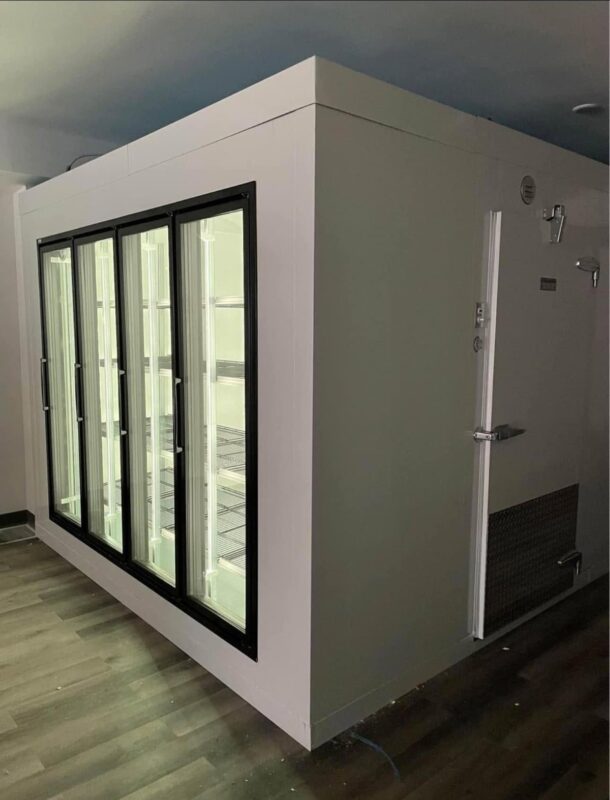
Finished walk-in cooler with glass doors.
Refrigeration down? Call us now.
Commercial refrigeration repair across Toronto and the GTA. Emergency calls are received and assessed around the clock.
- Walk-in coolers & freezers
- Reach-in fridges & freezers
- Display cases
- Beverage coolers
- Prep & sandwich tables
- Compressors, condensers, evaporators
- Digital controllers & sensors
- Defrost systems & electrical controls
- 24/7 Emergency Calls
- Mechanic 313A
- ODP/ODS Certified
- Toronto & GTA
Request Service
Tell us the equipment and the problem — we will get back to you.
What a Walk-In Cooler Installation Covers
Sizing for Real Load
Capacity is matched to room volume, insulation, door openings and the warm product that arrives on delivery days — not to floor area alone.
Airflow Layout
Evaporator position and air throw are planned around shelving so no corner of the room sits outside the airflow pattern.
Commissioning
The room is pulled down, operating conditions are measured, the controller is set and the finished readings are recorded before handover.
What Decides Whether a Cooler Holds
- Door traffic and how long the door stays open
- Warm product going in during deliveries
- Shelving blocking the return air path
- Condenser location, clearance and summer heat
- Gasket, closer and sweep condition from day one
- Controller sensor placement inside the room
Cooler or Freezer?
A walk-in cooler holds chilled product above freezing. A walk-in freezer holds frozen product and needs a different defrost strategy, heavier line insulation and heated drains.
If you are not sure which room you need, tell us what you store and how long it sits. The product decides the room, not the other way around.
Who This Is For
Restaurants, grocery and specialty retailers, bakeries, butchers, caterers, commissaries, bars, breweries, florists and institutional food service across Toronto and the GTA.
Sizing a Walk-In Cooler Properly
Most walk-in coolers that never hold temperature were not broken — they were sized for a room rather than for a business. Capacity is set by heat load, and heat load is not a function of cubic feet alone.
- Product load. How much product arrives at once, at what temperature, and how quickly it has to be pulled down. A room that receives warm pallets daily needs capacity a static storage room does not.
- Door traffic. Openings per hour during the busiest period, not the average. Infiltration through a doorway is usually the single largest load in a working cooler.
- Envelope and location. Panel thickness, whether the box sits against an exterior wall, a hot service line, or under a roof deck that gets hot in summer.
- Internal loads. Lighting, fans, people working in the room, and any equipment running inside it.
- Defrost and airflow design. Coil selection, air throw and the number of fans decide whether the room is even at every shelf or warm in one corner.
- Condensing location. Indoor, outdoor or rooftop, the ambient it will actually see, and whether head pressure control is needed for winter operation in this climate.
Site Conditions That Decide the Quote
These are established before a price is given, because each one changes the work and none of them can be discovered halfway through the job.
- Where the condensing unit can physically go, and how refrigerant lines will be routed to it
- Available electrical supply: voltage, phase, capacity and the distance to the panel
- Where the condensate drain will terminate, whether the run can be pitched correctly, and whether it needs a heater
- Floor construction, levelling and whether a ramp or threshold is required
- Access for the condensing unit and coil — door widths, corners, stairs and elevator dimensions
- Ceiling height and clearance above the room for coil mounting and service access
- What has to keep operating while the work is done, and when the site can be handed over
Commissioning and What Gets Recorded
An installation is not finished when the room gets cold. It is finished when it has been proven to hold, and the proof is written down.
- Pressure test and evacuation of the refrigerant circuit before charging.
- Charge weighed in against the nameplate rather than added by feel.
- Superheat and subcooling set and recorded at operating conditions.
- Controller setpoint, differential and defrost schedule set for the actual load, not left at factory defaults.
- Pull-down test from ambient with the recovery time recorded.
- Door alignment, closer, sweep and gasket seal checked and adjusted.
- Drain line, trap and pitch verified with water, and the drain heater confirmed working.
- Handover with the readings, the settings and the model and serial numbers written down.
Frequently Asked Questions
How long does a walk-in cooler installation take?
It depends on panel delivery, site access, the electrical work and where the condensing unit goes. A realistic schedule is given after the site visit, with the parts that could move flagged honestly.
Can you install into an existing space?
Yes, where the floor, clearance and access allow. Those three are checked on the site visit because they decide the quote more than the box size does.
Do you handle the electrical work?
Electrical connection is coordinated as part of the installation. What is in scope and what needs a licensed electrician on your side is stated in writing before work starts.
What is the most common installation mistake you see?
A drain that was never pitched or heated correctly, and a condensing unit placed where it cannot get air. Both cause service calls for years afterwards.
Do you also service what you install?
Yes, and the commissioning readings become the baseline that later service visits are compared against.
Request a Walk-In Cooler Installation Quote
Tell us the room size, what you store, expected door traffic and where the condensing unit can go.
Planning a Walk-In Cooler?
Send the room dimensions and what you store and we will size it properly the first time.