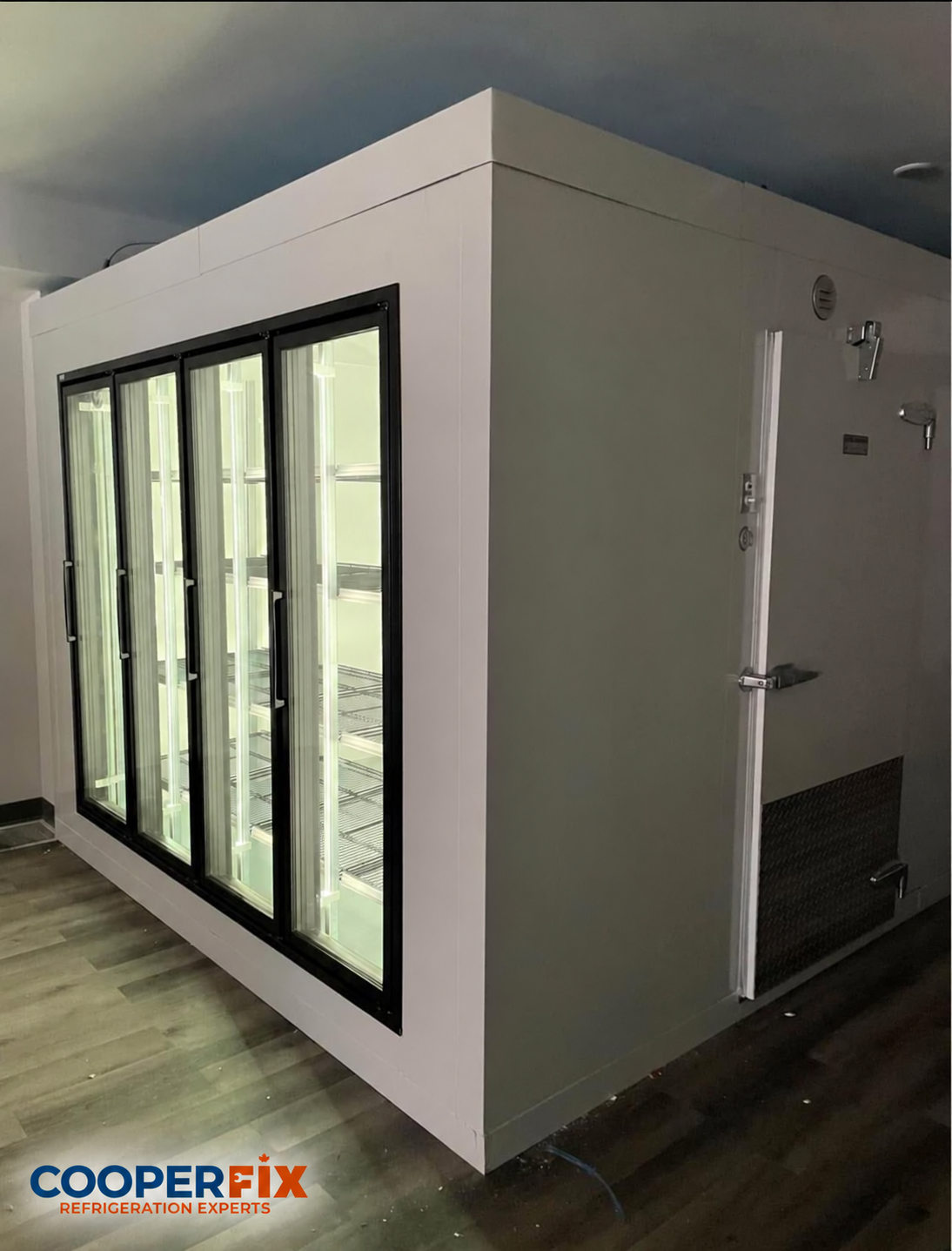
Define the refrigeration work apart from the room enclosure
A walk-in cooler project can involve an existing room or a new one supplied by others. CooperFix’s installation scope concerns the refrigeration equipment serving the chilled space: evaporator, condensing equipment, refrigerant connections and controls. The mechanic establishes the room’s intended use and available connections before specifying that work. The business receives a clear account of the refrigeration components CooperFix will install and commission.
Choose evaporator capacity and air distribution together
An evaporator has to transfer heat from the room to the refrigerant, while its fans distribute cooled air through the occupied storage volume. Coil capacity alone does not ensure a usable room if air movement is uneven. CooperFix evaluates the selected evaporator, its operating temperature difference, fan arrangement and connection to the condensing system. The equipment must suit the chilled-storage application and the intended room temperature.
Commissioning checks the installed evaporator’s operation, not only its nameplate. The mechanic observes fan and controller response, refrigerant feed and the movement of room temperature under the available load. If the system has more than one evaporator, each branch needs a clear control and piping relationship. A room can appear to cool near one unit while another area recovers poorly; the commissioning record should describe the conditions actually assessed.
Match the condensing unit to the full system
The condensing equipment must reject the heat collected by the evaporator and operate within the requirements of the chosen refrigerant and application. Equipment size, location, available heat-rejection airflow and electrical service influence the result. CooperFix checks whether a proposed unit is compatible with the evaporator and the expected load. A nominal capacity printed on a component is only one part of that decision; actual operating conditions and manufacturer data matter.
For an outdoor unit, the installation also has to account for the conditions it will experience through the year. For an indoor unit, heat rejection and available airflow still need attention. CooperFix reviews access for service and the practical route between the unit and the cooler evaporator. The scope records any site dependency that must be addressed before a reliable installation can be completed. The business sees what is included rather than discovering a missing connection after the equipment arrives.
Place equipment where it can be operated and serviced
Evaporator and condensing equipment need locations that support the cooler’s airflow and allow the installed refrigeration system to be assessed later. CooperFix considers access to those components when defining the layout of the refrigeration work. A location that accommodates a unit physically may still create a poor service route or an unsuitable air path. The installation plan therefore considers both performance and practical access within the business’s existing site.
A refrigerant line set is part of the design
The line set connects the evaporator and condensing equipment. Its dimensions, route, condition and compatibility with the selected refrigerant influence how the system operates. In a replacement, CooperFix evaluates the existing lines before deciding whether they can stay. A new condensing unit connected to an unsuitable or contaminated circuit may experience problems that appear to be defects in the new equipment. The proposal identifies any necessary piping change and why it is required.
After connection, the mechanic performs the appropriate pressure and tightness checks, evacuation and charge procedure for the installed equipment. Refrigerant handling follows the actual circuit and manufacturer requirements. Startup measurements are interpreted with the evaporator, condensing unit and control state together. The goal is an installation that feeds the evaporator and rejects heat as intended, not a charge chosen from a generic rule of thumb.
Replacing an Existing Walk-In Cooler Refrigeration System
A replacement project should not assume that the existing evaporator and condensing unit were correctly matched to the room’s present use. CooperFix reviews the refrigeration equipment, line-set dimensions, electrical supply, controller arrangement and the load the cooler now serves before defining what can remain. A compatible existing component may be retained when its condition and operating requirements support the new system; an incompatible component is identified in the proposed scope. The replacement is then commissioned as one connected refrigeration circuit rather than as isolated equipment. This approach gives the business a clear explanation of which installed components are being reused, which are being replaced and how the selected system will be verified under the conditions available at startup.
Controls and defrost for a cooler
A walk-in cooler controller directs the call for cooling, fan operation and any defrost sequence used by the equipment. The selected probes and their location affect what the controller reports. CooperFix installs and configures controls for the actual refrigeration system. A controller setting copied from another room can cause unnecessary cycling or leave a coil in the wrong operating state, even when the new mechanical equipment is sound.
Cooler defrost requirements depend on the selected evaporator and operating condition. The mechanic confirms the sequence specified for that system and checks how the controller returns the unit to cooling. The commissioning record notes relevant settings and the observed response. If a full cycle cannot be witnessed at startup, the record should say so. For a project focused specifically on the control package, see Commercial Refrigeration Controller Installation.
Condensate belongs in the refrigeration design
Chilled evaporators remove moisture as part of their normal operation. CooperFix accounts for the equipment’s condensate path and the applicable controls when installing the refrigeration system. The service scope addresses the components connected to that equipment. At startup, the mechanic can verify the drainage functions available under the observed conditions and record any limitation in that check.
New installation and replacement have different questions
On a new installation, the chosen evaporator, condensing equipment, line set and controls can be considered together. A replacement starts with existing assets and a history of operation. CooperFix identifies the installed system and examines what caused the replacement request. A failed component might justify a focused change if the remaining equipment is suitable. Repeated weak cooling or incompatible parts may require a broader refrigeration scope.
The business receives a clear description of what will be installed, connected and retained. If separate electrical capacity, access or other site work is needed, it is recorded as a dependency. A proposal should not blur a refrigeration-equipment replacement into an undefined whole-room project. CooperFix’s installation work is centred on the cooling system that serves the walk-in space and on proving that system’s operation after the work.
For a business that operates several chilled rooms, the scope should also identify which room and circuit each new component serves. A replacement evaporator in one space does not demonstrate that a neighbouring room has suitable capacity. CooperFix separates the project equipment from other working systems and records any shared component that affects the installation. That distinction keeps later maintenance and repair requests tied to the correct refrigeration circuit.
Commissioning under real site conditions
At startup, CooperFix verifies the electrical supply and protective controls appropriate to the equipment, the compressor and fan operation, the refrigerant-side behaviour, controller calls and the cooler’s response. The mechanic considers the temperature trend in the space rather than declaring success when the compressor first starts. Where possible, the checks include the recovery and cycling behaviour relevant to the business use. Each installed circuit needs to be identified in the handover.
The site may not present its peak product load during commissioning. The report distinguishes the measured startup result from performance that will be observed during regular operations. If the system cannot be tested under a necessary condition, that limit is stated. This does not remove the value of commissioning; it makes its evidence precise. Any fault found during startup is addressed or defined for a separate decision rather than described as normal without support.
For chilled-storage projects, CooperFix brings 20+ Years of Experience to planning and commissioning walk-in cooler refrigeration. Ontario 313A licensed mechanics assess the installed cooler refrigeration and document the conditions under which it was commissioned. The records give the business a starting point for later service on that equipment.